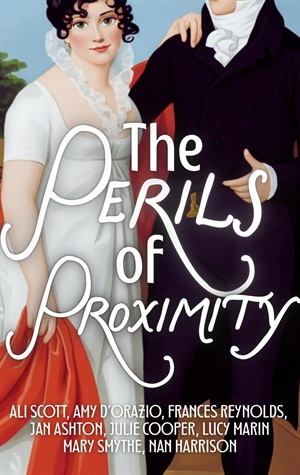
The Perils of Proximity
Chapter 1
ONE
FITZWILLIAM DARCY
Fitzwilliam Darcy pulled his gloves on with angry, jerky motions and jammed his hat onto his head as though it had committed a grave offence. He paused, his hand on the parsonage door, and sucked in a disbelieving breath.
She had refused him. Miss Elizabeth Bennet, the daughter of a man with a small estate known to no one of consequence, had refused his proposals.
She had cast aside his affections, his position, his wealth, everything he had offered her, because she did not like him.
She found him ungentlemanlike—that certainly stung—as well as arrogant, conceited, and unfeeling.
Seen through her eyes, he was a poor specimen, indeed. How very lowering.
And how very unjust. He almost turned about to confront her, to defend himself, but something held him back.
A little whisper in the back of his mind that her feelings were not entirely unfounded, a twist of shame in his belly that he could not wholly put down to the humiliation of having been so roundly and fervently refused.
He opened the door and, before he could even step forward, was greeted by a great flash of light, followed immediately by a deafening clap of thunder.
He was blinking away the spots in his vision when the rain began to fall, the patter swelling in seconds to something much more akin to the march of a battalion.
He could no longer see more than a faint silhouette of the hedgerow across the road.
He closed his eyes, shook his head, and sighed.
She was standing by the window, gazing out at the impenetrable downpour with an unreadable expression, when he reached the parlour’s doorway.
She was quite pale, he noted with a pang.
She had not, then, been so unmoved by their altercation as she had seemed when she coolly told him he was the last man on earth she would agree to marry.
“Pardon me,” he said, stepping inside. She turned her head just enough to spy him out of the corner of her eye; she did not appear at all surprised to find him there.
“I was unable to return to Rosings,” he added with a nod towards the window.
“If there is another room in which I might wait for the rain to pass, I shall not trouble you further.”
“I would show you to Mr Collins’s book-room,” she replied, “but he has taken to locking it when he is absent, since the maid inadvertently disturbed certain of his papers last week. I daresay we might exert ourselves to civility, or at least to silence, for the space of a shower. Allow me to call for tea.”
She moved past him then and, ringing the bell, summoned the maid.
While she was thus occupied, he sat himself down, picked up the newspaper sitting by the chair Mr Collins favoured, and pretended to read it.
She returned to the settee and looked at the letter she had been reading when he first came upon her today, though she soon put it away and retrieved a book instead.
Never before had silence been so intolerable. Their earlier words seemed to hang in the air like smoke, dark and choking.
When the tray came, she prepared two cups and he resigned himself to drink it, though she had not asked how he took it and he was quite particular. When he sipped the brew, however, it was perfect. He spoke before he could recall that it might be unwelcome.
“You know how I take my tea.”
Her lips flattened fractionally, but she replied with apparent composure, “Whatever her faults, my mother is an excellent hostess and taught us early to take note of the preferences of those about us, that we might perform creditably if called upon to entertain them.”
His face stiffened with the effort of repressing a wince.
He had spoken of the behaviour of her family during his earlier speech, had he not?
Perhaps, he belatedly reflected, that had not been well done of him.
Mrs Bennet was loud and vulgar, but though Elizabeth was too intelligent to be ignorant of her relations’ failures of decorum, she could not like having it stated so openly by another.
Indeed, though he oft bemoaned Lady Catherine’s behaviour in the privacy of his own thoughts, and occasionally with Colonel Fitzwilliam, had Elizabeth baldly called her a meddlesome termagant, he should have been greatly offended.
“Forgive me,” he said. “I was surprised because many who have been informed from my own lips exactly how I prefer my tea cannot seem to get it quite right, and I knew I had never told you.”
She paused, then nodded and said, “I noticed while I was at Netherfield that you seemed best pleased when Mrs Hurst prepared your cup. I merely copy her.”
He smiled faintly. When first he had told Miss Bingley that he liked his tea with half a spoon of honey and a drop of lemon, she had said, “It is kind of you to think of our housekeeping, but I assure you, sir, we are well able to afford sugar.” From that moment to this, she had put a full spoon of sugar into every cup she prepared for him, as though to demonstrate her complete unconcern with the cost. Mrs Hurst, however, had taken him exactly at his word, and prepared his cups better than anyone but his own housekeepers and his sister.
“Is this honey from Mr Collins’s hives, do you know?” he ventured to ask.
“It is indeed,” she replied, stirring some into her own cup, though she eschewed lemon in favour of a modest dollop of cream. “He credits the nearness of his orchard and the variety of trees therein for the quality of his honey.”
“It is very good,” he agreed. “I may ask if I might take a jar of it away with me.” He had never considered doing so before, but the desire to continue this studiously polite conversation lent him inspiration.
“He will be utterly overcome with delight, I am sure,” she replied with a hint of a smile.
“He was speaking to us last night of a plan to add more hives. Charlotte has recently learnt to make candles from the wax, and they hope to sell any honey and candles they produce beyond what the household needs.”
“Are the tithes and the glebe lands not producing a comfortable income for them?”
“They are at present, but Charlotte is a most practical lady. She understands what one bad harvest might mean for both, particularly if they have children when it comes. She is saving most assiduously against the future and has persuaded her husband of the rightness of that course.”
“Admirable,” he said, and could think of nothing further to offer. He sipped his tea in silence, hoping she might have more to say, but she did not. In time, he picked the paper up once more.