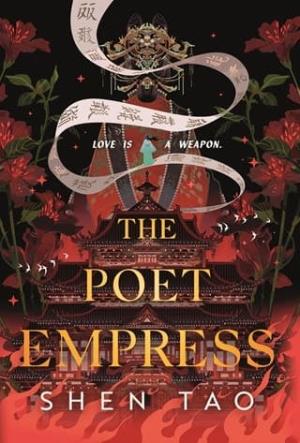
The Poet Empress
Chapter 1
FRUIT FROM NOTHING
House of the azalea, where thorn meets bud;
Brother betrays brother, blood forgets blood.
My sister Larkspur was the fifth child we buried.
It was a cold and misty dawn as Ma and I climbed the hill out of our village, towards the Ancestors. We carried with us only some incense and a bamboo casket small enough I could tuck it under one arm.
The fifth time had been the easiest. She had been so little when she left us, only three days old.
When Ma wept yesterday, when Larkspur’s tiny chest had stopped rising, I suspected that she mourned not her daughter but all the extra bowls of rice she’d consumed during her pregnancy, nutrition that was now wasted.
Ba didn’t even weep. He might have wept, I thought, if Larkspur had been born a boy.
My brother Bao was still young enough to believe dead girls became kittens in their next life. He liked kittens, so he did not weep either.
So it happened that, of all of us, I was the one who mourned Larkspur the most. Not as much as the other times, but I did cry as we lowered the casket on a bed of poppies at the crest of the hill.
As I knelt next to the box on the damp soil, I remembered how I had already nicknamed her in my head.
Little Lark. I remembered how I had pictured us chasing each other down the drying rice paddies, her delighted laugh as I showed her the best corners to catch catfish.
I remembered how I had imagined braiding her hair, as I thought big sisters ought to do, as we giggled and gossiped about the village boys.
After we lit the incense, I kissed the cold crate. I told the Ancestors to take Larkspur to a place where she would never be hungry.
A place, or a time.
I asked the Ancestors to let her be born again earlier. Perhaps when the Azalea Dynasty was not withering and a dying emperor did not sit the throne. I asked them for a time when the people who ruled over us were still good, and children newly born did not die of a famine nobody knew the cause of.
An earlier time, or perhaps even a later one. When dynasty and emperor and thrones and famine became all a distant memory. I should like Larkspur to be born again then, in a time when all children could learn to read, even poor ones, even girls.
It was not long before the land took her.
Ma and I watched, silent, as tendrils of vines snaked up from the soil and wrapped themselves around the crate. Little white flowers blossomed on the bamboo, and from the canopy above, a nightingale crooned. The country might have forgotten people like us, but the Ancestors still remembered.
For New Year’s there was no meat on the table.
There was only half an extra bowl of rice porridge for everyone—a whole bowl for Bao, since he was growing—and as many preserved bamboo shoots and spiced radishes as we could want.
Bao and I got two prunes each from Ba, who had traded some eggs to one of our neighbors, Uncle Gray.
“Take me to the city,” Bao said after lunch, tugging at my skirt as I washed the dishes. “I want a Blessing! Please, I want one!”
I smiled as I ruffled his hair. He was only seven to my sixteen, and the gap in our ages meant I was almost a second mother to him. “It’s a far walk, Bao-berry. We could play together at home if you’d like.”
I was too hungry to want to make the walk to Guishan.
The energy required for the half day’s journey could have been spent gathering extra food—foraging for dandelion leaves or catching frogs in the paddies—or resting.
But that was not the only reason for my refusal.
The more important reason was that I did not want Bao’s heart to be broken.
On New Year’s, supposedly, representatives from the palace would come to our cities and share their magic with the people.
A proverb or two that would help the fields grow lush and fertile, ward our huts from mosquitoes, or heal a child from the gray fever.
It was said that an Azalea House prince had once raised a lake in a drought-stricken town with a poem, and that another, with a ballad, had carved a valley road from Duerlong all the way to Cloud’s Landing.
Those were the stories, anyway. I had gone to Guishan every New Year’s since I was Bao’s age, and I had never seen them come by once. Perhaps another place or another time, the Imperial Houses might have given out Blessings, but I had given up hope for ours.
Bao was not giving up, however. He snuggled up against my side, his brown eyes wide in a way that he knew would move my heart. So I sighed, kissed him on the forehead, and said, “All right, Bao-berry. But you’ll have to stay close to me.”
I then looked for permission at Ma, who was sitting on a bamboo mat on the floor, mending Ba’s trousers. She said, without glancing back at me, “Change into a clean shirt, Wei. And remember to walk like a city girl, the way we’ve practiced.”
I didn’t miss the hint in her voice. It was every village mother’s dream for her daughter to marry a city boy.
Our knees were aching by the time we felt, through our worn soles, the dirt path turn into the paved cobble of Guishan. But as soon as we were through the gates, I felt myself infected by the excitement of the city, and promptly forgot my hunger and pain.
Though the shadows had turned long, it was so much busier here than back in Lu’an.
Festive red lanterns blazed from the sloped eaves of every roof.
Vendors hawked dumplings, fried mantou, and clacking wooden toys from every street corner.
As we wandered into the city square, we found it so packed with people there was almost nowhere to walk.
It smelled of firecrackers everywhere.
“Streets of powder and red,” Bao sang cheerfully, “means a girl will soon be wed!”
As we passed through the crowd, my brother’s hand in mine, I tried to walk the way Ma taught me to, purposeful and coy. I tried to smile sweetly. Ma might be the one who had the dream first, but she had taught me to have it too.
If I married a city boy, then he might have money.
If he had money, then Bao and I would no longer have to feel the dull ache of hunger in our bellies.
And maybe Ma would not be sick so much and Ba would not limp with pain as he carried bushels of rice on his shoulders.
Maybe the city boy would even have some money left over and Bao could go to school.
If Bao went to school he could learn to read, and if he learned to read, he could be anything he liked.
A minister, a merchant, a literomancer.
I realized suddenly that Bao was no longer holding my hand. Panicking, I searched the crowded plaza, and was relieved to find him near a stall that sold glazed hawberries on sticks.
When I came to take his arm again, I saw that his eyes were wide with longing. But he was a smart boy. He knew we had no money, and so he did not even ask.
“Would you like a prune?” I asked him in a hushed, secretive voice, as I pulled him away from the vendor.
His eyes went even wider. “You still have some?”
I gave him my best conspiratorial smile and pulled out one of the dried fruits from my pocket. I had saved both of mine for Bao, knowing how he loved sweet things.
Bao made an excited noise and took it. The precise moment he bit into the prune, a gong shuddered through the city square.
Everyone went very still.
Merchants stopped crying their wares, customers stopped haggling, passersby stopped their conversations. Another ring of a gong startled a flock of sparrows into the sky.
And then the voice of a herald: “Prince Guan Isan! Bringer of Spring, Overseer of Feasts, and Third Son of the Azalea House!”
Bao almost dropped his prune in surprise. My own heart was pounding fast. Prince Isan?
It seemed like a dream, like something that only happened long ago and far away. It was unexpected enough that someone from our Imperial House had actually come to give New Year’s Blessings at all. But it wasn’t even just any representative.
It was a seal-bearing son of the emperor himself.
The look of wonder on Bao’s face was as if he’d just found proof that all magic was real and all promises were true ones. I was so shocked myself that I didn’t even stop to question why a prince hadn’t sent a servant in his place but had come to Guishan in person.
The crowd parted to make way for the procession, and I stumbled stupidly back with them. Bao started to climb me to have a better view, and I helped him to sit on my shoulders. I myself could barely see through the layers of people in front of me, all jostling each other to have a look.
When the procession did come into view, there was no mistaking who they were. They were all dressed in a striking red, a red so true it was almost radiant against the brown of the common people and the gray of the city.
It was not just the color that made them stand out, but the sheer life they brought with them. Blossoming green vines crawled over their bodies in place of jewelry, lilies unfurled on their hair and their sleeves, and magnolias bloomed along the swords on their backs.
I felt Bao’s hand pull at my hair. “Look, sister,” he paused sucking on his prune to whisper. “Back there. That’s him, isn’t it?”
A horse-drawn carriage had appeared from behind the gong, surrounded by eight men on either side.
It was made of mahogany wood and draped with wisteria and spring briar.
The carriage stopped in the middle of the plaza.
A bowing servant reached out and pulled the curtain open, and out stepped Prince Isan into the reverent silence.
I did not know what I expected. In the stories, the children of the House were beautiful and valiant, filial and generous.
And though I did wonder where the stories came from, and who had a vested interest in telling them so, I did know them all by heart.
If I believed the stories, I might have expected Prince Isan to be beautiful.