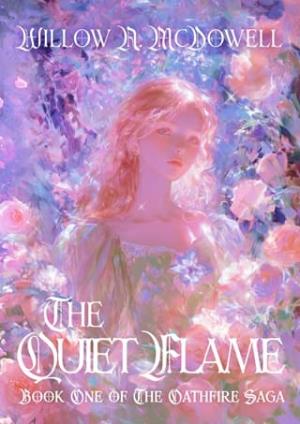
The Quiet Flame (The Oathfire Saga #1)
Chapter One
Wynessa
Morning dawned, calm and golden, moving through the shrubs then setting softly atop the garden dividers, dreamlike rather than upon waking. I liked it best this way, when the palace still slept, and the world hadn’t remembered how to be sharp yet.
I knelt in the rosemary patch with my skirts bunched around my legs, fingers dyed green and damp from dew.
Here, a small, plump thrush, with plumage the color of faded autumn leaves, lay nestled in my palms; its wing twisted at an odd angle, fluttering against the twine I’d knotted into a tiny splint.
“Steady now,” I hushed, my voice barely a breeze. “I know it hurts. But you’re braver than you look.”
The bird blinked up at me, its chest rising and falling so rapidly that the flutter was perceptible against my skin.
I smiled, brushing a stray strand of strawberry-gold hair behind my ear.
“You’re fortunate,” I whispered. “You fly when loads grow too heavy.”
The bird gave a faint twitch in reply. I was unable to determine whether it was in agreement or protest.
I’d found her beneath the balcony garden, half-buried in a bed of violets, her wing caught in the thorny grip of a rose briar.
I hadn’t even intended to go out this morning, yet something allured me here.
The garden often did. Only here, could I truly breathe.
Here, fear didn’t earn a scolding. Smiles didn’t need to be forced, and the weight of a kingdom I barely understood didn’t have to be shouldered.
The herbs didn’t care that I stammered in court, and the bees never asked about my lineage. I was myself here.
They just desired gentleness, plus perhaps some sunlight.
I opened my hands.
“There. Go on. You’re free now.” I smiled gently.
The thrush hesitated, tiny talons digging into my skin.
Then, with a sudden, breathless flutter, she launched from my fingers, wings wobbling slightly, but determined to fly.
She soared past the rosemary and thyme, through the dappled light and over the stone wall, her speckled breast soaring as she disappeared into a blur of soft feathers and silent flight.
I sat back on my heels, watching the sky swallow her. My heart ached with envy.
A memory from a summer long ago came to mind, before the crown was a heavy burden, before I understood what it meant to be watched at all hours, evaluated like a crop before harvest. Alaric and I had crept out here barefoot, racing across the lawn with wildflower crowns sliding off our heads.
The grass had reached our knees then, and we’d pretended it was a sea.
I was a sailor, and he was the sea monster dragging me under.
A faint, almost imperceptible smile played on my lips as our laughter echoed in my ears. We’d gotten in trouble for tracking mud back into the marble halls, but I didn’t care. That day, I laughed so hard that I cried.
Later, our nursemaid, with hands smelling of earth and woodsmoke, showed us how to steep valerian root and hang dried yarrow for warding off evil spirits.
She’d told us tales of the gods who once walked Wildervale, their very steps painting the land with vibrant gardens.
In those days, and in the magic she taught, I believed love could overcome anything.
But now I know better. The world was not made of magic; it was made of rules. And I possessed no talent for rule-following.
Sometimes I wondered if there was a place beyond the borders of Elyrien.
Where the high courts and walled gardens didn’t define me, where the silver threads of dirt, woven into each breath, loosened their grip.
A place where I could be Wyn, and not Princess Wynessa of the Grainlands, a name that felt less like an honor and more like a heavy cloak.
Elyrien, cradle of harvests. The softest kingdom on the continent of Aetherra.
A place of rolling sun, gilded hills, fields that hummed with unseen life.
Vineyards that spread like emerald tapestries across the slopes, their leaves trembling like whispers in the breeze, while ancient temples stood bathed in a soft, honeyed light that seemed to pulse with a quiet magic.
But beneath the abundance lay roots bound too tightly by ancient treaties and political debts. My existence felt no different: merely a field’s produce, destined to be harvested or worse, planted as a seed in their soil.
The sharp clip of boots on stone shattered the morning hush.
“Princess Wynessa?”
The voice startled me gently, like a ripple across still water. I turned to see a young page standing at the edge of the hedged path – Davien. He was barely older than thirteen, all elbows and sunburns, but he bowed with more grace than most men twice his age.
“My lady,” he said again, cheeks pink with embarrassment, “you’re summoned to the throne hall. The King and Queen request your presence.”
Of course they did.
Still, I offered him a warm smile, despite the urge to run in the opposite direction. “Thank you, Davien.”
He looked surprised to be called by name. “I’ll walk you there if you like.” He beams.
“Please.”
I rose, brushing soil from my skirts, and fell into step beside him. The palace loomed beyond the garden, all pale stone and gold-veined marble, beautiful and cold. As we walked, I traced my fingers over the ivy trailing the walls.
Davien bowed again at the carved double doors and scurried off, leaving me alone beneath the high arch.
Two guards swung open the throne room doors with a creak that echoed too loudly. I stepped inside.
The hall was not vast, but it was tall, with columns rising like pillars of judgment around me.
Sunlight streamed through stained glass in gentle shades of rose and sea foam, casting a wash of color across marble and gilded archways, softening the edges of the hall, but never quite dispelling its chill.
My mother, Queen Elenya Elira, stood in her usual place, one gloved hand resting atop her carved ivory staff.
Her pale hair, the color of spun moonlight, was drawn back from her face and meticulously coiled into an intricate knot at the crown of her head, with not a strand out of place.
Her expression was carved from ice, like the face of a statue in a perpetual winter.
Her silks were the color of frost-kissed lavender, and she wore them like armor.
Beside her, my father, King Thalen Elira, occupied the silverwood throne. He was older now, his beard entirely white, his posture stiff from old battle wounds, but his eyes were warm when they found me. Tired, perhaps. But not cruel. Not like her.
“Wynessa,” he whispered, gesturing me forward. “Come.”
I trod softly on the stone floor, the sound of my slippers echoing fainter than my perception of myself. When I reached the podium, I curtsy with lowered eyes. My mother did not bid me to rise.
“Wynessa,” she said, crisp as frost. “Why are you covered in soil again?”
I stood quickly and tucked my herb-stained hands behind my back. “There was an injured bird. I was helping.”
She narrowed her eyes at me, still just as cold. “And that deserved your attention, did it?”
Her eyes were like twin magnets, pulling me down, and I could feel my body shrinking beneath the crushing weight of her judgment. “I thought so,” I said, timidly. The moment the words left my lips, I instantly regretted it.
Her eyes only seemed to grow colder at my response, making a chill run down my spine.
“We’ve come to a decision,” my mother announced, raising her head to the court, her voice smooth as if it were polished bone. “The matter of Caerthaine must be resolved. They have drawn a treaty. You will marry Prince Kaelen before the next moon wanes.”
Each word fell like a stone into a bottomless well, sinking into me with cold, unforgiving finality.
“But—” My voice cracked, thin against the vaulted ceiling. “I haven’t even met him.”
“There is no need. He is young, wealthy, and politically valuable. That is all that matters.” She stepped closer; rosewater and iron filled my lungs.
“This marriage will keep Elyrien safe from Vireth’s ambitions.
That is your role, Wynessa.” Her words pressed the air tighter around me, until even the stones seemed to lean in, reminding me that my desires were shadows against duty.
“My lady,” I tried carefully, “surely there are other ways to secure an alliance.”
Her eyes narrowed like frost closing in. “There are not.”
My father shifted in his seat, discomfort clear in the angle of his shoulders.
“We have delayed this as long as we can, little star,” he said, using the name he once gave me when I was small and clumsy in the orchard.
“We are not simply choosing a husband. We are choosing survival. Elyrien feeds half the kingdoms in this quadrant of Aetherra, but we are farmers and villagers, not soldiers. If Vireth marched tomorrow, our armies would not hold. And Caerthaine has already tied itself to Vireth. Together, their strength would crush us.”
He exhaled slowly. “Caerthaine’s fields are salt and stone. They cannot feed their people. They need Elyrien’s grain as much as we need their ships. This union ensures we both endure.”
Mother’s gaze sharpened, a blade hidden in silk. “It is not a question of if you will sign the treaty, Wynessa. You will. That is what is expected of you.”
I swallowed hard, my throat aching. “So, it is my choice only in ink.”
Her lips curved, thin and unyielding. “Your father and I were an arranged match, and we are fine. You will learn to be fine too.”
The silence that followed felt like a door closing, leaving no air behind it.
The urge to scream clawed at my throat, to run until my lungs burned, tear off the restricting slippers glued to me and escape over the garden wall barefoot, without looking back.
“You’ve always been delicate,” she said coldly, and somehow, it was the cruelest thing she could’ve picked. “Softness is not a virtue for a crown.”
My father cleared his throat, his voice roughened with regret.
“You’ll leave tomorrow at first light. You’ll travel by horse to Caerthaine.
Captain Gideon and Erindor of the guard will accompany you.
They’re the best swordsmen I can spare.” His gaze flicked briefly to my mother, then returned to me.
“I would have sent your ladies, but the queen believed…distractions would only make things harder.” He lowered his head like a submissive puppy, avoiding my gaze.
My shoulders slumped, and a heavy sigh escaped me, a defeated whisper into the suddenly cavernous silence. What more was there to say?
My mother turned toward the steward and started issuing instructions to him.
I curtsied again—though it was like bowing to a noose—and walked calmly from the room. My steps were quiet, but I could sense the pressure building behind my ribs, a tide of grief I did not know how to name.
The hall sealed itself behind me like the lid of a coffin.
I walked quickly at first. Not fast enough to draw attention, but fast enough that no one dared stop me. I briefly looked over my shoulder—no sign of any guards. I let out a small sigh.
No stewards appeared with scrolls or itineraries.
The message had been delivered, and the deal had been sealed.
I had become just one more pawn in their intricate game of appearances and expectations.
A familiar tightening landed in my stomach.
It was the same feeling I’d had as a child whenever my parents arranged a playdate with someone they deemed 'suitable. '
Two maids rounded the corner near the archway, arms full of linen and sweet-scented sachets. I knew them; Mira and Lina. They had worked in the palace since I was a child and had long since stopped being surprised when I addressed them.
“Good morning,” I murmured as we passed.
“Morning, Princess,” Lina said with a soft smile. Mira added, “We saved the last honey cakes for your tray.”
Their voices were gentle, familiar. I gave them a grateful nod.
I kept walking. Down the long corridor, past the portrait hall, past the window alcoves where Alaric and I used to sneak peach tarts, past the tapestry of the First Queen holding out a blade to the sea.
The familiar marble floors, once polished to a mirror shine, now seemed to absorb the light, their intricate patterns lost beneath a film of dust that shimmered faintly, like a layer of forgotten dreams.
I reached my chambers and closed the door quietly behind me.
The sunlight that had spilled so warmly across the stone earlier was fading now, retreating up the wall like it, too, was unwilling to stay.
I didn’t change. I didn’t wash. Instead, I sat down at the edge of my bed and stared at nothing.
They had decided.
Not asked. Not warned.
I would be sent to Caerthaine to wed a stranger.
A prince known more for his perfect etiquette and glacial court than anything resembling warmth.
His lands worshipped the god of water, Kaelor, whose temples were quiet, silver, and still.
His priests never smiled. The new place would be a hollow drum, lacking the vibrant heartbeat of affection found here within these walls.
A long, slow exhale escaped, laden with the weight of the day and what would become of my future.
They said Caerthaine held back Vireth’s ambition. And it was the only thread holding back the tide of war.
But now, apparently, I was what stood between Caerthaine and betrayal.
I rubbed my thumb across the palm of my hand, grounding myself. The skin was still stained with rosemary, still faintly fragrant with earth.
My mother called me delicate, as if it were an accusation.
Maybe I was delicate, but fragility differed from frailty. Flowers bloomed in ash. Kindness thrived where cruelty expected silence. What did my mother know about kindness? She never gave it.
I looked toward the lavender sprig on my nightstand. I harvested it last summer, dried it carefully, and bound it with a blue ribbon. I remembered laughing as I gathered it. How it stained my slippers and made my hair smell like comfort.
But I had no desire to laugh right now.
I lay back slowly on my soft, peaceful mattress, my skirts still rumpled, hands clasped on my chest like I was waiting to be buried.
Stars and ships adorned the ceiling above, a mural from when an astronomer-princess had owned the royal chambers generations ago.
I used to trace constellations in the dark.
Now, as I stared at them, I wondered how many other girls had been promised away under the same painted sky.
I closed my eyes and tried not to imagine the sea.