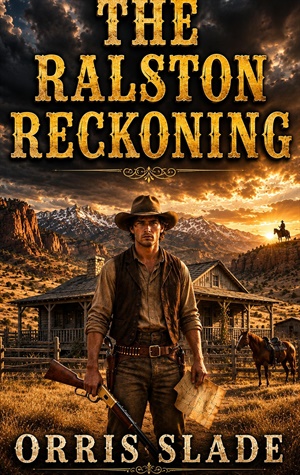
THE RALSTON RECKONING
Chapter 1
The night the world ended, Nate Ralston was seven years old and chasing a moth around the lamp in the front room. His mother had told him twice already to settle into bed.
He’d promised twice and broken the promise twice because the moth was the color of butter and it kept landing just out of reach, and a boy couldn’t be expected to sleep with such a creature loose in the house.
His father sat by the window with a cup of coffee gone cold, looking out at the dark shapes of the corral and the mountains behind them.
Then came the sound of a horse.
Not the easy clop of a neighbor riding up in daylight. This was fast, hard, a single rider driving an animal up the track at a pace no honest man kept after dark. His father set the cup down without a sound and stood too still. The back of Nate’s neck went cold.
“Vallie.” His father’s voice was low. “Take the boy.”
His mother’s hand closed around Nate’s arm. She steered him across the room, quick and quiet, toward the big cedar trunk where the winter quilts were kept. She lifted the lid. The smell of cedar and wool came up at him.
“In,” she whispered. “Not a sound, Nathaniel. Whatever you hear. Promise me.”
He climbed in among the quilts. Her face above him was white in the lamplight, her eyes wet and fierce at once. She pressed a kiss to his forehead and lowered the lid until only a sliver of yellow light came through the crack at the hinge.
Boots on the porch. A fist on the door, then no waiting for an answer. The door banged open.
“Eldon Ralston.” A man’s voice, big and certain, a voice that expected to be obeyed. “We can do this friendly. Or we can do it the other way.”
“You’re not welcome in my house.” His father, steady. “Say what you came to say and get off my land.”
“The cave, Eldon. You’re going to draw me the way to it. Tonight.”
“I don’t know what you’re talking about.”
“Don’t.” Through the crack: a strip of the room, no more.
His father’s legs. A second pair of boots, polished, the man who’d come.
A heavy gold chain swung across the stranger’s belly when he moved.
“You found color in that canyon. Half the assay office knows it. I’m offering you the chance to be reasonable about it. ”
“Get out. Off my porch and off my land.”
So his father had gone to the door, had stepped up into the open frame of it to put himself between the stranger and the house.
Through the crack, only the doorway now, the night beyond it, his father’s broad back filling the threshold and the polished boots of the visitor below him on the steps.
The gold chain caught the spill of lamplight.
The stranger’s arm came up and jabbed at the air, one thick finger stabbing up toward Nate’s father, again and then again, keeping time with his words. “You’ll learn to give a man what he asks for.”
His father moved. Then the night split open with a sound louder than thunder, a sound Nate felt in his teeth, and his father went backward and down, off the top step, out of the strip of light, and did not rise.
A scream tore through the house. His mother.
Her skirts swept across the floorboards toward the open door, toward the fallen shape on the steps, and Nate had his hand on the lid before he remembered his promise, and then the thunder came a second time, out on the porch, and her skirts stopped moving in the doorway.
He did not breathe. He could not. He lay in the dark and the cedar and bit down on a fold of quilt, dust and wool thick on his tongue, until his jaw ached.
His heart slammed so loudly against the wool that he was sure the stranger would hear it, would cross the room and throw back the lid and find a boy curled among the winter blankets like a rabbit in a snare.
He squeezed his eyes shut as if not seeing could make him not be seen.
Mama. Get up, Mama. Get up and tell him to go.
She did not get up.
Drawers came open. Things were swept to the floor and broke against the boards.
A chair went over. The stranger went through the house room by room, cursing low and steady, hunting, lifting and dropping and tearing.
Paper ripped somewhere. A cabinet door banged.
Boots passed within a yard of the trunk, close enough that the creak of new leather reached him.
The jingle of a spur, and he held the breath in his chest until his lungs burned and spots swam behind his shut eyes. His whole body had turned to stone. The footsteps moved on.
A long time later, the boots went back across the porch. The horse went down the track, slower now, unhurried, a man who had no reason left to hurry.
Nate counted to a hundred the way his mother had taught him, the trick she’d used when thunder frightened him, and she wanted to show him the storm would pass. Then he counted again, slower, his lips moving without sound.
The cedar smell had gone thick and sick in his throat. His legs had cramped under him, and he didn’t feel them. Then he lifted the lid an inch and listened and lifted it the rest of the way.
He climbed out into a room he didn’t know. The lamp lay broken and dark. Moonlight came through the open door and lay in a long, pale stripe across overturned furniture, across the white scatter of his mother’s spilled flour. And a smell he wouldn’t have a name for until he was much older.
He went to the window because he couldn’t make himself look at the open doorway, couldn’t make his eyes go to the still shape crumpled across the threshold or the larger shape below it on the steps, the one reaching back toward the other in the dark.
Out in the moonlight, the rider was a black shape against the paler dark, drawing rein at the bottom of the rise to look back at the house.
The moon caught one side of his face for the space of a breath.
Heavy jaw. Pale hair swept back. Then the man touched his hat brim, courteous as a gentleman taking his leave, and rode into the trees and was gone.
That was all Nate Ralston carried away from the night his parents died: a jabbing finger, a gold chain, and a heavy face turned half into the moon.
* * *
The Kansas Pacific car swayed under him, wheels beating their iron rhythm against the rails, and Nate Ralston watched the plains run past the glass and turned the envelope over in his hands for the hundredth time that day.
It was good paper, thick, sealed once with his grandfather’s red wax and broken now along the crease. Inside was a single folded sheet, soft as cloth from age, and on it lines and marks in a hand Nate had no memory of but understood anyway.
A creek drawn in, a notch of canyon, a shape near the top that might have been a church steeple or a split rock. His grandfather had kept it in Boston for fourteen years, locked in a drawer in the narrow house on Beacon Hill, and had said nothing of it until the lawyer read the will.
To my grandson Nathaniel, the Colorado property, and the enclosed, which his father entrusted to my keeping. He will know what to do with it.
He was twenty-one now. The Boston docks had put muscle on the boy and taken the softness out of his hands and most of the trust out of his eyes.
He’d been passed from a churchman to a workhouse to a fishmonger who needed a strong back and asked no questions, and by fourteen he’d run his own life along the wharves, sleeping where it was dry and eating what his wages bought.
He’d carried trunks and crates till his shoulders went to iron. He’d learned to settle arguments with his fists when a foreman tried to dock a man’s pay. And through all of it, the jabbing finger and the moonlit face waited in him, lodged like a splinter that wouldn’t work free.
Other boys forgot their nightmares by morning. Nate had kept it, turned it over, polished it, until he could have drawn that half-lit jaw from memory. He didn’t let himself wonder whether fourteen years had changed the face past knowing. He’d know it.
Somewhere west of here, a man was still alive who had done that. Nate was nearly sure of it.
He folded the map away inside his coat and pressed his palm flat against it through the cloth.
Out past the glass, the land had begun to change.
The flat brown earth buckled and rose, and there along the whole western rim of the world, blue and impossible and tipped with white even now in the warm months, stood the mountains.
He hadn’t seen them since he was seven. They came up out of the haze like something remembered from a fever, and his throat closed without his leave.
His father had pointed to those peaks once and named them, a big hand on Nate’s shoulder, a voice full of something the boy had been too young to understand and would never hear again.
The memory arrived whole and uninvited and left an ache behind it like a bruise pressed.
I’m coming back, he told them: the mountains, the man somewhere under them, his father and mother fourteen years cold in the ground he had never stood beside. Whoever you are. However long it takes. I’m coming to find you.
The conductor came swaying down the aisle, calling the next stop, a water-and-coal halt at some hardpan town whose name Nate let go the moment he heard it.
The train slowed. Brakes squealed. The car shuddered and stilled, and beyond the window, a low plank platform crept into view, a water tower, a knot of people waiting in the flat afternoon glare.
Nate stretched the stiffness from his shoulders and looked out at them without much interest, idle eyes filling the minutes till the train moved on.
One of them was watching back.
He stood apart from the others at the far end of the platform, a tall man, rangy, in a long dust-colored coat too heavy for the heat. A flat-brimmed hat threw his upper face into shadow, but the lower half showed a jaw pitted and scarred and a mouth set in something short of a smile.
He wasn’t waiting for the train. He was reading the windows of it, car by car, the way a man reads a wanted poster.
Then the shadowed eyes came to Nate’s window and stopped.
For three full seconds, the man didn’t move and didn’t look away. Across the dusty glass and the dozen feet of platform, the gaze held him, flat and cold. The look, Nate thought, of a man who’d been told exactly what he’d find in that window.
Then the stranger touched two fingers to his hat brim, courteous as a gentleman taking his leave, and turned into the crowd and was gone.
The gesture went through Nate like a blade of ice. He had seen it before. He had seen it through a window in the moonlight, fourteen years ago, on the worst night of his life.
The train jolted forward. The platform slid away. And Nate Ralston sat very still, one hand pressed flat to the map inside his coat and understood that whatever waited for him in Colorado already knew he was coming.