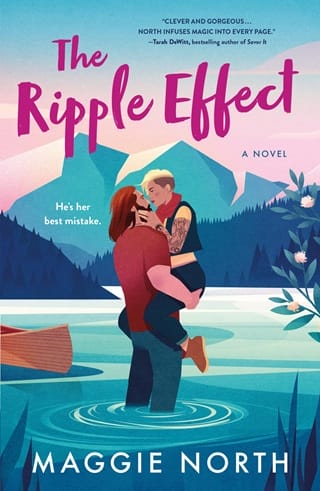
The Ripple Effect
Prologue
ONE YEAR AGO
Objectively speaking, this concert is a disaster. Which makes it exactly what I need tonight.
Earlier, when the surprise May cold snap came down in a blast of arctic air, the lead singer of the opening act kicked off their performance by drunkenly slurring, “We hate playing Canada.” Two hours after they wrapped up their sullen set, the crowd’s still shivering, waiting for the headliners to take the stage.
But I love a good disaster. My specialty is “working the problem,” a skill I perfected as an emergency physician: list all possible solutions, rank them from most to least useful, and try them all exactly once.
Don’t freeze if one or two or six solutions don’t work; getting stuck can literally mean life or death.
Crises are when you discover who you are—when you get to choose who you want to be.
And tonight, I need to be who I used to be. I need to get back in balance.
Because I don’t feel so steady these days.
Sometimes, I’m mostly myself: little, but fierce. Still pissed off at the state of the world, if a bit tired of throwing myself into finding solutions.
Other times I feel like even the tiniest pebble tossed into my inner waters would make a ripple big enough to take me under.
So here I am, back in my town for a weekend, looking to soak up some chaos and energy to tide me over for a while. Everything I love is here—grumpy mountains, turbulent rivers, and Liz, the best friend who’s more of a sister to me than anyone I’d match to with a cheek swab.
I wish she’d come to this festival with me.
Then I’d have someone to hug for warmth—someone to hug, period—and she wouldn’t be staying home to do yet more unpaid work for her douchecanoe boss.
The only familiar face I’ve spotted in this farmer’s field is an acquaintance at best, a friend of Liz’s husband who goes by the frankly unbelievable name of McHuge.
He’s big, sure. But I’ve seen bigger. Like that time an NFL defensive back gave the keynote speech at the Pacific Northwest Trauma Society conference. Or in Jason Momoa movies. Probably.
All evening, I’ve watched guys slap him on the back before asking if he could spare a twenty.
Long-legged women wearing flower crowns leap into his arms, then walk away five minutes later with his food and tea.
They all promise to pay him back; he brushes them off with hippie platitudes about energy and karma.
Everywhere I look, McHuge’s head and shoulders rise above the crowd, dark-ginger curls and pale skin popping against the blue-green mountains bracketing the Pendleton Valley.
We’re not hanging out together, but when aggressively intoxicated people lurch in my direction, he materializes to gently redirect them before nodding and stepping a respectful distance away.
He’s not my type. Obviously. I’m only watching him because I can’t figure him out.
Besides his size, there’s nothing physically remarkable about him.
He’s got longish hair and a big beard—not an uncommon look in Pendleton and Grey Tusk, the famous ski resort half an hour south of here.
Prominent nose balanced by full lips. Generous auburn brows over eyes of dark mossy green flecked with gold. No visible tattoos or piercings.
He’s not what I’d call pretty. Rather, he’s attractive in a rough way; clean but not quite tame.
There’s something about the way he crosses his bulging arms and vibes to the music that makes me picture him in one of those medieval woodsman hats, playing levelheaded Little John, solving everyone’s problems by giving them his stuff.
My mom was like that: generous to a fault, unable to hold on to anything if she thought someone wanted or needed it. Then along came my dad, convinced he deserved everything for nothing. A perfect match, as long as you weren’t their kid.
That history is why I turned McHuge down half an hour ago when he offered me a flannel shirt big enough to fall past my knees. That, and I’m sensitive about my height. If I look too cute at a concert, people pick me up and surf me across the crowd, and some asshole always takes one of my shoes.
I took care assembling tonight’s anti-cute outfit: red lips, platinum pompadour, fresh undercut.
A black tank top emphasizes my newly completed left sleeve—a cyborg fantasy in shadowy gray with the Rebel Alliance symbol on the back of my wrist and Luke Skywalker’s prosthetic circuits over the tender skin immediately opposite.
I look pleasingly scary, but I’m fucking freezing.
The second I glance at McHuge, toasty in his long-sleeved, high-necked fleece, he appears at my side like he can hear my brain waves. “You’re shivering. How ’bout you borrow my jacket for ten minutes, and give it back once you get warm?”
Not even this miserable cold can unclench the hesitation that fists in my stomach. I don’t take spontaneous favors from people I don’t know. That’s how my dad would reel in a mark, with favors they didn’t ask for but felt obliged to repay.
“N-no, thanks,” I say, teeth chattering.
A spiky-haired figure takes the stage. The crowd wakes like a beast, miserable moans giving way to a roar of excitement. Relief floods me, feeling almost warm. I’ll duck up to the front—one of the rare times being tiny comes in handy—tuck myself into the crush, and get my core temperature up.
“Sorry, everyone. The Bare-knuckle Fighters have some cold-related equipment problems we haven’t been able to fix. We wish we could play for you, but we have to cancel.”
Disappointed wails transform to an angry mutter, then a collective scream of rage.
Bodies surge around me, knocking me face-first into McHuge’s chest, because of course he’s right here, where I’d swear he wasn’t a second ago. Maybe he is that big , I think, as my cheek mashes against his pec.
Somebody grabs my shoulder while clawing their way to the howling mayhem in front of the stage. McHuge’s chest tilts hard. Shit, I’m falling, my head accelerating toward a seething forest of legs.
Before I can get my arms over my face, I’m up again, two big hands hoisting me to my feet.
No, farther; he’s somehow gotten an arm under my ass and I’m cradled in the crook of his elbow like a new puppy.
His arm is… I think “thick” is the word I want?
Thick and oaken, dusted with springy ginger-blond hair that teases the back of my thighs.
“Are you all right? Take any hits?”
I scan my body for pain points. “I’m good.
Damn, that was close. Thanks for the lift.
” Up here, I see things I missed before.
His beard is trimmed around those full lips with surgical precision.
The harsh artificial lighting gives everyone here a zombie complexion, but when I look at his face, my imagination superimposes a fringe of pale-ginger lashes, hair a couple of coppery shades darker, beard two tones deeper still, face and arms covered with a dense lacework of golden freckles.
Someone jostles him. For a second, I’m afraid we’ll both fall.
The smallest cloud crosses his placid expression as he sets his feet wide. The next person who bumps him bounces off, landing on their ass. His lips twitch microscopically.
He liked doing that.
Now that’s interesting. Underneath the Friendly Giant personality he wears in public, there’s something steelier. Something that doesn’t give.
Maybe he’s a little bit my type.
The crowd pushes toward the exits, rushing to get away from the trouble seekers up front with their chaos dreams of smashing guitars and starring in blurry social media videos.
“You have unusual eyes,” he says, like he’s too tall to have seen them before this moment. “Pale blue. Like whitewater.”
Compliments aren’t my thing. “You can put me down now.”
He looks at me for a beat. Two. Three. Then sets me down carefully, one armed.
Okay, that was hot.
“How are you getting home?” he asks.
“The buses.”
“Those buses?” He jerks his chin at the public transit parking lot, where there are enough buses to handle a slow trickle of people, not a full-on stampede. They’re all jammed with bodies. The drivers honk ineffectively at the swirling, pushing crowds, unable to leave so more buses can pull in.
He watches my face fall. “I’m heading south,” he says. “I can drop you off anywhere from here to Grey Tusk Village.”
I hesitate, doing mental math. What would I owe him? “I’m in Pendleton. I can give you gas money.”
“It won’t cost me anything to take you.”
“And it wouldn’t cost you anything to leave me here, either. Take the money, McHuge.”
Am I imagining the way his lips curve ever so slightly upward again?
I feel a rush of lightness, a tug in my skin that makes me want to see whether he has room inside his oversize fleece for one more person.
And I remember something else I used to do that made me feel steady—that is, before I turned thirty and decided I’d better try to have a grown-up relationship.
When I wanted companionship but didn’t want to roll the dice on love, I’d find someone like me who was looking for a night of warmhearted fun and nothing more.
Hookup math was simple: give as good as you get; leave someone at least as happy as you found them. I got good at avoiding people who were only in it for themselves and even better at gently turning away those whose eyes said they wanted my tomorrows.
It wasn’t as good as partnered sex, but there was an equilibrium to it.
I gave some, they gave some, repeat. I’d try this, they’d redirect me to that, the pleasure dulled a little by the effort of making sure everyone got their fair share.
Nothing I loved was lost when it ended, because it was supposed to end.
I need something to bring me back to myself. After being an ER doc during the pandemic, then getting run out of the hospital by my so-called work family, I can’t weather any more loss.
And I’d very much like to forget that this afternoon, going through boxes of my stuff my ex-girlfriend left at Liz’s house, I pulled out an unfamiliar pair of bikini underwear with SWEET AND SOUR written across the ass.
Not my size. Not hers, either.
I realize I’ve been staring at McHuge’s fleece too long when he strips it off and drapes it over my shoulders.
It feels so good against my bare arms. This guy runs so hot, his jacket is warm on the outside , for fuck’s sake.
It smells like a mountain rescue: honeyed tea and laundry warm from the dryer.
The burst of comfort triggers a wrenching shiver.
“Ready to go?” He raises his eyebrows. One of them is crooked, a white line running through the ginger, the two halves meeting slightly off-kilter. Oh, I like his face—the straight nose that says he’s never been in a fight, the eyebrow that says he has. I think he’s not who he pretends to be.
What I should do is go back to my too-expensive vacation rental, stand in the shower until I feel 50 percent sure I won’t die of cold, then sleep until it’s time to head to the airport for my flight back to Brittle Rock, the far north mining town where I’m the locum doctor.
What I’m going to do is see whether I’d like to hook up with a guy named McHuge.
Step one: I ask him to give me something. Not a fleece, no matter how amazing it is. He’s given his clothes to a lot of people today, so a fleece isn’t special. I need something specific. Something I choose.
I catch up to him to walk alongside. “What’s your name, McHuge?”
“You just said it.”
“Not your professional wrestling name. Your real name.”
“I could argue professional wrestling names turn into real names, given enough time.”
“You’re funny.” I keep my tone light. I asked, he refused, done. I’ll give him directions to the rental place.
He looks down at me, brows drawn together. Again, I have the disconcerting feeling he senses what I’m thinking. This might be why people are afraid of gingers, and their forest eyes, and their miles of muscles that would go on and on underneath your fingers.
“It’s Lyle. Lyle McHugh.”
Huh. Didn’t see that coming. “What’s your middle name, Lyle?”
“Planning to steal my identity?” He cocks that crooked brow.
“Yes. It’s because we look so much alike.”
“In that case, it’s Quillen.”
My middle name has made me lightning fast at calculating the humiliating permutations of names and initials. “Your parents named you Lyle Q. McHugh? Were they reading too much Dr. Seuss?”
“I think by the time they got to the fifth kid, they were too tired to think it through.” He doesn’t look embarrassed. I don’t think anything unnerves Lyle Q. McHugh.
“Meh, I’ve heard worse.”
“Oh yeah? What’s yours?”
There it is: step two in my hookup test, the reciprocal ask I’m hoping for. I usually say my middle name is Wilhelmina or Brunhilde. Any unusual name is close enough, in spirit. But for some reason, I give Lyle the truth.
“It’s J. Like the letter J , full stop. Explaining it at the DMV is a nightmare.”
“Stellar J. Like the bird.” Unlike me, he doesn’t make a joke about what kind of parents would name their kid Stellar J Byrd.
We reach the parking lot, weaving through rows of cars until he points his key fob at a small SUV.
Inside, it’s worn but clean. On the underside of the flipped-down sun visor is a photo of Lyle in the center of six Chewbacca-sized gingers—siblings, maybe.
It looks like it was taken as everyone lost patience and started tormenting each other.
Elbows are being thrown. Ponytails fly. Lyle alone stands still, hands folded, body blocking the brawl.
Nothing about this guy is what I expect.
I’m not in a place where I can let myself like him. But I can sleep with him, if he’s willing.
“Where are you heading?” he asks, once we’ve joined the slow crawl of cars out of the lot.
“How about your place?”
Breath comes out of him in a catch, then a rush. He turns my way, darkness falling in his eyes of midnight moss.
“You don’t owe me anything, Stellar J. I’d never… I’d never offer you a ride because I wanted to ask for that. I don’t want that energy between us.”
“That’s not the energy I’m bringing, Lyle. But if the answer’s no, let me out at the corner of Junction and Currie, and we’ll never mention this again.”
He makes a rumbling sound that shakes me all the way down and all the way back up again, like a natural disaster. I can’t look at his hands on the steering wheel, big and rough like a pair of grizzly paws. I’d like to see those hands—
“Hey, you want some music?” I say it to interrupt myself, more than anything. “What do you like?”
He touches a button on the stereo. A folk-rock station mercifully takes the edge off the silence.
When we get to Pendleton, he doesn’t take the turnoff, and I don’t mention the fact that he missed it. We keep driving south, toward the lights of Grey Tusk.