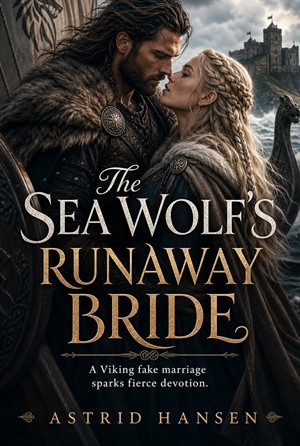
The Sea Wolf's Runaway Bride
1 Fleeing the Betrothal at Skara
The bridal veil snagged on the market gate as Inga ran.
She tore it free, leaving a strip of fine linen fluttering behind her like a white flag of surrender. Behind her, men shouted her name. The clatter of boots and harness struck the packed street, growing louder between the timbered houses of Skara.
“Inga Hrolfsdottir! Stop!”
She did not look back.
Rain from the night before had turned the harbor road to brown slime.
It sucked at her soft shoes and spattered the hem of her blue wool dress.
Her pale-blond braid slapped between her shoulders, heavy with the beads her father’s household had fastened into it for the betrothal feast.
One bead broke loose and struck the stones.
She had no cloak. No knife. No purse.
Only the small bronze key clenched in her palm and the knowledge that every street behind her belonged to kin.
Her father’s men had searched the hall first, then the storerooms, then the women’s quarters.
They had not expected her to climb through the smoke vent above the hearth, nor to drop into the tannery yard with soot on her face and blood running from her scraped knee.
She had expected the harbor to offer freedom.
Instead, Skara seemed to have swallowed her into a maze.
Fishmongers shouted over one another. Ropes creaked.
Gulls shrieked above the salt-stinking quay.
Between carts stacked with wool and barrels of ale, faces turned toward her, curious and sharp.
Some knew her. A merchant’s daughter did not vanish unnoticed on the morning she was meant to bind two families together.
A hand caught her sleeve.
Inga twisted hard. The cloth tore, and she stumbled against a post slick with rain.
A woman carrying a basket glared at her. “Watch yourself.”
“Forgive me.” Inga pressed onward, forcing air into lungs that burned. Her blue-green eyes stung from wind and smoke. The little mole above the right side of her lip felt strangely exposed without the veil.
The longship lay at the far end of the harbor, beyond the fish racks and the row of smaller boats. Dark timber, high prow, red-and-black shield rims. She had heard the rumor three days before, whispered by a dock boy who had been paid to carry a message to her chamber.
Rurik Eiriksson had come into Skara with a cargo of walrus hide and iron. He took passengers when the price suited him. More importantly, he did not bend easily to local lords.
Inga had never met him.
She had only one chance to make him listen.
A horn sounded behind her.
The betrothal party had reached the market road.
She ducked behind a cart piled with rushes. The rushes scratched her cheeks and smelled of damp earth. Two men thundered past, one wearing her father’s blue-bordered cloak.
“She cannot have reached the water,” one said.
“She knows the harbor,” the other answered. “Search every ship.”
Inga waited until their boots faded beneath the market noise.
Her fingers shook around the bronze key.
It was not valuable, but it was proof of what she had done: she had taken the key to the small warehouse where her father kept the silver meant for her bride-price negotiations.
Not the silver itself. She had no wish to steal from him.
But the key could open a merchant’s chest, and a merchant’s chest could buy passage.
If Rurik refused her, she would have nothing left but the harbor water.
She slipped from behind the cart and ran.
The quay opened before her, gray sea rolling beyond it. Men hauled a gangplank toward the longship. Rurik’s crew moved with the practiced impatience of those who had been delayed too long. A broad-shouldered sailor shouted for a coil of rope. Another shoved a barrel aside.
At the foot of the gangplank stood Rurik.
He was taller than she had imagined, his dark-brown hair tied at the nape, his expression carved into a hard displeasure that did not belong to the morning alone. A wool cloak hung from his shoulders. His green eyes swept over the quay, alert and cold.
Then they found her.
Inga stopped three paces away, mud at her ankles, torn sleeve hanging loose.
His gaze dropped to the wedding dress beneath her cloakless shoulders. It moved to the men emerging from the market street.
“Are you Rurik Eiriksson?” she asked.
“Who wants to know?”
“Inga Hrolfsdottir.”
Recognition sharpened his face. Not surprise. Calculation.
Behind her, someone shouted, “There! By the longship!”
Rurik’s jaw tightened. “You have chosen a poor place to introduce yourself.”
“I have chosen the only place left.” She stepped closer. “You sail before the tide turns.”
“I do.”
“Then take me with you.”
His eyes flicked toward the approaching men. “Why?”
“Because I am being married against my will.”
The words came out too plainly. A few crewmen glanced over. One made a low sound of interest before Rurik silenced him with a look.
“You expect me to carry a bride away from her kin?” Rurik asked.
“I expect you to carry a passenger who can pay.”
“With what?”
She opened her hand and showed him the bronze key.
His expression did not change. “A key is not payment.”
“It opens my father’s warehouse. Inside are goods enough to cover a passage and more.”
“Goods you have stolen?”
“No.” Her cheeks heated despite the cold wind. “Goods I can claim by right when I am no longer trapped beneath his roof.”
“You are a merchant’s daughter, not a merchant.”
“I have kept his accounts while he drank with men who lied to him. I know what is in that warehouse, and I know what it is worth.”
Rurik leaned nearer. He smelled of tar, salt, and wool warmed by a body that had spent years at sea. “And when your father’s men come aboard with a claim that you were taken?”
“They will say whatever serves them.”
“They will say you are promised.”
“I am not married.”
“Your word against theirs carries little weight.”
The men were close now. Inga heard the slap of boots on wet boards. Her pulse beat painfully at her throat.
“Then give my word weight,” she said.
Rurik’s gaze fixed on her face. “How?”
She had thought of this in the dark, while smoke filled the loft and the bells of the feast began below. The plan had seemed bold then. Now, beneath his scrutiny, it felt like stepping onto thin ice.
“Take me as your wife.”
For one breath, the harbor noise seemed to fall away.
Rurik’s eyes narrowed. “You have met me for the first time.”
“I know.”
“You know nothing of me.”
“I know you are sailing. I know men who fear no lord are difficult to command. I know your crew will not hand a wife to the first armed party that comes demanding her.”
“That is not marriage. That is a shield.”
“Yes.” She forced herself not to retreat. “A shield is what I need.”
His missing finger caught her attention when he lifted a hand. The tip of his left index finger was gone, the old injury pale against weathered skin. He noticed her looking and lowered it again.
“Why should I risk my ship for your trouble?” he asked.
“Because I can make the lie convincing. Because I can read accounts, bargain with traders, and keep your stores. Because I will not be a burden.”
“Every runaway says she will not be a burden.”
“I am not every runaway.”
“No,” he said. “You are a woman dressed for a wedding, standing beside my gangplank with a key in your hand and armed men behind you.”
“They are not armed for my sake.”
“That does not make them less dangerous.”
The first man reached the edge of the quay. “Inga! By authority of your father, come back at once!”
She flinched before she could stop herself.
Rurik saw it. His mouth hardened, but not with pity. He turned toward the crew.
“Cast off the shore line.”
The nearest sailor blinked. “Captain?”
“Now.”
The order snapped across the deck. Men moved.
Inga stared at him. “You will take me?”
“I will take you to sea,” Rurik said. “The rest is not decided.”
Her relief rose too quickly, almost making her weak. “The marriage - ”
“Will be spoken of when we are away from this quay.”
The men behind her began pushing through the crowd.
Rurik caught her wrist.
His grip was firm, not painful. Heat traveled through the place where his fingers closed over her skin. He looked down at her hand, at the wedding ring still absent from it, then back to her eyes.
“If you step aboard,” he said, low enough that only she could hear, “you obey my orders while we are on the water. You do not wander. You do not hide what may endanger my crew. And if I offer you a bargain, you will hear it before you agree.”
“I have already agreed to worse bargains without being asked.”
Something shifted in his expression. Not softness. A deeper attention.
“Then do not make the same mistake twice.”
The men reached them.
“Inga Hrolfsdottir,” called the one in the blue-bordered cloak. “You are bound by your father’s agreement. Come ashore.”
Rurik stepped between them and Inga.
“She is aboard my ship now.”
“She has no leave to go.”
Rurik’s green eyes turned flat. “Then bring your claim before the law. Do not shout it at my deck.”
“She is promised to a powerful house.”
“Promises are not chains.”
The man’s hand moved toward the knife at his belt. Rurik’s crew became still. The air tightened with the clean, dangerous silence before violence.
Inga could not let blood be spilled for her before she had even boarded. She moved beside Rurik, close enough that her shoulder brushed his arm.
“I go willingly,” she said.
The man’s face twisted. “You are confused.”
“No.” Her voice shook, but it carried. “I am choosing not to marry a man I have never accepted.”
A murmur passed through the crowd.
Rurik glanced at her. His attention struck like a touch.
“Then choose quickly,” he murmured.
She climbed the gangplank.
The longship shifted beneath her weight, alive with the sea’s restless pull. For one terrible instant, her foot slipped on wet wood. Rurik’s hand closed around her waist and steadied her.
She felt the strength of him through the thin wool of her dress. His breath touched her temple.
“Careful,” he said.
“I am.”
“You nearly went into the harbor.”
“I said nearly.”
His hand remained at her waist for one beat too long. Then he released her and turned to the shore.
Inga reached the deck, but freedom did not feel like freedom yet. The ship was narrow. The crew watched. Rurik stood between her and every road back to Skara.
Below, the men began shouting legal claims, invoking her father’s name and the authority of the household that had meant to receive her as a bride.
Rurik listened without answering.
Then a rider appeared beyond the harbor road, horse steaming in the cold air. Another followed. The sight drained the last warmth from Inga’s face.
“They sent for riders,” she said.
“I see that.”
“They will reach the outer road before the tide takes us clear.”
Rurik looked at her, irritation and something more guarded moving through his eyes.
“You said the marriage would shield me.”
“I said it could.”
“Then you had better become my wife convincingly.”
The shore line splashed into the water. Oars dipped. The ship began to pull away from Skara.
Inga stood beside him as the harbor widened between them and the quay. Her torn sleeve fluttered in the wind. Rurik’s cloak brushed her hand.
“Do you regret boarding?” he asked.
She watched the riders gallop toward the water, too late to seize her but close enough to make the threat plain.
“No,” she said.
Rurik’s gaze remained on her. “You should.”
“Perhaps.” She met his eyes. “But I have never regretted leaving a cage.”
For the first time, his hard expression cracked - not into a smile, but into recognition.
The longship turned toward open water, carrying her away beneath a borrowed name that had not yet been spoken. Behind them, the riders reached the end of the quay and raised their hands as if the law itself might drag the ship back.
Rurik’s fingers closed around the rail.
Inga stood at his side, with no husband, no home, and no certainty that his protection would last beyond the next bargain.
Still, the sea opened before her.