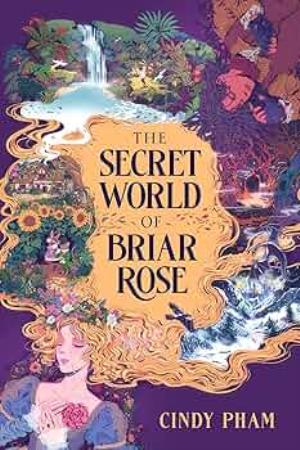
The Secret World of Briar Rose
Chapter 1
THE LAST WORDS Elly said before she disappeared were “I hate you.”
To Corin, the sentiment was nothing new. Saying “I hate you” was a universal language between sisters, and their tongues spoke it fluently.
Elly yelled it whenever Corin stomped over her chalk drawings and wiped them off the concrete. Corin hissed it whenever Elly hummed songs in the middle of her sleep and woke them up.
They went to bed angry yet huddled for warmth every night.
After the warplanes destroyed their homes and soldiers seized their family’s belongings, the only thing they had left was each other.
But this time was different.
This time, when Elly said “I hate you,” Corin knew she meant it.
Her sister had vanished as swiftly as any other resident come sunrise. Anyone living within the dilapidated buildings or rubble-filled streets of Gyldan knew their home wasn’t forever.
There would be a few years of normalcy and routine, if their factions allowed it, before the rumbling sound of bulldozers came to tear down the walls.
A century-long turf war between rivaling countries meant constant itinerance: new military, new flags, but never any warnings for the families who lived in Gyldan.
Houses were simply strategic locations to be secured, and people like Corin and Elly were just collateral damage, about as insignificant as roaches that were crushed to death if they didn’t move out of the way.
As Corin wandered through the city center in search of Elly, she could hardly imagine these same streets bustling with trade and people a century ago.
Her grandparents had risked their lives seeking refuge in the prosperous kingdom surrounded by forests, but those dreams were quickly dashed when the royal family abandoned its people, leaving an ungoverned country to descend into chaos. Warring groups divided into territories, and with soldiers patrolling the borders, Corin knew Elly couldn’t have left their faction.
She pasted posters with her sister’s likeness around soup kitchens, town squares, even shops that had closed their shutters, like the burning bakery she had looted for bread after the last round of warplanes came. Her stomach rumbled with hunger by the time she circled back to the marketplace, a deserted area with ramshackle storefronts and stragglers sorting through trash. She approached a few of them to ask if they had seen the girl on her poster, but their eyes glazed over the image, or they muttered a noncommittal response, or they cursed her out, which always resulted in her cursing them back.
Mostly, though, Corin was ignored, like another body rotting on the street.
Her appearance probably didn’t help. Hunger had whittled her limbs to bones and hollowed her cheeks. Swaths of crow-black hair stuck to fresh bruises across her face. Tattered pants and ripped sleeves revealed grime and mud, the stains blending with her dark skin and old scabs. At eighteen years old, she already looked dead.
Corin nailed her last poster onto a wooden pole and took a step back, examining her work.
She had recreated Elly’s face in charcoal with all the details she remembered. Every freckle on her dark skin, every birthmark on her long limbs.
Her short, choppy hair, which always curled behind her ears. She had a small, rounded nose and wide cheekbones, two large pools of eyes the color of summer soil after it rained.
While Corin inherited their father’s broad shoulders and strong nose, Elly carried their mother’s features, soft and feminine like a black-eyed daisy.
The longer Corin stared, the more she hated the drawing. The sketches were too crude and badly smudged. They looked like Elly but couldn’t capture her.
They didn’t show what it felt like to hold her hand, to feel the stickiness of her palms from all the times she broke dandelion stems and marveled at their white milk.
They didn’t show the light in her eyes whenever she heard a new story, the cuts on her fingers from plucking weeds in the cracks of sidewalks, the dirt under her nails from digging into soil and shouting that there was another world underneath that they couldn’t see.
“She’s still asleep down there,” Elly would insist in rushed breaths, “the princess from long ago—”
Corin shook her head, dispelling her sister’s foolish enthusiasm for fairy tales. Even at the age of twelve, Elly still latched onto bedtime stories she’d heard as a child when they had lived with other artisans. Corin thought leaving the commune last year would, at least, let Elly outgrow childish interests and forget their friends. In the end, it was only Corin who wanted to forget them.
Before she dwelled longer, the sound of footsteps approaching made her reach for her belt. She turned to flash a dagger at the stranger’s throat, then pulled back as the elderly woman before her gasped.
“I’m sorry,” the stranger stammered, her voice frail and light. “I wanted to see your poster.”
Deep wrinkles etched the woman’s face like a crumpled plant. She wore a faded shawl that thinned above her wrists, showing a wedding ring that glinted from her finger. Corin handed her the crinkled paper and watched the woman squint at the drawing of Elly. Her lashes nearly brushed against the charcoal as her face pressed closer to the parchment. White clouds that surrounded her pupils shifted, her eyes straining to scan every detail.
“The shading on the girl’s face is excellent,” the woman murmured. “You’re very talented.”
Corin counted her breaths to keep from cursing at the stranger. She felt foolish for hoping Elly would be recognized, and angrier that the woman would waste her time by prattling compliments. She was not here to show off her technical skills in some pitiful act of panhandling. But why would anyone care? Even if people knew Elly had been missing for a full day, they would assume she was simply another street rat who faced the early mercy of death.
But Elly wasn’t dead. Corin knew this, because there was no body. She had checked the usual places her sister loitered: the soup kitchens filled with lines of gaunt figures, the root cellars they hid to shelter from rain, even the riverfront where their old friends had built their commune, a now-destroyed home that Corin swore she would never return to again.
No, it wasn’t that Elly was dead. It was that she was nowhere to be found. As if she had disappeared into thin air.
“You remind me of the artists that lived by the river,” the woman observed. “People only remember the insurrection, but before then, I used to see them paint and build. Tragic, really, what happened to them.”
Corin steeled herself to shut out the sound of bullets, the smell of burnt flesh, the muffled scream that burned in her throat whenever she imagined that day. It had been a year, and still the scene came to her in nightmares and woke her in sweat and tears. There was no point in picturing how even the autumn leaves died that night, crumpled like the bodies strewn over the debris. She had not been there, after all. She needed to focus on the opportunities in front of her, here and now.
“Are you an artist?” Corin asked.
“Yes. But it’s difficult now, as you can see.” The woman’s disfigured hand gestured to her cloudy eyes. “My husband used to describe a scene to me and I would draw it. Before he died, we drew so much together.”
Corin imagined the woman and her husband, hunched over an easel, splatters of paint dripping over the canvas edges. Their voices were soft murmurs, an echo of her own parents’. See this, Corin? Her mother’s hand steadying Corin’s fingers over a brush. A round smear of orange paint, bright like apricot, messy like juice. You just made the sun.
“My parents were artists too,” Corin said. “My mother was a painter. She taught me everything.”
“Oh, that’s wonderful. And your father?”
“A sculptor. He liked making pots, the tiny ones you grow plants from. I’m better with a brush, though, so sometimes I’d paint them after he finished.”
The woman cracked a smile.
“You must keep painting, then. Sometimes art can be the only refuge in this world. These soldiers take our loved ones, but they cannot take this. That’s how we keep a memory alive, even if it’s gone.”
Corin thought of patchwork quilts stained with paint, clay pots drying by the window, a tiny cottage made of lime-washed brick, and a roof so low she could kiss the thatch. Her father’s calloused palms, her mother’s belly pregnant with Elly, the low hum of a song they’d made up. She could paint the memory into permanence, proof that there was once a home where love overflowed.
She took the elderly woman’s hand. This was someone left with no family, just like her, searching for a way to bond with another human being. Corin would give her that connection. She would let the woman know that, despite their despair, at least they had crossed paths with one another.
“Thank you,” she said. “I won’t give up on my dreams.”
The woman crinkled her eyes and nodded with conviction, as if her heart turned a little softer from their brief connection with each other. They bid goodbye, and Corin watched the woman leave before dropping her smile. Her hands dug in her pocket, where the edge of a wedding ring pressed against her palm.
It was smaller than she would have liked to barter with, but she could still make some decent money from it.
Maybe it took a mind deteriorating with old age to fall for a trick like this, believing in the dreams of a starving artist. But the truth was that dreams were never enough. Her mother died when Corin was ten, her paintings and clothes discarded by leering men who wanted to put their own marks over her body. Corin’s father changed after that, stewing in liquor and regret until he finally gave in to his darkest desires and drowned himself a year later.
No, if Corin painted a memory, it would be this: A raging river that took three bodies. A baby wailing as the water drowned them. A girl who only had the strength to carry her sister, not the weeping man who brought them there.
It would be a portrait of survival, because in the end, that was what mattered. Not the fleeting love of a mother gone too soon, not the strength of a father who’d lost too much. Not even a makeshift home that once opened itself to an orphaned teenager, only to disintegrate before she turned eighteen.
Corin had no capacity to focus on something as meaningless as art. After the insurrection took her friends, there was no one else but Elly and her.
Now, there was only her.
Because even as she kept searching, Elly never returned.
? ? ?
CORIN WOKE TO the sound of soldiers seizing her home. It wasn’t much of a home to begin with, but she had depended on the deteriorated building as a roof over her head, even if that roof was composed of wooden boards and cobwebs.
Troops barged in clanking metal and heavy guns, stomping up a creaky stairwell that led to an alcove blocked by a rotting wood door. When they kicked it open, she barely made it out of bed. Their eyes fell upon the pile of burlap and moth-eaten sheets, their noses wrinkling at the rotting odor of trash and unwashed clothes. She felt naked under the gaze of these strangers, like a roach found belly-up in a sticky trap.
“No squatters,” one of the men yelled. “You’re on our turf now.”
The distant roar of bulldozers made the floorboards rumble. The walls trembled, as if they could tell another man-made machine was coming. Corin’s pulse raced as she rifled through her bags and fished out crumpled documents.
“I rent under Woodbine,” she spat, as if the name of a rich landlord meant anything. Her pointer finger stabbed the bottom half of her papers, where both of their signatures were scribbled beside last year’s date. She had recalled the day she met the old man with as much regret as getting talked into holding a knife, even though she’d never made the cut. His pale eyes had locked onto her first, sensing her desperation even from across his shop. His smile had chipped incisors, like a wolf baring its teeth at his next prey. She knew she’d made a mistake shaking his hand and it had haunted her ever since.
The only consolation from their deal should have been the new roof over her head, even if it was in a decrepit building. But the soldier barely glanced at the document she presented. His disinterested expression felt like a rock sinking in her stomach. She understood, even before he spoke, that any prior agreement she’d made was for nothing.
“Woodbine sold ownership of his land and left Gyldan. Demolition orders call for any illegal housing to be claimed under Zilar military.”
The soldier stamped the Zilar flag, a striking blue marked by an eagle and a coat of arms. He raised the pole high enough to puncture the boarded rooftop. Corin watched the flapping cloth in the sky with shaking anger. Her curled fists wanted to smash Griffith’s pallid face. He had put blood on her hands the day they traded favors, and the desolate excuse for a home she was about to lose had not been worth her sacrifice.
The barrel of a gun pressed into her back, forcing her to move. She couldn’t even walk a clean path to the door as hordes of men swept the home for valuables. Metal detectors crawled the floorboards like mechanical spiders, hunting for hidden gold from a once prosperous land. Corin sneered at their pointless search. Greedy men who already had everything always wanted more. Her family had escaped Zilar for refuge in Gyldan, only for their home to be stolen once again.
If they had asked, she would have told them there was nothing to seize. She’d sold Elly’s old toys and baby clothes for a pathetic amount of bills after her sister outgrew them. She’d already thrown away palettes and brushes when she gave up on art. At least when they took her parents’ home, there was furniture to overturn and memorabilia to destroy. Old paintings and cracked pottery and things that could have mattered if she still had a family.
They couldn’t take from someone who had nothing left now.
Yet something floated behind a tattered sheet, small and round and strung by a metallic chain nailed to one of the scorched beams. Instinct crackled her heart and made her lunge for it. The sudden movement caused a soldier to knock his gun into her head and force her knees to the ground. He pressed a boot to her back and grabbed the chain. The pendant, a hollowed ring where a gemstone should have been, dangled between his narrowed eyes. He let out a snort, dropping the necklace to the floor where her cheek pressed against wood.
“Worthless,” he muttered.
He was right. Her grandmother’s pendant held no monetary value, the lack of gemstone turning the necklace into nothing more than a misshaped copper band. There was no practical reason for Corin to keep it like a family heirloom. And yet, his disgust at the ornament, as if it were as insignificant as the rest of her ancestry because they weren’t gilded by fortune, made something snap inside her.
Corin snatched the chain before standing.
“You’re wasting your time,” she spat. “There hasn’t been gold on this land for centuries. The only thing you’re digging up are the graves you’ve made yourselves.”
She had already braced herself for the soldier’s retaliation when his gun barrel swung down, metal crushing against her eye.