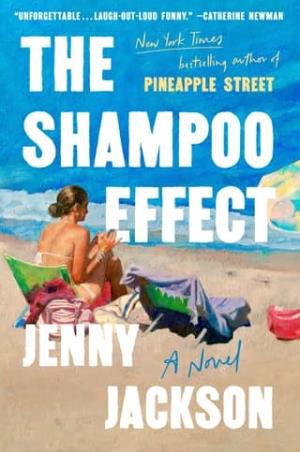
The Shampoo Effect
Chapter One Caroline
One
Caroline
Boston Cream
It could have been a Boston cream, puffy white, the inside sweet vanilla pudding, but instead it was a jelly donut, glazed with sugar, filled with the sort of fluorescent red goo that could only be created in a food-science lab.
Caroline didn’t even realize she’d stepped on the thing.
She was dragging a suitcase, a backpack was thumping on her back, and her eyes were on the track numbers blinking in green over the platform doors.
The voice over the loudspeaker was blaring boarding instructions, and Caroline dashed to her train, legs scissoring, suitcase wheels spinning along.
Her shoe must have hit the jelly donut from the perfect angle, because when it burst, the jelly squirted straight up, directly hitting the crotch of her light jeans.
She ran along the platform, feet pounding, oblivious, and by the time she hoisted her bag onto the overhead rack she had managed to coat her entire inseam with the sticky fuchsia slime, something she only noticed as she flopped down into her leather seat.
“Oh my God, what on earth?” Caroline muttered, her glasses fogging in the warmth of the train.
She unzipped her backpack and rummaged for a tissue.
She had a computer, a charger, two lip balms, a book, a pouch full of pens, and a can of almonds.
No tissues. “Does anyone have a Kleenex or a napkin?” she called out to the surrounding seats.
The woman sitting across the aisle glanced up, made a horrified face, and shook her head before burying her nose back in her phone.
Lovely. Caroline pulled a receipt from her wallet and started trying to wipe at the mess.
“Here.” A hand appeared with a sheaf of paper napkins.
“Thank you so much.” Caroline sighed, grabbing the napkins and wiping the jelly from her crotch. “This is such a disaster. I might need to change. Do you know which train car has the bathroom?”
“Oh, no, I’m sorry, there aren’t bathrooms on the commuter rail. None at the station either.”
Caroline looked up and finally registered the napkin-bearer. He was her age, with long, brown hair tucked behind his ears, a fleece jacket, a laptop bag hanging from his shoulder, and the vibe of someone who knew his way around a kayak or a climbing gym. She clearly wasn’t in New York anymore.
“I guess I’ll just have to be covered in this stuff for the next hour,” Caroline muttered, resigned. “But thanks for the napkins.”
“No problem.” The kayaker started loping off down the aisle. “I get it. I minored in women’s studies.”
“What?” Caroline startled. “But it’s not—” she tried, but it was too late. He was already gone, the train door sliding closed behind him.
The Good Guy
Moving to Massachusetts was the most impulsive thing Caroline Lash had ever done.
She recognized that was sort of sad. She was twenty-eight and that was plenty of time to amass some really bold impulses—she could have hooked up with a DJ at Coachella, she could have become a pastry chef at Le Cordon Bleu, she could have dropped out of high school and bartended at an eco-resort.
But instead, she had taken the road more traveled by.
She stayed in New York for college, attending Columbia, a mere fifty blocks north of her childhood apartment, she majored in English literature, and she spent her weekends drinking iced matcha the color of algae, shopping for vintage clothing in Bushwick, and going to flash tattoo parties where she never actually got a tattoo.
She graduated on time, signed a lease for a studio on Third Street, and took a job as an editorial assistant at a publishing house, a position secured by her mother’s industry connections—her mother a bestselling thriller writer, and nepotism remaining a powerful currency in the small world of books.
For six relatively happy years Caroline lived the life of a young person in New York publishing—complaining about her meager salary while accidentally spending three figures a week on espresso martinis, staying up all night reading manuscripts only to have them scooped away by more senior editors, and going to readings and parties at bookstores and private clubs, the publishing assistants’ Zara wool coats hanging misshapenly alongside the thick Irish wool of old money New York.
Caroline was a writer herself, and so on the nights when she wasn’t perched on a folding chair next to a long-suffering publicist at the Strand or Greenlight, she would venture down to Le Dive to drink wine with her friend Nina and eavesdrop on people, writing down all the best bits of dialogue for her short stories.
Nina was an actress, constantly auditioning, so she would arrive at the bar in character, dressed one day like a goth high school student, the next like a homesteader in a prairie skirt, resulting in the same guys accidentally hitting on them multiple nights in a row.
These were guys with rings on their pinkies, guys with ironic mustaches, guys conspicuously carrying paperback copies of Kurt Vonnegut in their back pockets.
They were funny, they were undatable, they were exhausting, and Caroline and Nina came up with a game where the first boy to mention he’d been to Mexico City had to buy them a round.
Even though Caroline was initially hired at the publishing house because of her famous mother, it turned out she was pretty good at her job.
She was a fast reader and had a gift for soothing anxious writers, for prying away their finished manuscripts before they overworked them like pie dough.
Still, she felt her mother’s celebrity presence in every interaction—the jolt of recognition every time she said her last name, the fact that the older editors even bothered to say hello.
She was given promotion after promotion, soon assisting the editor in chief, mastering the fine art of rolling calls from both his wife and his girlfriend, and then to associate editor, earning the right to handle authors on her own.
The path to a real office with a door was clear ahead.
(A closed door! Oh, to call the gynecologist from work!
To eat salad at her desk like a wild animal unobserved!)
But then, at twenty-eight, Caroline surprised even herself.
She placed one of her short stories in The New Yorker, walked into her boss’s office, and gave notice.
The other associate editors were shocked.
Who left a paying job over one short story?
Who thought that a decent six thousand words was enough to abandon an entire career?
Only someone with a dream, a rich parent, and a twentysomething’s blind confidence in her own untested abilities.
Caroline’s mother, Gwendolyn Lash, was less than pleased with her daughter’s sudden unemployment.
“Caroline, do you know how many people have read my books? Ten million. Do you know who reads The New Yorker? Nobody. They just skim the cartoons and then put it in their powder room to look smart.” Or “Caroline, don’t tell me you’re planning on writing in a coffee shop.
You’ll end up gorging yourself on eight-dollar croissants and dating a barista with a screenplay.
” As Gwendolyn sniffed and swiped, Caroline simultaneously realized two things: She was craving an almond croissant, and she really needed to get away from her mother.
In a flurry of industry, Caroline applied to every fellowship and writer’s residency she could find.
She sent her short stories off to New Hampshire and Sarasota, Wyoming and Alaska.
It didn’t matter where she went, she just needed a bed, a desk, and maybe some of Nina’s Adderall prescription.
When the email arrived from the Palmer Preston Foundation, Caroline screamed.
She had been awarded a fellowship, complete with eighteen months in a seaside cottage, sponsored by the late Palmer Preston, the famous American author.
Preston had lived in this tiny village of Greenhead, Massachusetts, had written his Pulitzer Prize–winning novels there, and now Caroline would go off and follow in this legend’s footsteps.
As Caroline scrolled through the pictures of the fellowship cottage, she felt nearly drunk with excitement.
The house had rickety wooden steps that led from a scrubby yard to a pebbly beach, two spartan bedrooms, a dated kitchen that hadn’t been renovated since the sixties, and a desk looking out at the water.
It was the kind of writer’s retreat Caroline had always imagined for herself, the spot she pictured when her subway was trapped in the tunnel, or a rat ran over her sandaled foot.
A room of one’s own! Of course, as Caroline googled the village of Greenhead, she saw that it was actually a fairly normal New England town, peppered with clam shacks and pizza parlors, nail salons and dog groomers, but still, there were acres of farmland, yellow marshes, old lobster boats, and a vast white sand beach far prettier than anything New York had to offer.
It was, Caroline decided, the perfect place to hole up and write, to make a name for herself far beyond the long shadow of her famous mother.
Caroline had been in Greenhead for two weeks when she ran into the kayak-looking guy at the bank. They were waiting in line for the ATM, so she decided to say hello.
Caroline tapped his shoulder. “Hi, we met on the train.”
He turned around, puzzled. “The train?”
“Remember, you gave me napkins?”
He smiled uncertainly.
“I just wanted to let you know that was actually a donut. A jelly donut. I stepped on it.”
“A jelly donut,” he repeated, and Caroline briefly wondered if he didn’t speak English or if he was really high.
“Yes, anyway, just wanted to let you know that red stuff was jelly. On my jeans.”
“Cool, cool.” He grinned, then moved to take his turn at the ATM.
Caroline rolled her eyes, wishing she hadn’t even bothered.