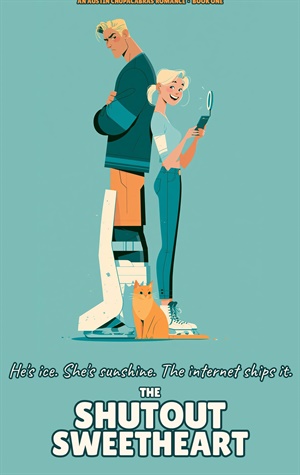
The Shutout Sweetheart (The Austin Chupacabras #1)
Chapter One
JUNIE
But I’m getting ahead of myself. Content day started the way all my content days started, which was with me arriving at Moontower Arena two hours early, hauling forty pounds of equipment through the loading dock while a Zamboni driver named Gus pretended not to see me struggling, and taping a sign to the glass that said PLAYERS: YOU ARE BEING RECORDED. SMILE OR AT LEAST DON’T SPIT.
It was seventy-one degrees outside at nine in the morning, in January, and inside the building a compressor system the size of a school bus was fighting the entire state of Texas to a draw so that grown men could slide around on frozen water.
I loved that about this job. The sheer stubbornness of it.
Somebody looked at Austin, a city that closes schools over a rumor of sleet, and said, here, this is where the ice goes.
I ran the Austin Chupacabras’ social media accounts.
All of them. Alone. If you’d seen a video of a rookie failing to pronounce “charcuterie,” that was me.
If you’d seen our mascot, Chuy the Chupacabra, attempting the splits and requiring assistance to stand, me.
The content calendar lived in a spreadsheet that our assistant coaches had learned to fear, and January fourteenth had been circled for three weeks: MIC’D UP PRACTICE. FULL ROSTER. NO EXCUSES.
One player had submitted an excuse anyway. In writing. It said, in its entirety, “No.”
“He’ll come around,” Mason Duffy told me at the bench while I clipped a mic pack inside his shoulder pads.
Mason was our captain, thirty years old, built like a friendly barn, the kind of Texan who called everyone “bud” including the referees he was screaming at. “Saint loves this stuff. Deep down.”
“How deep?”
“Mantle of the earth, easy.”
Lars Lindell was already in his crease at the far end, which was where he lived.
Saint. Twenty-nine, from Duluth, our starting goalie and the single best thing about a team that was, and I say this with love and also access to the analytics, in trouble.
Attendance was the polite word for it. The league had given Austin three seasons to prove that hockey could survive ninety-degree Novembers, and we were in season two, and the upper bowl on a Friday night looked like a mouth missing most of its teeth.
Which was why I was here, in skate guards and a puffer vest, carrying my ring light onto NHL-adjacent ice.
Yes, the ring light had a name. Beyoncé had been with me through three jobs and one catastrophic career fire, she had a dent in her tripod from the day I fled my last office, and she made everyone look like they’d slept eight hours and forgiven their parents.
You name the things that save you. That’s just science.
I set her up at the edge of the crease to catch warmup saves in decent light, and Saint skated over and looked at her, then at me. He had dark blond hair flattened in mask-shaped patterns and the general expression of a man reading a parking ticket.
“Move that,” he said.
“Good morning to you too. Twenty minutes, tops. The fans want to see what you see.”
“They don’t. That’s why I stand here and they don’t.”
I beamed at him, because beaming was my whole business model.
“Lars. Saintly Lars. Our engagement numbers are the only thing standing between this franchise and a moving truck to Hartford, and your glove save from Saturday got more views than our last four wins combined. You’re a star. Congratulations. It’s terminal.”
He stared at me for one full second. “The light is in my crease.”
“She has a name.”
“It’s in my crease.”
“Beyoncé is a professional.”
He skated away. I chose to interpret that as consent, because I am an optimist, and because I had a content calendar with a hole in it shaped exactly like his face.
Here is what you need to know about mic’d-up practice footage: it’s ninety percent skate sounds and men saying “yep” and one percent gold, and my whole job was panning for the one percent.
Pickle, our rookie, narrated his own line rushes like a golf announcer.
Mason challenged the entire third line to a push-up contest and lost to a twenty-two-year-old and blamed “the barometric pressure.” Coach Barb Halvorsen chewed gum at a frequency that could shatter glass and told the power play unit they moved “like a funeral in July.”
And at the far end, Saint said nothing, to anyone, for fifty minutes, except twice, quietly, in what I would later learn was Swedish, to his own goalposts.
He moved like the drills were happening to someone else.
Shooters came in waves and he swallowed everything, drop, seal, up, reset, square before the puck knew where it was going.
It was the least dramatic elite thing I’d ever filmed.
I’d have gotten more expression out of a load-bearing wall, and I say that as someone who has interviewed our Zamboni.
I got closer to catch it. That was my first mistake.
My second mistake was physics. Barb ran a clearing drill, dump-outs under pressure, and Saint came out of his net to play a rimmed puck, and I have watched the footage since, frame by frame, at every speed, and I want to be fair to him: the man tried to eat the shot rather than let it go where it went.
It went where it went. The puck rose off his stick blade, cleared the half boards, and center-punched Beyoncé at approximately the velocity of regret.
She didn’t fall. She detonated. LED panel one direction, tripod the other, a sound like a pi?ata full of dinner plates. The entire rink went silent except for Mason, somewhere behind me, whispering, “He shot Beyoncé.”
“It was in the crease,” Saint said, to no one, to God.
“She was NEAR the crease,” I said, and I was already moving, because grief makes you stupid, and I crossed behind the net right as Pickle, who did not know the drill was over, put a puck on goal.
The rebound came off Saint’s pad like it had somewhere to be.
It clipped my wrist. Not hard, honestly.
A bee sting with a union card. But I yelped and dropped my phone and did the thing where you fold around your own arm like it’s the last arm on earth.
What happened next took maybe four minutes, and it changed everything, and I remember it in pieces.
Saint got to me before anyone else. He didn’t ask if I was okay, which I appreciated, because I would have lied. He looked at the wrist, looked at me, and pointed his blocker at the bench like I was a defenseman who’d taken a bad penalty. “Sit.”
I sat. He kneeled. He pulled his glove and blocker off, set them down with the care of a man handling sleeping infants, and produced a roll of white tape from somewhere in the many-pocketed universe of a goalie’s existence.
“It’s fine,” I said. “I have another wrist. Backup wrist. It barely plays.”
He didn’t laugh. He took my forearm in both hands and turned it, gently, the way you turn a page in a book you don’t want to end, and pressed his thumb along the joint until I hissed, and nodded like the hiss was information, and started taping.
And this is the part four million people have now watched: he taped my wrist the way he tapes his pads.
Slow. Overlapping. Muttering under his breath in Swedish the whole time, a low grumbling stream, and when I asked what he was saying, he said, in English, “That you stand in bad places,” and kept taping, and his hands never once stopped being careful.
“You know,” I said, because silence and I are old enemies, “you owe me a ring light.”
“I owe Beyoncé a ring light. You I’m billing for the tape.”
It took me a second. That was the thing about him I learned right there on that bench: the joke shows up a sentence after he does, like it took a later flight.
He finished, pressed the tape end flat with his thumb, held my wrist a beat longer than the job required, and said, “Ice it. Twenty minutes.” Then he stood, collected his glove and blocker, and skated back to his net, and tapped both goalposts with his stick, twice, left post then right, like he was apologizing to them for the interruption.
Neither of us noticed his chest mic. Hot the whole time. Neither of us noticed my phone on the ice, camera up, still rolling, framing the entire thing from below like a cinematographer with a grudge.
Coach Barb found me in the tunnel afterward, appraised the tape job with one look, and said, “He does the pads the same way. Takes him eleven minutes. We’ve timed it.
” Then she moved her gum to the other cheek and walked off before I could decide what to do with that information, which turned out to be nothing, all day, loudly.
I noticed the wrist, though. All afternoon. Not the sting. The tape. He’d left a little folded tab at the end so it wouldn’t hurt coming off. Who does that. Who thinks of the coming off while they’re still putting it on.
That night I sat on our couch in East Austin with a bag of frozen edamame on my arm while my sister Hazel highlighted a nursing textbook and judged me with her whole face.
“So the goalie murdered your light and then wrapped your wrist like it was a war injury.”
“It’s called first aid, Hazel.”
“I’ve done first aid. I do first aid academically, for credit. Nobody’s ever grumbled at me in Swedish during it.”
“That’s a gap in your program, then. Take it up with the dean.”
“For twenty minutes?”
“Four minutes.”
“You said twenty.”
“The icing is twenty. The taping was four. There was tenderness but it was brief and clinical.” I pointed the edamame at her. “I’ve sworn off men who talk into microphones for a living, and you know that.”
“He what?” I said.
“He’s currently at one point one million views,” Hazel said, and turned her phone around.
The video was posted from our account. My account.
The scheduling queue had eaten my drafts folder and published the one file I had marked, in capital letters, DO NOT POST, HUMAN MOMENT, PRIVATE, which is apparently what my software considers a title.
Fifty-two seconds. His hands. My wrist. The tape going around twice, gentle as a confession, while a man who says eleven words a week grumbled at my pulse point in Swedish.
I watched it four times with my thumb over delete, and I did not press delete, and I want that in the record too.
The top comment had four thousand likes and gained a hundred more while I stared at it:
SIR. THE WAY HE HOLDS HER ARM.
Four thousand likes. While I watched.