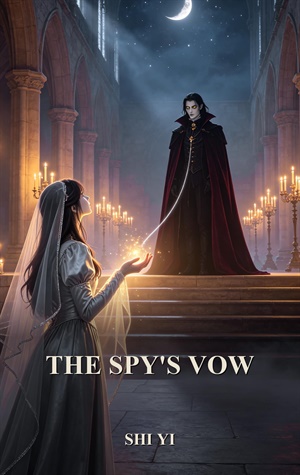
The Spy's Vow (The Ever-Night Saga #1)
Chapter 1 The Bride Price
A stub of candle burned on the table between them, low and patient. Oris Venn turned the last page of her file the way a man might close a book he had read too many times, and he did not look up.
Lira had already counted the ways out of the room.
The door behind the director's chair, one.
The servants' slit in the far wall, two, too narrow for a shoulder.
The smoke grille above the candle, three, too high and too clean.
She stopped at three, because since the summons came she had been practicing how to stop.
A woman who counted exits in the Veiled Hand's own chamber would count them in the Night Court, and a bride who counted exits would be noticed, and a noticed bride did not come home.
"You're doing it now," Oris said. He had not raised his eyes from the file, and still he knew.
She let her gaze go soft, the way he had taught her as a child. "No, sir."
"You are the finest liar I ever made, and you could never lie to me.
" He set the file down at last. Candlelight had carved the hollows beneath his eyes into ravines.
"That folder holds your whole life, Linnet.
Every test and border and body you left behind.
It ends tonight. There is no page after this one. "
She had been ready for this hour for as long as she could remember. It did not feel the way she had imagined. It felt like a held breath.
"Two days ago," Oris said, "the Night Court's envoy rode to the dusk-line under the new lord's seal.
The armistice is three months old, and the old treaty carries a clause no one has honored in two hundred years.
When a new lord takes the Ever-Night throne, he may claim a bride from the old blood of the League, to bind the peace.
" He let the quiet sit. "Kael Veyne has claimed one. "
"We refuse," she said.
"We cannot. The north will read refusal as war, and half the council already wants war." He turned a page of nothing, a habit from years of briefings. "So the council will send a girl. A true girl, some house's last daughter, to sleep in the monster's keeping and bleed for his court's amusement."
The shape of it opened in front of her before he could name it, and she understood he had arranged it exactly so. He always fed her the conclusion first, so that she would believe she had reached it herself. It was the gentlest kind of leash.
"Lady Serel of Vess," she said.
"Six years on our books. Old blood, no living kin, no one left to miss her." Oris smiled with his mouth only. "The lords will offer her to seal the armistice. And the bride who walks into the Night Court will be wearing a face we made and carrying a purpose we made."
She spoke the creed the way other women said prayers. "The war ends when the lord dies. There is no other end to it."
"The Hand has put steel inside that court before," Oris said.
"The steel did not come back with a story.
A bride is different. A bride is the one stranger the lord must keep close, and keep safe, because a dead bride is a broken armistice and he wants the armistice badly enough to be gentle with her.
" His voice dropped. "He wants peace, Linnet.
That is what makes him dangerous. A monster you can kill.
A man who makes the whole north want to lay down its knives, that monster you must kill before he teaches everyone the war was never necessary. "
She filed the words away without letting them find purchase. The war had been necessary since before her grandparents were born. Every child of the League knew the shape of that necessity the way they knew their own hands.
Oris reached into his coat and set a thing on the table between them. It was small, no longer than her thumb, silver-stoppered, and the glass was warm where his hand had held it. She caught the smell off it even at that distance, bitter and sweet at once, like withered almond and old coin.
"Morrowbane," he said. "The apothecaries spent a decade on it.
It is silver distilled until it is a poison, and it does not care how old the blood is that drinks it.
One drop, in a cup you pour with your own hand.
He will take a cup from his bride, and that will be the last courtesy he accepts from anyone. "
She reached for it.
"Not yet." His hand closed over hers before she touched the glass.
"You will carry it the night you leave, and not a moment sooner.
A woman who smells of poison does not get close enough to use it.
" He looked at her then, and for a breath he was simply the man who had pulled her out of a burning town twenty years ago.
"He has lived three centuries. He has learned to smell a lie the way you learned to count a room.
The bride must be perfect, Serel. Perfectly dull, perfectly afraid, perfectly empty. Can you be empty?"
"I can be anything."
"That is what frightens me about you." He took his hand away, and the moment passed.
"There is a shrine at the border where travelers leave candles for the dead.
When the deed is done, a lantern will burn there for three nights.
You will walk south under it, and the League will receive a widow whose monster husband died in his sleep.
" His mouth curved again, and there was nothing warm in it.
"The war ends with him. One way or another. "
The room had no window, so it was impossible to say how the hours had passed. She left the chamber the way she had come in, through three corridors and two doors, memorizing faces on the way out because the habit was older than the discipline that told her to stop.
The dressers were waiting for her in the tower room, and the bridal gown was already laid out on the bed like a corpse that had been arranged for viewing.
White silk, high-collared, heavy with hand-stitched stars that caught the candlelight and threw it back.
The older of the two women pinched the hem between her fingers as though the fabric had insulted her personally, and said nothing.
Lira stood on the stool and let them work. The corset went on first, tight enough that each breath had to be chosen. Then the underskirts, then the gown itself, then the veil, a drift of gauze that the seamstress pinned to her hair with a grip that meant business.
Oris came in when they were lacing the bodice. He stood by the fire and watched her the way a mason watches a wall he has built himself, looking for the crack.
"Who raised you?" he said.
"The sisters of the Star at Vess." Her voice went up half a note on the last word, small and careful. She had been drilling the catechism since she could walk, but the gown changed the shape of her breathing and she wanted it perfect.
"Your father."
"Drowned with the grain fleet off Coldharbor when I was nine. House Selwyn's debts went to the Star for my keep."
"Your mother."
"The wasting took her within the year. She did not wish to stay in a world that had taken him." She let her chin tremble, a fraction, timed to the word wasting, and watched Oris's eyes to check the timing. He nodded once.
The mother she described had died in a harbor city with clean sheets around her.
The real one had died with her palm pressed over her daughter's mouth in a mill that was burning down around them.
It had taken Lira years to learn to tell the two stories apart without flinching.
She had learned grief the way other girls learned the harp, and she could play it in any key.
"A lady of Vess walks like the floor might bite her," he said.
"You walk like a soldier at the end of a long parade.
Smaller steps. Shoulders an inch forward.
When the lord speaks to you, you will count to three in your head before you answer, and you will drop your eyes, and your voice will shake on the last word. Do it."
He asked her a question about the grain fleet's tonnage and she answered badly, in a rush, then looked away as though ashamed.
He asked her the name of the harbor and she gave it correctly, then too fast, and bit her lip.
She performed the whole trembling creature so well that for a moment she almost disliked herself.
The younger dresser, kneeling at her hem, glanced up at her face and away again quickly, the way a servant looks at something she has been told not to see.
Lira filed the woman's face away without thinking, then was angry at herself for filing it.
There would be no files in the north. There would only be Serel, and Serel noticed nothing.
When they were done, the older dresser produced a mirror from its case and held it up, and Lira looked at the bride.
The woman in the glass was soft in the jaw and white in the face, a girl who had never counted a door in her life, who would flinch at a loud voice and weep at a cruelty and know nothing of the world beyond her father's debt and her mother's grave.
The veil made a halo of candlelight around her.
She looked breakable. She looked like the sort of girl a monster would keep close and safe, the better to drain slowly.
They left her alone with the mirror and the fire, and the silence settled in around her.
She waited until the footsteps had died on the stairs.
Then she crossed the room, knelt, and drew the chest out from under the bed.
It was a plain soldier's chest that had come with her from the border when she was seven, and it had followed her through every safehouse and every posting since. The lock was her own.
Inside, folded in linen, was the scorched edge of a locket.
Fire had taken the chain and blackened the rim, but the clasp still worked, and inside were two braided strands of hair, one dark and one the color of winter wheat, and a scrap of paper the size of her thumbnail with a single word in her mother's hand. Hide.
She had hidden. That was the joke of it, the whole joke of her life.
Her mother had pressed her into the root cellar under the floor of the mill and put a finger to her lips, and Lira had hidden so well that she had lived, and lived, and lived, long after the town of Ironmarsh had stopped being a town and become a scar in the borderlands.
What she remembered of that night, she had never told Oris.
Firelight through the cracks in the cellar door.
Her mother's weight going still above her.
Boots crossing the floorboards, and then a voice, low and even, speaking words she had been too small and too terrified to keep, and the odd thing was that she had never remembered the voice as a snarl.
She had filed it for twenty years as the devil's courtesy, because the devil knew every tongue, and monsters wore human faces.
Oris had told her that when she was small, and she had believed him the way she believed the war was necessary, the way she believed the sun rose in the east and set in the west.
There were other things she had never asked.
How Oris had come to be standing in a burned border town before the smoke had cleared.
Why the Hand's director had been close enough to pull one orphan out of one cellar on one night of a war that had a thousand such nights.
She had told herself it was the Hand's reach, and reach meant care, and she had let the question lie there, wrapped in linen, next to the locket.
She closed the chest, and the locket went back against her skin where she had worn it for twenty years, warming slowly.
The knock at the door was his, two soft taps that she had known since childhood.
He came in without being asked, and he was carrying the small silver-stoppered vial.
The firelight caught it as he crossed the room, and she smelled the bitter-sweetness of it from the doorway.
He did not hand it to her at once. He stood in front of her, and for a moment he was the man who had taught her to read a room and to kill with a hairpin and to weep on cue, and she would have died for him, and he knew it.
He took her left hand and turned it over and pressed the vial into her palm, and closed her fingers around it until the glass was warm.
"You are the last thing of theirs that I saved," he said.
"I am sending you back into the dark to finish what the dark started.
" His voice was very low. "Kael Veyne burned Ironmarsh.
He drank the miller's blood and left his daughter in a cellar to be found by scavengers, and you are going to walk into his hall wearing white and pour him the one cup he will never drink from again. "
He said it softly, like a lullaby, a truth she had known since before she had words for it.
"This is how your parents are avenged."
His hand left hers, and the warmth of it went with him out the door, and she stood alone in the tower room with the veil still pinned in her hair and the vial cold against her palm.
She turned to the mirror.
Lady Serel of Vess looked back at her, soft and docile and afraid, a girl who had never once counted the exits in a room, who had never buried a knife in a man's throat and watched the light leave his eyes. The bride smiled, tentative, practiced, beautiful.
Lira Voss smiled back with the same mouth, and behind the smile she spoke to the two braids of hair in the scorched locket, to Maren and to Anya, to the town that had burned and the war that would not end.
The war ends with him. She would wear the veil through the sunless halls, learn the lord's weakness, find the chink in three centuries of armor, and pour the cup with a bride's trembling hand. The thousand-year war would end in one swallow.
She let the smile stay on her face, because it was the last time she would have to practice it, and practiced it anyway, until the mirror showed her nothing but a bride who was afraid of the dark she was walking into.
And somewhere beyond the dusk-line, in the sunless north, a man who had asked for her by treaty was waiting for his bride to come and kill him.