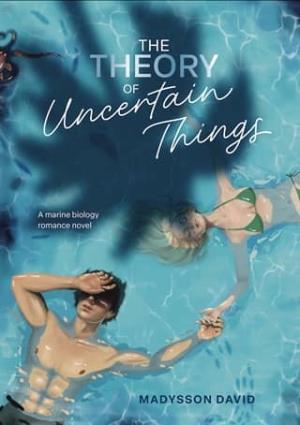
The Theory of Uncertain Things
Chapter 1
CHAPTER ONE
There are moments where your life feels like a controlled experiment. And then there are moments where the beaker explodes in your face and you realize—oh. New variables.
Recognizing that everything you’ve ever hoped and worked for just might be your demise classifies as the latter.
Theoretically, being here—in a new country, about to start at my dream school—is exactly the outcome I spent years optimizing for.
I charted the course with all the precision of a research scientist: drafting essays, collecting reference letters, refining my academic résumé like a pearl formed under pressure.
I shaped myself into a hypothesis I was sure would be accepted.
What I didn’t anticipate—what no amount of meticulous preparation could have predicted—was the moment I’d land in a place so bright, so warm, so impossibly other, that my body would forget how to regulate itself. No one warned me that ambition, when fulfilled, can feel a lot like altitude sickness.
I think part of me assumed that the second my feet hit Hawaiian soil, I’d become the fully realized, high-functioning version of myself I’d been painstakingly assembling since age twelve.
But here’s the thing: back home, I knew who I was.
Here, I’m a stranger, possibly even an imposter, with a full-ride scholarship I’m entirely too terrified to waste.
But maybe that’s what happens when your dream finally starts, and you’re not sure who you are outside of wanting it.
Because, you see, people like me—who come from little money, little opportunities, and statistically negligible odds—are taught to dream responsibly.
Aim for stability. Prioritize certainty.
Not out of cynicism, necessarily, but perhaps in the hopes that guarding your expectations would somehow guard your heart, too.
The problem, of course, is that my family significantly miscalculated how stubborn I would become.
So stubborn, in fact, that a 3% acceptance rate at my dream school has always felt more like an invitation than a deterrent.
If the door was cracked even slightly, I was going to wedge myself through it.
And so, most of my teenage years were spent reverse-engineering a future I didn’t yet have the language for.
I closed the diner my parents ran and stayed after school until the janitors gave up on trying to shoo me out.
I studied tides more religiously than most studied for finals, spent weekends memorizing Latin classifications instead of lyrics, and ran on the deeply irrational belief that sheer determination could substitute for access.
This was, understandably, to the dismay of my parents—who had long hoped I might pursue a gentler kind of ambition.
One that didn’t involve student loans, fieldwork injuries, or the possibility of being eaten by anything with a dorsal fin.
And for a while, I believed that might be enough for me, too.
That I could be satisfied living in the margins of marine science, listening to grizzled fishers grumble over burnt coffee about their tiring day.
But then came their stories about cephalopods. The octopuses that broke into lobster traps, remembered faces, solved puzzles. Creatures that soon made more sense to me than most humans did.
The more I listened, the more questions I had.
The more I questioned, the more I bargained—extra bacon at the diner in exchange for more octopus stories, a ride on someone’s boat in return for scrubbing buckets full of fish guts.
It was a messy, slightly unhinged kind of apprenticeship, but it worked.
Because when you combine an insatiable need to know why with a pathological resistance to being underestimated, what you get is… well, me.
A normal—if not mildly peculiar—girl from a foggy, salt-stung town on the Canadian East Coast, stepping off a plane in Honolulu to begin her dream Marine Biology Graduate Program at her top-choice school, on a full scholarship that still doesn’t feel entirely real.
A scholarship earned by years of nose-to-the-grindstone hustle, and also—let’s be honest—because my mentor, a brilliant woman in STEM, sent glowing recommendation letters every single week until someone in admissions blinked.
I don’t know who finally caved, but I imagine they’re still recovering from the email thread.
Surely, by now, we can all agree there is no version of this story in which I am allowed to screw this up.
Not when going back home would mean confirming that dreaming big is inadvisable.
Not when I’m this close to what I want. Not when I’ve made it this far on sheer intellectual belligerence and the unwavering support of that one, perspicacious woman.
So here I am, dragging my life in two suitcases behind me, regretting my choice of fleece-lined everything, and facing uncertainty once more. Which, as it turns out, is becoming something of a specialty.
Still, in the interest of pretending this is character development and not a slow-motion train wreck, I’ll admit there’s something almost poetic about kicking off a new chapter of life by nearly being obliterated by a rogue luggage cart and stepping in what I sincerely hope was an aggressively blended smoothie and not, say, someone’s gastrointestinal disaster.
I switch off airplane mode, and the universe immediately reminds me I am not, in fact, alone in this. Three texts from my mom. Two from my dad. One from my old mentor that simply says: Breathe.
A gentle nudge, and a fair point—oxygen is, after all, non-negotiable for continued existence.
I walk through the unfamiliar building, my tracksuit—selected hours before for the rugged Atlantic, not the tropics—clinging in all the wrong places.
Sweat is making an ambitious bid for freedom down my spine, and I hoist my curls into a messy, lopsided bun atop my head.
No one looks great in airports, right? Right?
The terminal is more concept than building.
Half open to the sky, unapologetically unfinished in places, and freely accessible to the occasional bird that, presumably, will fly straight for the vending machines.
There’s something strangely reassuring about an airport that doesn't pretend to seal you off from the outside world.
I pass a courtyard shaded by a huge, twisting tree, sunlight dappled across the walkway like someone spilled gold through a sieve.
It’s quiet, green, unfairly beautiful for an airport.
There’s a man reading on a bench, and I crane my neck just enough to try and see the cover of his book—because if someone chooses to read in public, the least you can do is find out what strikes their fancy.
At the bottom of the ramp, a small crowd clusters around cardboard signs and lined up cars. Some hold placards for hotels, others for tour groups. Only one bears my name, bold and green: Coralie Taylor.
The man holding it looks exactly like someone my mother would trust with my life.
Deep-set laugh lines, sun-softened skin, and a smile that belongs in the kind of stories people tell about good men and better days.
He greets me like he’s known me for years, offers to take my suitcases, and leads me toward a small car meant to bring me to my university, my new home.
“Welcome to Hawai?i, miss Taylor,” he says while sliding into the driver’s seat.
It’s a small mercy that he went with my last name.
Most people pronounce my first like Cora-lee, crisp and anglicized, or worse, Coral-eye—like I’m a Greek goddess or a species of invasive algae.
In reality, it’s Coh-rah-lee, the softer, rounder French version my mom whispers when she’s trying to coax me out of bed on Christmas morning, or the one my dad shouts across the harbour when I’m about to miss the last ferry.
I gave up correcting people around the time I realized the odds of finding someone who could actually roll their R’s without sounding like a malfunctioning lawnmower were… slim to none.
And just like that, we’re on the road.
The highway doesn’t impress—has a slab of concrete ever sparked joy in anyone?
But the mountains? The mountains are something else entirely. Massive, ancient, green in a way that makes you question if you’ve ever actually seen green before. They rise on my left and, as we drive, they only get taller, more implausible, like the landscape is trying to make a point.
My driver navigates the curves with the ease of someone who’s done this a thousand times.
I, meanwhile, am trying to discreetly press my face to the window, like my brain’s buffering real-time beauty and refusing to catch up.
We pass bus stops tinged green from oxidized copper, trees that cycle through white, yellow, and purple blooms, and—wait. Are those chickens?
Just… wandering around?
I don’t have time to confirm nor deny my observation before we turn onto University Avenue.
Tall marble markers stand like parentheses around the entrance, UNIVERSITY OF HAWAI‘I AT MANOA etched between them in understated black lettering.
And suddenly, I’m swallowing around the very inconvenient lump forming in my throat. Not because it’s beautiful—although it is. Not even because it’s surreal, though it’s definitely that, too.
But because I realize, with startling clarity, that this is what I’ve built my whole life around. This campus, shaded by flowering trees and cradled at the base of what might be the most impressive mountains I’ve ever seen, is no longer just a pin on a vision board.
Now, I’m here.
Still scared. Still out of my element. Still very unsure if the chickens were a hallucination.
But here, nonetheless.
One more right turn and we’re idling in front of a brown-and-beige building partially obscured by trees that look like they’ve been mid-embrace since the Velcro invention. My bags are unceremoniously deposited on the curb, and just like that, it’s real.