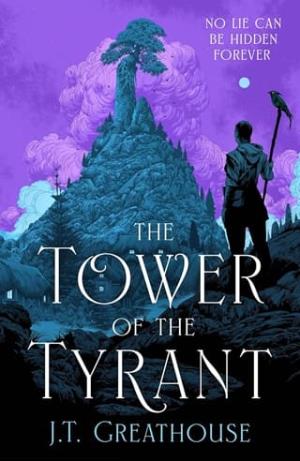
The Tower of the Tyrant
Chapter 1
The Haunting of Parwys
Madness is the natural condition of the monarch;
fear, rather, the king seeming sane.
A sapling may live on shallow roots. But for a haunting to grow into such terror as gripped Parwys, it must drink from the depths. From horrors as near the world’s foundation as it can reach.
Roots to tear up the cornerstones of a castle.
* * *
‘Your Highness.’
The touch on his shoulder, more than the voice, woke Owyn son Elbrech of the House of Abal, crown prince of Parwys, from the half-sleep that so often plagued him.
There were voices enough in the castle, by night.
Guardsmen and servants whispering in the halls.
The rumble of his father’s roars echoing down from the unfinished tower.
And on the worst nights, when sleep came most reluctantly, the low, rattling moan through the lead and glass of his chamber windows.
‘It is your father, Your Highness.’ Jon Kenn leaned across his bed.
The light of his lantern cast his eyes in deep shadow and filled the white cloud of his beard with a glow like fire.
A dull glint traced the three nested triangles etched into the pendant of raw iron that hung from his neck.
Sweat beaded in the creases of his bald pate, despite the chill of early autumn in the air.
‘You must come, and swiftly, at your mother’s insistence. ’
A wordless roar tumbled through the castle, followed by the flicker of lightning and crash of thunder. Wind and rain battered at the windows, sending rivers running between cells of coloured glass.
‘To the tower?’ Owyn murmured, swinging his legs from beneath the warm comfort of his bedding. Fear gnawed through the fog of interrupted sleep. Jon Kenn placed a white rimewolf fur about his shoulders. ‘In this weather?’
A gust of wind whistled through the gap in the windows. A keening wail, also wordless. Only the wind. Not the voices of the ghosts his father railed against and that kept them both from sleep.
‘That is precisely why we must hurry, Your Highness,’ the old scholar said. ‘Your father refuses to come down, no matter how your mother pleads. She fears he will catch ill, if he is not caught up by a gust of wind and thrown into the sea.’
‘And she thinks I will do a better job of convincing him?’ Owyn stuffed his stockinged feet into his boots and frowned up at Jon Kenn. ‘He never listened to me before he went mad. Why would he listen to me now?’
‘Let today be the day,’ Jon muttered. He might have said more, but the king’s voice boomed down, muffled and stripped of meaning by layers of timber and stone. His eyes went to the corner of the ceiling, as though to pierce through the castle and observe his master’s distress.
‘He’ll calm down,’ Owyn said. ‘He always does.’
Despite his effort to mask it, the disquiet pounding through Owyn made his voice quaver.
He felt a sudden need for Ifan, his boyhood friend, now the Count of Glascoed.
Ifan had endured much the same terror—had survived it, though it had claimed his own father.
He would make a better comfort, and a better counsellor, than Jon Kenn.
Twice more the king’s howls reached them as they traversed Castle Parwys.
The narrow passageways and unadorned brick of the old wing spilled into the audience hall, the great contribution of King Abal the Protector himself.
Each king since had added to the castle: most a turret, or a wing of bedrooms, transforming it over centuries into a sprawling display of architectural styles and tastes.
Presiding over an era of peace and prosperity, Owyn’s father had sought to make his contribution a lasting, irrefutable testament to his reign.
A great stone tower fitted with broad windows, built to loom high over the Roaring Bay, tall enough for the gaze of the king to sweep across the far reaches of the kingdom.
A door bracketed in raw iron led up the spiralling stair of the unfinished tower.
Owyn shuddered as he passed through it. In his childhood, such precautions had been unnecessary.
Until the haunting, Parwys had had little cause to guard itself against magic.
In truth, magic had been a boon to Abal’s house.
The Old Stones, the druids who wielded them, and the great weapon left by the First Folk had formed the foundation of Parwys’s safety from monsters and grasping neighbours alike.
Rainwater formed waterfalls on the stair.
Not thirty steps up, they passed the first window.
The wind had torn away one of the boards covering the unfinished glasswork.
Now it reached through the gap and whipped at the white fur around Owyn’s shoulders.
He leaned on the hardwood railing, braced his other hand against the far wall, and took each step with deliberate care, the soles of his boots slick on the wet stone.
Raised voices echoed down: his mother’s and his father’s, and that of Uli Boar-arm, the head of his father’s housecarls.
Owyn hastened his pace as much as he dared.
‘Do … not hear … Uli?’ the king roared, the wind stealing away half of his words. ‘Are … deafened? Is your mind … stone?’
‘Owyn! Take care!’ Jon Kenn’s voice chased Owyn’s quickening steps.
‘Your Majesty, there is only the wind!’ Uli’s voice rumbled. Owyn was near enough, now, to hear their speech clearly. ‘The storm grows in strength. It will pull this tower down around our heads!’
‘That it will, Uli!’ A harsh, sobbing laugh echoed down the stair. ‘And not this tower only, but all of Parwys, save the deepest, oldest roots of this castle and the Old Stones themselves.’
‘Please, Elbrech.’ Owyn heard the tears in his mother’s voice. ‘You will catch your death. Come down from there, at least out of the rain and wind.’
‘You don’t fear the storm, Medri,’ the king shouted, his anger fierce and pointed. ‘You fear what my father and his father knew, and what I know. You fear that no king of Parwys will ever lift that hammer again!’
Owyn rounded the final turn of the stairwell as lightning flashed, outlining his father, a broad-shouldered silhouette in a wind-tossed dressing gown.
The king leaned against the tread-wheel of a crane.
In the darkness the crane seemed some great, crouching beast—a monster of the First Folk’s make, come to roost on the scaffolding of the unfinished tower.
The king stared along its arm at the rainscoured city below.
‘Then I should catch my death,’ the king said softly, his voice almost lost in the wind and the crash of waves in the Roaring Bay below them.
Then, as thunder boomed, his voice rose again to a manic roar.
‘May it appease them. May it spare the kingdom. That is what they say, is it not, witch-wife? Only death can sate the undead!’
‘You don’t know that, Elbrech,’ his mother cried. ‘It is all in your mind!’
‘Father!’ Owyn cried, stepping past his mother.
She startled, then clung to his shoulder.
He eased her hand open and moved forward, leaning on the scaffolding.
With the other hand he cinched the rimewolf pelt tighter against the pull of the wind.
A downward glance revealed a glimpse of white foam exploding against sharp, jutting rocks.
He shut his eyes, tried to calm himself. ‘Please, Father, come down!’
Jon Kenn emerged from the stairwell at another flare of lightning, his cheeks puffed out behind his beard. ‘Owyn!’ the old scholar wheezed. ‘It isn’t safe!’
‘Lad, keep back from there,’ Uli warned.
The housecarl placed his bulk between Owyn and his father.
Easier to tear an oak tree out by the roots than to move Uli Boar-arm, a three-hundred-pound mountain roped with muscle.
His bristle-haired forearms were wide around as the neck of a horse.
One of those hands gently settled on Owyn.
‘Let me go to him,’ Owyn commanded, mustering all his authority, cursing the quaver in his voice.
‘Nay, lad—’
‘Uli, let him come,’ the king called down. ‘I would speak with him.’
Uli’s hand lingered a moment longer, then released Owyn. ‘You can speak from here, lad. The wind will pull you right from the—’
‘Do you hear them, son?’ The king turned from his kingdom, his eyes full of a wild brightness. ‘Turn your ear to the wind.’
At first Owyn nodded, then shook his head.
The light in his father’s eyes, the desperation in his voice, made it difficult to think.
More difficult, still, to form an answer.
A terrible sensation filled him that all the world was balanced as a coin on its edge, and any word he spoke might be the breath of air that set it tumbling on to one face or the other.
‘I don’t hear them now, Father,’ he said. ‘But some nights, yes, I hear their moaning on the wind.’
The king closed his eyes. A chuckle rolled through him.
Owyn felt a sudden longing, a wish that he had found the bravery to broach this subject with his father before.
He had brought his fears to his mother and his questions to Jon Kenn, neither of whom offered more than empty reassurances.
With his father, he only ever discussed matters of state: taxation; military manuals; lessons in governance passed from king to crown prince for generations.
There had been no time, nor any occasion, for him to share his fear of the night, nor to ask the king why he climbed his tower to rave at the wraiths that haunted him.
The former might have indicated cowardice; the latter gestured, however faintly, towards the question of his father’s sanity, and was tantamount to treason in his mouth.
Again, Owyn felt the need for Ifan—for someone who might understand his own fear, his own confusion. Who would not, in a vain attempt to protect him, stifle his every attempt to discuss the horror that had seized the kingdom.
‘That, then, is no answer.’ The king leaned his head back, letting the rain wash through his black and iron mane. ‘Can there be an answer? One that does not twist my soul out of shape? That does not demand reparations I can never give?’
Jon Kenn stepped forward. ‘Your Majesty—’
As a spark on dry leaves, the king’s anger flared anew. ‘No words from your mouth, scholar.’ He spat the last word. ‘Nothing from you.’
‘Please, Your Majesty, let us return to your study, where—’
‘I said quiet!’ the king roared.
There was a voice on the wind, in the fragment of time between the flash of lightning and the rumble of thunder. A wordless howl in a tongue Owyn did not speak. Guilt and terror stirred in him. His knees buckled.
‘Lad!’ Uli caught his arm as lightning tore apart the crane, the tread-wheel, the scaffolding. The explosion hurled Owyn backwards, wrenching his shoulder against the housecarl’s grip.
‘Elbrech!’ His mother’s voice cut through the ringing in Owyn’s ears. Shapes danced behind his eyes. Silhouettes against the bright, forking after-image of lightning. Shadowed bodies hanging in the air. Reaching hands.
There was a low, wet, throaty laugh. Owyn crawled forward, slipping free of Uli’s grasp, the last dancing shapes and flickers fading from his vision.
His father lay on the edge of the shattered scaffold.
The smouldering ruin of the crane loomed over him.
Rain washed his blood through the gaps in the wooden platform.
The rise and fall of his chest filled Owyn with a relief to match the horror of that ghostly, incomprehensible accusation in the wake of thunder.
‘Father, can you move?’ he said. ‘Try to come this way. Jon Kenn is right here, Father. He’ll see to your wounds. It will be all right.’
The king’s eyes opened, their wildness gone, their sharp fire muted—by pain, or by lucidity? Slowly, wincing, he shook his head.
‘It will not, my son,’ he said. ‘But this … This is justice, of a kind. Far, far too late, and too simple. But … I can hope—’ A cough tore through him. He wheezed, his face twisting in agony. ‘Too late. I’m sorry. I can only hope it will be enough.’
He heaved himself on to his hands and knees, the rain battering at him, his limbs shaking with pain and effort.
‘That’s it, Your Majesty,’ Uli said, leaning towards him. ‘A few paces this way, and I can pull you to safety beside the prince here, see?’
A pit opened in Owyn’s stomach. He had to say something. What word would bring his father back from the brink of madness?
Elbrech looked past him, his eyes filling with tears. ‘Goodbye, Medrith. Care for our son.’
His mother’s shriek tore the air as his father, King Elbrech of Parwys, of the House of Abal, hurled himself from the scaffold into the rain, the wind, and the crashing waves far below.