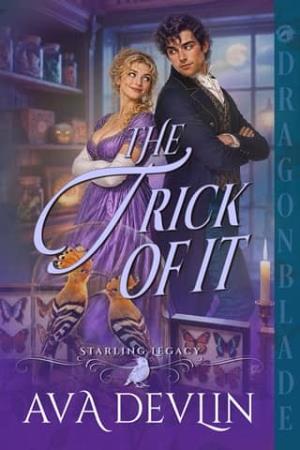
The Trick of It (The Starling Legacy #3)
Prologue
Rhys Caradoc was an only child.
He was an orphan too, of course, but that had never bothered him so much as the other thing. In his estimation, a boy ought to have siblings, and lots of them, to boot.
He did have an uncle. Sort of.
Hughes had been friends with Rhys’s late parents, before they’d been taken by the influenza. Or, at least, that was what Hughes always said. He took care of Rhys, shared his bread and his secrets, and took him along as he walked town to town, making coin where and how they could.
So, that meant it was probably true.
Why else would he want an urchin around? Why else would he teach Rhys how to pick pockets and charm strangers and steal fruit from market stands?
Hughes was his uncle.
That was just the way of things.
And perhaps that was why Hughes had had to get sick and die as well. Perhaps it was because Rhys was meant to be an only child. Only a child. Alone.
He’d stepped on a sharp stone that had cut through his boot when they’d been crossing the Severn, just off the Wales Coast Path. They’d had to take the meadow rather than the trail after the business in Chepstow, and they’d had to do it quickly if they didn’t want to get caught.
Hughes had a map. A tatty, oily map that was very good, by Rhys’s estimation. The river was where it was supposed to be. The ferry was where the map said it was.
The rock, however, was not accounted for. There were no sharp rocks on the map.
As they moved forward into England, by foot and by boat, Hughes had started to limp. His veins had turned black. His skin had gotten hot. And then, of course, he had died.
They all died, in the end.
But he’d left the map behind. The map and stories of the rich pickings and fantastical fixtures of a place called Brighton.
Rhys was only ten. He could not bury his uncle. But he did say goodbye, out loud, before he left him with the morgue at Aust.
Aust.
It sounded like lost, which Rhys was not.
He had a map.
He did notice, some nights when he’d built a fire or found a stable to sleep in, that the map also had Newport on it, back in the opposite direction. He knew he could go back to Newport. But he’d already come this far.
Hughes had to have died for something, hadn’t he?
So Rhys continued. He used what he’d learned. He avoided sharp rocks. He foraged and stole and sneaked for the final month of spring, until finally, he reached the fabled shingle beach of Brighton.
He could read. A little. He saw the sign had the right shape to it, but he asked people just to be sure.
“Is this Brighton?” he’d ask.
“Are you lost, little Welshman?” many would answer.
“Not if I’m in Brighton,” Rhys replied.
He was, though. He’d found it. And it was exactly as magical as Hughes had promised.
All along the beach were warm stones in soft shapes and the lapping of the great, big sea. People wore bright colors and laughed aloud and no matter which direction he started in of a morning, he always saw something spectacular.
One day, it was a man juggling swords. Another, it was puppet shows about kings and knights. Often, it was music. He saw fiddlers and drummers and flautists, and once, a German man in fancy suspenders, playing an instrument that looked like a fireplace bellows and sounded like angels in a choir.
The best part of these shows was that they always distracted the people watching them. People, as it happened, who often had heavy coin purses and flashy jewels and little things that they wouldn’t miss very much, should they find their way into Rhys’s pockets.
Even the children here were rich, he found.
He saw a woman, a rich lady with auburn hair and a thin, little nose, who always seemed to have several of them in tow. The rich woman had five children, he had counted: a fat boy, a slight girl, a lad with shoulders that were slightly too broad, and two brown children, a boy and a girl.
Siblings, he thought.
Lucky.
It was the boy with the brown skin who drew his eye that day, however.
He was an upright, swaggering lad, likely two years or so older than Rhys himself, and every time Rhys saw this odd family, the boy was playing with a silver watch fob, flicking it open and closed absently as he trailed to the back of their little duckling line.
He knew after a while that they appeared predictably. Church on Sundays. Market on Wednesdays. Pavilions on Fridays.
He knew that the only adult they ever had with them was the tall woman with the thin nose.
And he knew exactly when he’d be able to swipe that timepiece from the boy who carried it.
He did, for the record, swipe it. He got it clean.
But the boy noticed before Rhys could flee the churchyard, and now he had no watch. He had no map. He only had one shoe after his flight and scuffle with the thief-taker.
All he had now was bread too stale to bite into, a thin blanket, and a tiny stone room that was colder than it ought to be when it was so warm outside.
He hadn’t been hungry, really hungry, since the day he’d found Brighton. There was always good forage here, on the downs and in the meadows. There was always food to steal in the markets and under the pavilions.
He’d thought he’d finally conquered it. Hunger.
But that night, in that cell, he felt it creep back into his stomach and ache through the thin, reedy lines of his skinny arms and legs. He heard it grumble at him for being so foolish, and he curled into a knot to try to keep it quiet.
It was so much work shushing his stomach that he fell asleep. He fell dead asleep.
And only woke again to the smell of something marvelous and savory creeping in through the bars that held him in place.
He opened his eyes, wondering if smells could fill the belly, even if only a little. He wondered if the watchman would describe this thing he was smelling to Rhys, just to let him have a part in it that way.
He didn’t move.
Not until the covered dish that was emitting the smell appeared right at his bars. It was being carried by a woman. A tall woman. With a very thin nose.
“Good evening to you, young man,” she said, nodding to the watchman, who grudgingly proffered his key and opened the cell for her to step inside. “I have brought you some dinner.”
He scrambled up, his narrow back flat and bumpy against the cold stone wall. “They’re going to hang me?”
She paused, blinking twice, and then gave a short, sharp, little laugh. “God, no. But I can see how it might appear that way, now that I’ve thought about it.”
He frowned. “I stole from you.”
“You did,” she agreed, floating forward and sitting on the bench next to him. She flipped the cloth back so he could see the platter of food she’d brought. “This is my favorite fish, a salmon. Have you had one before?”
He squinted at it. “Of course,” he said. “From the Severn.”
“Oh, indeed!” she said, sounding delighted. “Did you fish in the Severn?”
Rhys pressed his lips together, narrowing his eyes at her. “I won’t confess to poaching, miss.”
The woman gave another one of her short, surprised little laughs. “No, of course not. Eat up, lad. I have a proposition for you and I think you’ll be better able to consider it on a full stomach.”
“What’s that?” he asked, already reaching toward the food. “‘Proposition’? A dessert?”
“Sometimes.” She tittered again, as though she’d told herself a very funny joke.
It smelled so very good that Rhys was a little angry with himself at how fast he ate it. He shoveled every morsel into his mouth and swallowed without even chewing very much, just to get the grumble and ache to stop. Just to get it to be quiet.
And then he frowned down at the plate, empty and smeared with fish oil, and sighed. “Did you cook that, miss?”
“No,” she said. “How was it?”
“It was good,” he told her, awkwardly extending the plate back toward her. “But would have been better with skin. Don’t let your cook take the skin away.”
She raised an auburn eyebrow. “I shall endeavor to remember that. I am Willa, by the by. What is your name?”
Rhys hugged his arms around himself and did not answer.
“I’m afraid you embarrassed poor Malcolm today when you took his timepiece,” she continued, after noting that he did not wish to speak.
“You have a good eye. It is Easterling silver, something my late husband used to carry. My boy Malcolm was using the numbers to challenge himself to sums at random. After today, I promised to get him a better one all his own.”
“But I gave it back,” Rhys pointed out, frowning. “He can keep that one.”
She shook her head, reaching into the pocket of her skirt and producing the thing, a round, glinting disc of clockwork and etching. “How did you get it from him?” she asked. “It was deep in his pocket.”
“I took it?” Rhys replied, his brows squishing together.
“Yes, I know you took it, young man, but how? Without him knowing, I mean. If I put it in my pocket just now and look away, could you do the same to me?”
He scoffed. “Of course.”
She smiled at him. A brilliant smile, a confusing smile, as she put the thing back in her skirt. “All right. I will turn around and count to twenty. If you get it without me feeling, hearing, or sensing anything, you may keep it.”
“‘Keep it’?” he said, balking. “Forever?”
“Forever,” she agreed, and then she turned her back to him and began counting aloud. “One, two, three …”
Rhys waited until the number ten. He was ten, so it followed that this was his favorite number. And when Willa turned back around, he was holding the watch in his lap, waiting politely for the end of the ruse.
“Well, now,” she said, looking pleased. “Aren’t you a talent?”
“I suppose you want it back now,” he said glumly. “I am sorry, you know.”
“No, you aren’t,” she replied with a click of her tongue. “Do you not have people, young man? Why has no one come to get you out of this place?”
“Had an uncle,” he said, shrugging. “He died.”
“Are you with the foundling home?” she asked. “Where do you stay?”
He wrinkled his brow, jutting out the hand with the silver fob so that she would take the cursed thing. “On the beach, usually. It’s warm.”
“It’s warm now,” she corrected. “It won’t be in a few months. What will you do then?”
“I don’t know,” he answered, frowning at her. “Ask me when it happens.”
She touched his outstretched hand, only enough to wrap his fingers back around the silver disc. “Would you like a room in my house, perhaps?” she asked. “With your own bed and fireplace? You can tell my cook yourself how to properly make salmon.”
He didn’t speak for a moment, hope and caution leaping and colliding in his chest. “For what?” he said. “What will I have to do?”
“Good question,” she said with a curt nod of approval. “You will have to give up thieving, I’m afraid. You will need to apologize to Malcolm. And you will have to submit to an education.”
“‘Education’?” he repeated warily. “I can read. Some.”
“Good,” she said. “Then you will have many books with which to do so.”
He licked his lips, dry and slick from the food, and clenched his teeth, looking down at the silver treasure in his hand.
“You can say no, my boy, and I will respect that,” she assured him. “You can also have that timepiece, no matter what you decide. It is yours now.”
“Rhys,” he mumbled, blinking away the hot pressure that had suddenly started to build behind his eyes. Strange, stinging heat pricked at the corners on either side of his nose. “Name’s Rhys.”
“Lovely to meet you, Rhys,” she said gently. “Do you want to come home with me?”
He looked up at her.
He knew there were tears on his cheeks.
And he nodded.
Even if this is a trick, he thought, it’s a good one. Sometimes tricks are good.
He followed the lady called ‘Willa’ out of his jail cell and up to her mansion, clutching the silver timepiece so hard that he was surprised it did not dent.
In the end, he did get a room. He did give an apology. And he was provided an education.
The tall lady with the thin nose was Willa Selwyn, the Baroness Selwyn, and she now had six ducklings when she appeared on the Brighton streets.
Rhys Caradoc was an orphan.
But he was no longer an only child.