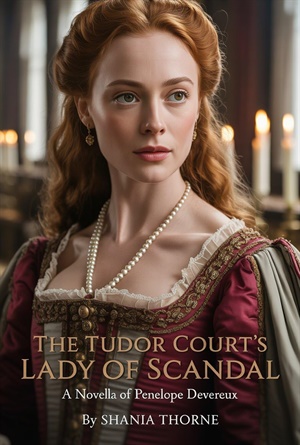
The Tudor Court’s Lady Of Scandal (Women of Tudor Scandal #2)
Chapter 1
I’ve been told that the whispers began before the priest had even finished pouring water over my head.
Lettice Knollys was nineteen years old that winter, and even swaddling a newborn against her hip did nothing to dull what men noticed about her.
My aunt told me the story of that day so many times that I came to see it as though I had watched it myself.
Murmurs rippled through the guests. Certain gazes lingered a moment too long on my mother’s face.
Even the priest’s voice rose higher than it needed to, straining to be heard over a room that was not, in truth, listening to him at all.
My father noticed nothing that day. Walter Devereux was a soldier’s son, bred for duty rather than court intrigue.
And in that hour, he thought only of his daughter and the alliance her birth represented.
He could not have known, watching her christened, that the beauty he’d married would one day set him against the most powerful man at court.
And that by then, it would already be too late to matter.
I share this scene not because I remember it, but because it set the pattern of my life before I ever spoke a word.
My mother’s face opened some doors and closed others.
It initially drew Queen Elizabeth’s favor and later, her fury.
It would shape my fate long before I understood what beauty cost a woman in that world, or how quickly the court’s admiration could curdle into judgment.
I was born a Devereux. I was the granddaughter of a family that Queen Elizabeth trusted.
I was related by blood to the Boleyns through my grandmother, Catherine Carey, daughter of Mary Boleyn.
This made my mother the great-niece of the late Anne Boleyn, Queen Elizabeth’s mother.
That connection ran through us like a current, invisible until it surged.
My mother’s resemblance to her cousin, the queen, was often remarked upon, and not always with kindness.
They were two women who might have been sisters in another life, one crowned, and one merely favored.
They orbited each other for decades, and their fortunes rose and fell in ways I would come to know all too well.
Chartley itself was no quiet country manor.
My father held ambitions that outpaced his modest fortune, and his household reflected it.
Chartley was full of ceremony and watching.
My father was away in Ireland for most of those years, but when he returned home in the winter of 1575, he came back to whispers he could not ignore.
There were rumors of the earl who allegedly sent my mother gifts in his absence.
He said little to us children, but nothing escaped notice in our house.
Not truly. Not even across the Irish Sea.
I grew up believing this was simply how families lived, until I understood that other households did not track a woman’s every glance the way ours tracked my mother’s.
My father spent very little of my childhood at Chartley.
Queen Elizabeth granted him an earldom in 1572, making him Earl of Essex.
This was an honor that came wrapped in obligation.
He sailed for Ireland soon after, tasked with subduing rebellion and establishing English rule over land that resisted every attempt at control.
I remember him mostly through the letters my mother read aloud.
He offered formal accounts of sieges and setbacks that revealed little of the man beneath the title.
Those letters grew farther apart as the years went on.
They also grew shorter, and my mother took longer each time before she read them to us, as though she were choosing which parts we were old enough to hear.
I was thirteen when the messenger arrived to tell us that Walter Devereux would not be coming home.
My father died in Dublin in September 1576, and the manner of his death spread through England faster than any account of his campaigns.
Some called it dysentery, the common curse of soldiers abroad.
Others whispered about poison and pointed toward my mother and Robert Dudley, Earl of Leicester.
Their alleged friendship had already drawn comment before my father ever boarded his ship.
I did not understand those whispers then.
I only understood that my father was gone, and that the grief in our household came laced with suspicion even before the funeral rites were finished.
Whatever truth lay behind his death, its consequences fell on all of us at once, though unevenly.
My brother Robert, not yet ten, became the new Earl of Essex the moment our father breathed his last. The title was a debt-ridden inheritance, and a future the law had already decided was his to claim regardless.
I inherited no such thing. I was fatherless and, by the law’s reckoning, I was too young to manage my own affairs.
So I became a ward of the crown, and my future was no longer my family’s to decide.
Queen Elizabeth assigned my guardianship to Henry Hastings, Earl of Huntingdon.
He was a stern and deeply pious man whose duty left little room for warmth, and none at all for indulgence.
My brother Robert became a ward too, as his title demanded.
But the crown sent him to a different household entirely, and into the keeping of Lord Burghley.
I would not see him again for years at a time.
I was sent from Chartley to the Hastings household to be raised according to a stranger’s notion of what a young noblewoman should become - away from my mother and away from everything familiar.
My sister Dorothy went with me, and if wardship diminished either of us, at least it did not do so in isolation.
I remember the packing for that journey more clearly than I remember my father’s face. I recall the careful folding of gowns I would outgrow within the year, and my mother’s hands steady on my shoulders while the rest of her was clearly anything but.
I did not resent Huntingdon. Not truly. He gave me an education sharper than most girls received.
I had tutors in languages and history. I received instruction that assumed I possessed a mind worth cultivating.
But I keenly felt the absence of choice in it.
My father’s death had rearranged my entire existence.
And I was learning, far too young, that a woman’s life belonged to whoever held authority over her - a father, a guardian, and eventually, a husband.
I had no father left. I had a guardian instead, and a mother whose reputation was about to detonate in a way that would leave the whole court talking.
It happened in 1578, two years after my father’s death.
Because I did not live with her, I heard of it the way I heard most important things in those years.
I heard secondhand, through servants who thought I could not hear, and through letters that arrived and were quickly folded away before I could read them fully.
My mother had married Robert Dudley.
She had not merely accepted his friendship.
She had not merely enjoyed his company at court functions where widows and favorites often crossed paths.
She had married him, in secret, without the queen’s knowledge or consent.
She had married him at a time when Queen Elizabeth’s jealous devotion to Dudley was already the stuff of legend throughout Europe.
Dudley had courted the queen for decades.
He was her rumored lover and, allegedly, her intended husband.
Dudley was the one man the queen trusted above all others.
And my mother, her own cousin, had taken him while Elizabeth remained unmarried and, in her own way, unclaimed.
As young as I was, I understood that this was not simply scandalous. It was a wound aimed directly at the queen’s pride, and Queen Elizabeth did not forgive wounds to her pride.
When the news reached court, more than a year after the wedding itself, the queen’s fury became the talk of every household in England.
She banished my mother from court. She refused to receive my mother and refused even to speak her name without contempt.
Dudley, whom Queen Elizabeth needed too much to punish outright, escaped with a reprimand and temporary disfavor.
My mother received no such mercy. She had committed the unforgivable offense of taking for herself what the queen had never permitted herself to claim.
And Elizabeth made certain the entire court understood the cost of that choice.
It was said that Elizabeth called my mother a she-wolf.
Some said she spat the words like poison whenever Lettice’s name arose.
I cannot swear the words were hers exactly.
I can only say that everyone at court repeated them as though they had heard her say it themselves.
It was not the last time I would hear a queen’s anger directed at a Devereux woman for daring to want something for herself.
But I could not have known that yet, standing on the edge of childhood and watching my mother’s disgrace unfold from a careful distance.
What struck me most, turning it over in my memory afterward, was how little any of this had to do with wrongdoing in any ordinary sense.
My mother had not betrayed a living husband.
She had not broken a vow to any man. Her crime, in the queen’s eyes, was daring to claim happiness the queen had denied herself for the sake of the crown.
It was not adultery. It was defiance. And it was defiance from a woman who resembled the queen closely enough to serve as an uncomfortable mirror.
I was fifteen when the full weight of my mother’s banishment settled over our family.
And I understood, the way children do when their security depends on adults they cannot control, that my future rested on ground that had shifted beneath me without warning.
My mother could no longer advocate for me at court.
She could not secure me a match. She could not whisper my name favorably into the queen’s ear, or do any of the things a well-placed mother might do to shape a daughter’s prospects.
I was a ward of Huntingdon, sister to a young earl still finding his footing, and daughter to a woman the queen had come to despise.
Whatever door might open for me in the years ahead would only open if I proved myself different from my mother.
I had to be more careful, more obedient, and more willing to accept whatever match was arranged for me without complaint.
I did not yet know how impossible that would prove to be.