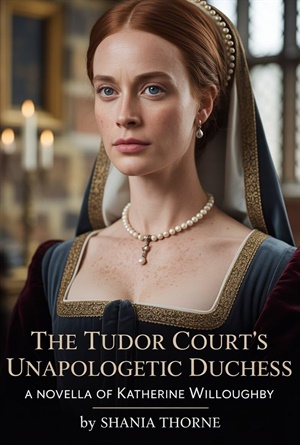
The Tudor Court's Unapologetic Duchess (Women of Tudor Scandal #3)
Chapter 1
They called me fortunate because I was born wealthy. They did not understand that a woman’s fortune was often the first thing men noticed, and the last thing they allowed her to keep.
My father was William Willoughby, eleventh Baron Willoughby de Eresby.
I remember him mostly in fragments. I recall the smell of leather and horse, a laugh that filled a room before he did, and hands too gentle for a man who spent his days managing estates that stretched across half of Lincolnshire.
I have one memory of him that I trust completely.
I was small enough that he carried me on his shoulder through the long gallery at Parham.
He stopped before a window and told me to look out at the land.
He said that one day it would answer to me and no one else.
I did not completely understand him. I asked if my mother or someone else would also own it.
He laughed and said that was a very good question, and one I would spend my life answering for myself.
At the time, I did not know that he had just handed me the entire argument of my life in a single sentence.
Not who owns the land, but who gets to decide anything at all.
My mother was María de Salinas, a Spanish noblewoman who had crossed the sea as a girl in the retinue of a young Spanish princess named Catherine who had come to marry an English prince, Arthur. When the prince died within months, she stayed to eventually marry his brother, Henry, instead.
My mother did not leave when the princess became a discarded bride in all but name for years after Prince Arthur’s death.
She did not abandon the princess when no one in England seemed to know what to do with a Spanish widow nobody had paid for.
She did not leave when her beloved Catherine finally became a queen to King Henry at last. By then, half the ladies who had crossed the sea with her had married Englishmen and had quietly stopped calling themselves Spanish at all.
My mother kept her friendship with Queen Catherine through all of it.
And the queen repaid that loyalty in the way queens repay such things.
With land, with favor, and with a wedding at Greenwich Palace so lavish that people spoke of it for years afterward.
It was paid for by the king and queen themselves, as well as the gift of Grimsthorpe Castle to mark the occasion.
My father was the wealthiest man in Lincolnshire. My mother was the queen’s dearest friend. Between the two of them, I arrived already weighted down with more history than most children are asked to carry, and I had not yet done anything at all.
Queen Catherine and my mother were bound by something thicker than duty.
I grew up understanding that friendship could survive the sea, a foreign tongue, and the cruelty of lost children.
I did not yet understand what it would cost my mother to keep that friendship when a king who had once smiled on both of them decided he no longer wanted the wife attached to it when she couldn’t produce a son.
I did not yet know that type of hardship and grief. I would learn. But as a child, I believed that the two people who had made me would always keep me safe. I believed this the way children believe such things, entirely and without supporting evidence.
I learned how wrong I was when my father died. I was seven.
Childhood grief is not a thing you understand so much as a change that happens to what is around you - the hall grows quieter, the servants move differently, and your mother’s face rearranges itself into an expression you’ve never seen and have no name for yet.
In that first year, I did not know that my father’s death made me valuable in a way that had nothing to do with me.
My father left no sons. He left me. And that meant he left me much of what he owned.
At seven years old, I became the sole heir to some thirty manors across Lincolnshire alone.
This was land that housed tenants who had never seen my face and held rents that would make men five times my age reconsider their prospects entirely.
I did not think of myself as wealthy. I thought of myself as a girl who missed her father and did not understand why the house had filled with visitors who greeted my mother with smiles that never reached their eyes.
What I did not understand then was that my father’s death had done more than pass me his land.
It had passed me into the King’s keeping.
That is the plain truth of it, however strange it sounds.
An heiress without a father belonged legally to the Crown until some man could be found to buy the right of her marriage and her wardship.
Not her land alone. Her. A girl of seven could be bought and sold on paper as easily as a manor or a flock of sheep.
No one thought this was remarkable because it was simply how the world worked.
My mother understood this the moment my father took his last breath.
I would not understand it fully for years.
But I came to realize that the truest thing about being an heiress was that the grief was mine, and the girl who felt it was not.
I did not have to wait long to see this lesson unfold. Within a year of my father’s death, my uncle, Sir Christopher Willoughby, went before the courts to say that my mother had kept him from lands that should have been his rather than mine.
I did not understand the particulars then.
The dispute dragged on for so long and grew so knotted with old grievances that clever men made careers of arguing it.
But a child does not need the law to understand betrayal.
My own kin had looked at a fatherless girl and a foreign widow and decided that we were a financial opportunity rather than a family to be protected.
My mother fought him in every court that would hear her. She did not win everything. But she did not hand me over easily either. I think that this was its own kind of inheritance. Not land. Not a title. But the plain example of a woman who intended to preserve what belonged to her daughter.
My mother did what any woman in her position would do. She fought to keep me close. She had watched a queen lose everything for want of a son. She was not about to watch her daughter get swallowed whole for want of a father.
She did not win that fight, either. Not entirely.
No one did, in that court, against the tide that decided a fatherless heiress belonged to whoever could afford her wardship.
But my mother taught me something in the loss of it.
She taught me to watch the men who smiled at me.
I learned to notice which ones spoke to my face and which ones spoke past it, toward the manors behind me.
At seven, I did not know that I would spend the next decade being purchased, reassigned, and finally claimed by a man old enough to have fathered my father.
I did not know that my greatest gifts - thirty manors, my name, and a bloodline that made kings and dukes take notice - would become the very thing that made me impossible to protect.
They called it fortune. I have come to think of it as the first debt I never agreed to owe.