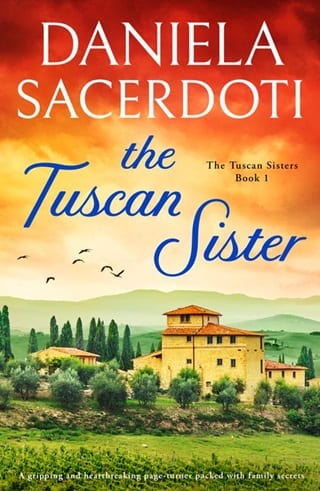
The Tuscan Sister
Prologue
PROLOGUE
LUCREZIA
In all my years of exile I dreamed of Casalta, the villa nestled in the heart of Tuscany, where vineyards and olive groves stretched on the cypress-crested hills.
Casalta had been my haven, before the terrible events that turned my sweet home into a place of fear and loneliness, before I was banished at the age of twelve, like a little Eve out of Eden.
Casalta had nourished me and protected me since I first opened my eyes to the world. Here my mother watched over me, here I shared every moment with my twin, Bianca, and my younger sisters, Eleonora and Maria.
Bianca, Nora, Mia and me, Lulu: this was us, the four Falconeri sisters, the Casalta girls, known in the village as self-contained, aloof and a little uncanny, perhaps little magical…
Our mother had passed on to us the nameless gift that runs in her family, a gift that manifests differently in different generations and different women. Mine is that I can see people’s emotions and inner thoughts as halos of colour around their bodies – some call them auras. Bianca can see and hear people long gone – memories and stories imprinted in the stones of our home. As for Nora and Mia, they were too small when I was exiled: their gifts are a mystery to me.
After my banishment, the only way I could go back to Casalta was in my daydreams, cold but indispensable comfort. I made my fantasy so vivid that I could smell each scent, taste each taste. It was more real than reality, and as warm as my mother’s hug.
In my dream, I close my eyes and walk the winding dirt road from the village up the hill, the air full of the song of cicadas and of the scent of wild fennel and oregano.
The path is lined with fig trees, elders and hazelnut trees. Every once in a while I stop to eat a fig straight from the branch, examine the shed skin of a grass snake, crumbly and translucent under my fingers, or follow a Vanessa atalanta ’s black wings fluttering among the flowers – my mother had taught me the names of our native butterflies: licena , ninfa , icaro … She loved butterflies, and they represented her perfectly, with their colours, their instinct to fly free. Their vulnerability.
I arrive on the terrace carved out of the hill almost a thousand years before, where Casalta was first built as a small stony fortress for warring peoples. Here, Bianca is waiting for me at the gate, between the two ivy-covered stone dryads that watch us from their pillars. They are like us, identical, specular images of each other. I used to pretend that they came alive at night to wander around the gardens and vineyards, and returned onto their pillars at the first light of dawn.
Bianca opens the gate for me and holds my hand as we make our way into the courtyard. We dip our fingers in the water of the fountain in the middle of it, a little ritual of ours, and slip through the kitchen door.
The kitchen was never cold, never empty. Something was always cooking on the stove or cooling on the marble slab of the table – tomato sauce for the winter, jars of jam, an enormous pot of bean stew or potatoes covered in herbs and olive oil, almond biscuits or bottles of our own wine. I follow Bianca through the living room with its open fireplace, and down the corridor lined with floor-to-ceiling windows. The corridor ended with my father’s study: but we never went in there.
In my daydream, that part of the house didn’t exist.
Instead, we open the glass door to the rose garden, and make our way to the bench where my mother used to sit and paint. Here I find Mia, sitting on that same bench with a sketchbook in hand, and Nora, playing outside in the sunshine as she always did. Both are frozen in time at seven and eight years old, like the day I last saw them, and they run to me, and hold me tight. Bianca joins our embrace and we’re one again, the four Casalta girls. The Falconeri sisters, reunited.
After a while, I climb the stone stairs that lean on the side of the house, and watch my sisters from above – sweet Bianca, headstrong Nora, dreamy Mia, a red head and two brown ones close together to contemplate a rose – and slip through the window across the last step, into Bianca’s bedroom. I twirl in the sunny garden painted on Bianca’s wall, among the pink roses that decorate the window and the doorframe. Our mother had painted each of our rooms before we were born; she knew, somehow, that she was going to have four daughters, and who we were going to be, and she reflected her vision in her frescoes.
I peep into Nora’s room, with its yellow roses and the fresco of a beach dotted with running horses, and then enter Mia’s, the most spectacular of all. White roses around the windows and the door, and the rest of the space full of galaxies, stars, comets, constellations, in a symphony of blue, black, silver and all shades of purple and pink.
Finally, I step into my childhood room.
It was unfinished, because my mother had gone into labour with me and Bianca while she was still working on it. She’d decorated the walls with red roses, but that was it. She’d told me that she would complete it in years to come, with all the wonderful things I would see and do.
But we never had those years to come, because she died on the hills around our home just before my twelfth birthday, and my room remained unfinished.
My daydream always stopped there, when emotion overwhelmed me and I knew it was time to raise my inner walls again, against the memories, against the longing, against the anger. It was at that point that in my mind’s eye, I’d fly out of Casalta, the childhood home I’d been exiled from too fast, too suddenly, to even have the time to say goodbye.