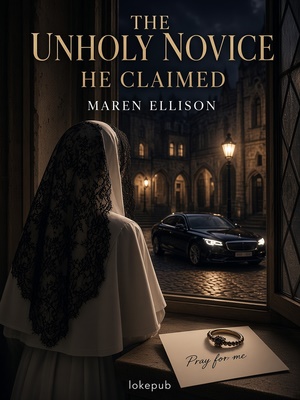
The Unholy Novice He Claimed
THE CHOIR LOFT
POV: RONAN
A thin white line under the edge of her postulant’s veil. It’s the only thing in this church I came to look at.
Not the altar. Not the Advent wreath with its first purple candle lit. Not the eleven old women mumbling vespers below me the way they’ve mumbled it since Truman.
Her.
Magdalene Holloway kneels in the third pew, left side, the way she has every evening for two years. Hands folded. Lips moving. Shoulders too thin under a gray cardigan she darns at the right elbow every Sunday night.
I know about the elbow.
I know everything.
I pay for the heat in this church. I pay for the roof over the nave and the new boiler in the basement and the bed she sleeps on, three floors up, behind a window that faces Adams Street.
Two years ago her father tried to sell her to the Kavanaghs for a hundred and eighty thousand dollars and a bottle of Jameson.
I bought the debt instead. I put her here.
I told the Reverend Mother which cell to give her.
I told myself watching would be enough.
It was a lie. I’ve known it for months.
Below me, the last Magnificat dies against the plaster. The old women creak to their feet. Mae stays kneeling one breath longer than the rest, the way she always does, like she’s waiting for someone to tell her she’s allowed to go.
Then the sacristy door opens.
“Magdalene. A moment, please.”
Monsignor Albright. Diocesan auditor. Sixty, soft in the middle, silver hair combed wet over pink scalp. He smiles at her the way men smile at things on a menu.
She rises. Smooths her skirt. Follows him in.
He doesn’t close the door all the way. Men like him never do. They like the risk.
I move along the loft rail until I’m above the gap. The wood doesn’t creak. I had it replaced in September.
“Your father came to see me,” Albright says.
Her breath catches. I hear it from twenty feet up.
“I’m sorry, Monsignor. He shouldn’t have bothered you.”
“He’s in a great deal of trouble, child. With very serious people.” His hand comes up. He tucks a loose strand of her hair under the veil and lets his knuckle trail down her jaw. “But debts can be forgiven. With the right counsel.”
“I don’t have any money.”
“I didn’t ask for money.” His voice drops. “Tuesday nights. My office. We’ll work through it together. Just you and me.”
She doesn’t answer.
She doesn’t step back, either. She’s been trained her whole life not to step back from men with power. Her father started the training. The Church finished it.
“God bless you, Monsignor,” she whispers.
“And you, Magdalene.”
He lets her go. She walks out of the sacristy with her head down and doesn’t see me.
They never see me.
I take my mother’s rosary out of my coat pocket. Onyx beads, worn smooth. I push the first one along the cord with my thumb.
One.
Albright whistles on his way to his car.
Let him whistle. Let him have one more night of thinking Tuesday belongs to him.
***
At three in the morning, St. Agnes sounds like an old ship. Pipes knocking. Wind worrying the slate. Sister Bernadette snoring through two walls.
I let myself into the east wing with a key the Reverend Mother pretends not to know I have. Back stairs. Third floor. Fourth door.
It isn’t locked. It never is. The bolt sticks in wet weather, and in two years she has never once asked anyone to fix it.
Her cell is eight feet by ten. Iron bed. Wooden crucifix. A chair with her folded habit on it for morning. A shelf with three books and a jar of drugstore hand cream she rations like gold.
And the window.
The blind is up.
Streetlight pours across her bed, orange and cold. She sleeps on her side facing the glass, one hand under her cheek, dark hair loose on the pillow. Without the veil she looks younger. She isn’t. Twenty-two last August. I sent a cake to the kitchen with no name on it. She got the corner piece.
I stand at the foot of her bed and breathe her in.
Starch. Cheap soap. Vanilla. Her.
Her breviary lies on the chair, cracked spine up. I know what’s tucked between Compline and the Psalms. I’ve read it every week since October.
I open it.
The newest line is in pencil, pressed so hard it scored the page.
If it’s you, come closer.
For a long moment the only sound in the room is the pipe knocking behind the wall.
There’s a pencil stub tucked into the spine. Hers. Chewed at the end.
I take it out. Under her line, pressing as hard as she did, I write one word.
Soon.
I put the pencil back. I close the book. I put it back exactly the way I found it, spine up, one corner hanging over the edge of the chair.
Then I do what she asked.
I come closer.
I crouch beside the bed. Her lashes are dark against her cheek. There’s a crease between her brows, like she’s arguing with someone in her sleep. I take off my glove, one finger at a time, and I touch her hair.
Only her hair. It’s softer than I imagined.
I imagined a lot.
She sighs. “Please,” she murmurs.
She doesn’t wake. She turns her face a fraction toward my hand, the way a plant turns toward a window.
Something in my chest locks.
I set the box on her pillow, an inch from her mouth. Black. Square. Ribbon the color of dried blood. Inside, a veil of black lace, a gold ring shaped like a rosary with my initial where the cross should hang, and a card in my handwriting.
Three words.
Then I kneel at her door with the driver from my coat and take the old bolt off. The pipes cover the sound. In its place I fit heavy brass that turns only from inside. No keyhole. No handle on the hall side. Nobody opens it now unless she lets them in.
Not even me.
I stand. Pull the glove back on. Look at her one more time with the streetlight on her throat.
Tonight a man touched her face and asked her to come to his office on Tuesday.
He won’t live to see Tuesday.
And she won’t spend many more nights in this cell.
“Enjoy your last night as His bride, dove,” I whisper.
“Tomorrow, you’re mine.”