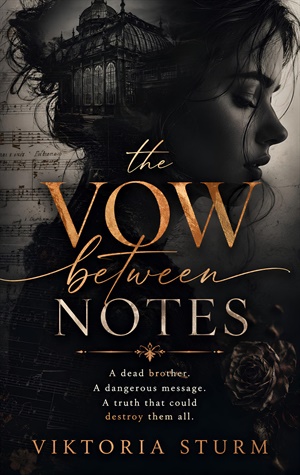
The Vow Between Notes
CHAPTER 1
ELISE
The message arrives while I am listening for a fault in the room.
At seven in the morning, Arden Conservatory has not yet learned to disguise itself as busy.
The main hall is empty, the lobby lights are only half awake, and the heating pipes carry a soft, irregular knock behind the walls.
I sit at the Steinway with my coat folded over the front row and my right hand resting above middle C.
The sound that troubles me is not in the piano.
It is in the air.
A faint metallic vibration follows the ventilation cycle, too small for most people to notice and too regular to be accidental. I tilt my head, wait through the next pulse, and hear it again near the stage-left service wall. Then my phone lights beside the score.
UNKNOWN NUMBER.
One audio file. I should call security before opening it.
That is the sensible response, and sensible responses have surrounded me since my brother died.
Sensible people lowered their voices, adjusted my schedule, and made decisions in rooms I entered only after the decision had become fact. I press play. Static breathes once.
Then Theo says, “Lissie. Don’t let them sell it. And don’t trust the man who says he came to protect you.” My hand drops to the keys. The chord that answers is ugly and loud.
For seven years, Theo has been dead. His voice survives in interviews, birthday videos, donor speeches, and one voicemail I have never deleted because in it he is irritated about a parking ticket and therefore still ordinary. I know every version. This is his voice. And it is wrong.
The name gives it away first. Lissie was public when Theo wanted an audience to understand we were close.
In private, he softened the first consonant until the name almost began with breath.
Here it is bright and shaped, the version he used under lights.
But the words after it are lower, tired in a way the public recordings never were.
I play the file again. Don’t let them sell it.
The board meeting at noon will consider the offer for the west property and the great hall.
Simon Creel calls it restructuring. Malcolm calls it preserving the institution.
I call it selling the part of the conservatory that makes the rest worth saving.
The last line plays. Don’t trust the man who says he came to protect you.
The service door behind the stage opens.
I turn too quickly. Pain pulls through my shoulder.
No one enters. The door settles against its frame.
I rise from the bench and walk toward it, phone in my left hand.
The metal vibration I heard earlier returns beneath the floor.
The stage has always carried sound strangely.
Theo used to say old buildings remembered footsteps because architects were sentimental.
I reach the service door. Locked. When I turn back, the piano looks unchanged.
Black case. Open score. Bench slightly left of center because I moved it myself.
The conservatory technician inspected the action last night after I complained about resistance in the upper register.
I watched him replace the front panel. Nothing should have changed since.
Yet one key near the center sits a fraction higher than the others. I return slowly.
The phone remains in my left hand, recording now because I do not know whether the threat is in the message or the room.
I lower myself onto the bench and hover my right index finger above the raised key.
A careful touch. Resistance. Not felt from the action beneath.
Something rigid presses upward against the key bed.
I should stop. Instead, I use the edge of a pencil to depress the key.
A strip of metal snaps upward. It cuts across the base of my right thumb before I can move. Pain arrives white and clean. Blood follows, spreading over the ivory and into the seam beside the key. I stand so fast the bench falls behind me.
The strip is thin, sharpened, fixed inside the mechanism like a crude blade. Had my hand been placed for the opening chord, the movement might have driven deeper through the palm. My phone slides from my left hand and strikes the floor. The hall doors open. Two men enter.
The first is broad-shouldered and dark-haired, moving with the speed of someone who has already decided the room contains danger.
The second remains half a step behind and checks the balcony, side doors, and rear aisle before looking at me.
The first man sees the blood. His attention narrows to the wound; every other response leaves his face.
“Elise Arden?”
“You know who I am.”
“Yes.”
He is tall enough that the stage makes him seem taller, nearly filling the distance between the front row and the piano. Short dark-brown hair, amber-brown eyes, a pale scar beneath the left side of his jaw. His coat is open, but he does not reach inside it. The second man closes the hall doors.
“I’m Jonah Velez,” he says. “Keir Security.”
The first man does not introduce himself. I press my left palm over the cut. Blood escapes between my fingers.
“Do not touch the piano,” I say.
Neither man does. The first approaches only until I lift my chin.
“May I look at your hand?”
“No.”
He stops. The obedience is immediate enough to confuse me. Jonah takes out his phone and calls for medical support and police. His voice remains warm even while the information is precise. The first man removes a folded white cloth from his coat pocket and holds it out.
“You are losing more blood than you need to.”
“I can see that.”
“Take this.”
I do. The cloth is clean and expensive and becomes red almost immediately. He looks at the open phone on the floor. The audio file has restarted after impact. Theo’s voice fills the hall again.
“Lissie. Don’t let them sell it.”
Recognition—not surprise—tightens his mouth. Not surprise. Recognition. I pick up the phone before he can.
“You know that voice.”
“Yes.”
“Who are you?”
“Nolan Keir.”
The name belongs to reports I have seen at the edge of board packets, security contracts Malcolm signed without discussion, and a private firm that appears whenever wealthy people want risk removed without public inconvenience. The message continues.
“And don’t trust the man who says he came to protect you.”
Nolan looks at the blood on my hand, then at the phone.
His right thumb touches the edge of his watch.
“You weren’t supposed to hear his voice again,” he says.