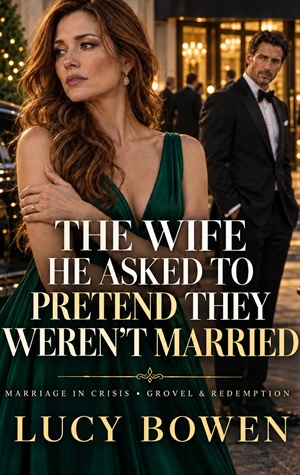
The Wife He Asked to Pretend They Weren't Married (Marriage in Crisis, Grovel & Redemption #24)
Chapter 1
CHAPTER ONE
ROSALIE
I had spent the better part of that afternoon at the Bellweather Theatre with Daniel, reviewing preliminary access permits, and had come home energized in the specific way good work always left me, hands still faintly smelling of the plaster dust that seemed to work its way into everything no matter how carefully I washed up afterward.
I'd planned the evening around that energy, a real dinner, the good wine we'd been saving, a chance to tell Yates about the permits over something other than a hurried five minutes before one of us fell asleep.
I had the chicken back in the oven for the second time when I heard Yates's car in the driveway, and I made myself stop checking the clock on the microwave.
Eight o'clock had come and gone an hour and forty minutes ago.
I'd turned the oven down to warm rather than admit that to myself in any more concrete way, but the roasted vegetables had gone soft and a little gray at the edges, and no amount of foil was going to save them now.
I heard his key in the door, then his voice, low, still finishing a call. "Tell Marcus I want the environmental assessments by Thursday, not Friday. Voss's people will ask for them the minute we sit down." A pause. "Good. Thanks, Priya."
He came into the kitchen unbuttoning his coat with one hand, phone still pressed to his ear with the other, and mouthed sorry at me over it, the same apologetic wince he'd been giving me for the better part of eleven years, since long before he was the kind of man who took calls at ten at night about acquisitions worth more than either of our families had ever seen in a generation.
I turned off the oven and set two plates on the counter instead of the table, because it seemed pointless now to pretend the evening I'd planned was the evening we were having.
"Rosie." He ended the call and dropped his phone on the counter, then crossed the kitchen and kissed me, one hand sliding warm along my jaw the way it always did, like he was trying to communicate through touch what he didn't have time to say in words.
He tasted like the mint he kept in his car console.
"I am so sorry. The call ran long, and then Graham wanted to walk through the Voss numbers again before tomorrow, and I lost track. "
"I made dinner two hours ago," I said, not unkindly, just stating the geography of the evening so he'd understand where we stood.
"I know. I know, and I feel terrible." He reached into his coat pocket and produced a small velvet box, the kind that made my stomach do a complicated thing that wasn't quite pleasure and wasn't quite dread. "I saw this in the hotel gift shop in Geneva and thought of you."
Inside was a pair of earrings, sapphire, understated in the way he knew I liked, clearly not selected by an assistant.
He did have good taste. He always had. It was one of the things that made the pattern so hard to name, because if he didn't care, he wouldn't have picked out something so exactly right for me.
He would have let someone else do it, the way other husbands in his position did.
"They're beautiful," I said, and also felt the small, familiar ache of knowing that a gift had once again arrived in place of the evening it was meant to apologize for.
"You're beautiful." He said it easily, the way he said most things, certain of his own sincerity. "What smells like it used to be dinner?"
"Chicken. It was chicken two hours ago. Now it's an educational experience in patience."
He laughed, and some of the tension I'd been carrying since eight o'clock loosened, because that was the other half of the pattern too.
He was warm, and funny when he wasn't distracted, and when he looked at me like that, like I was the only interesting thing in a room full of people who wanted something from him, it was easy to remember why eleven years hadn't felt like a sentence.
We ate at the counter instead of the table, his tie loosened, my reading glasses pushed up into my hair because I'd been reviewing structural drawings before he got home.
I told him about the studio's meeting with the city zoning office, about a contractor who'd tried to lowball a materials estimate on a job in Georgetown, small things, the texture of a normal life.
He listened, or seemed to, in the way he had of nodding at exactly the right intervals while his mind ran three other calculations at once.
I'd learned to read the difference between his present attention and his performance of it, mostly.
"I have to talk to you about something," he said, once the plates were empty and he'd poured us each a small glass of the wine we'd been saving for an occasion that had apparently arrived without an invitation. "Business, not fun, so brace yourself."
"When has that ever stopped you before."
He smiled, but it didn't quite reach the rest of his face, and I set my glass down.
"The Voss acquisition is entering its final stretch," he said. "Eleanor's board wants to close within the next three months, which means the next three months are going to be the most visible I've ever been. Press, investor events, the whole circus."
"Okay."
"Graham and Simone did an analysis of the coverage.
" He said it the way he said everything related to strategy, evenly, like he was presenting a slide deck rather than asking his wife for something.
"Apparently a significant part of Hargrove Collection's brand value, the actual dollar-figure kind, is built on this image of me as, and I'm quoting Graham here, an eligible bachelor who represents freedom and exclusivity. "
"You're not a bachelor," I said. "You're extremely married. I was there. I believe I signed something."
"I know that. You know that." He reached across the counter and took my hand, thumb moving over my knuckles in the gesture that had once made me feel cherished and now, faced with whatever was coming next, made me brace instead.
"But we've never corrected the assumption publicly, because it's never mattered before.
Now it apparently matters a great deal to a due diligence team that's trying to model brand valuation for the next decade. "
"So correct it."
"That's the thing." He exhaled. "They're asking me to let the ambiguity stand for the length of the campaign. Nobody will call me unmarried, and I'll tell the truth if a reporter asks directly. Keep our marriage private the way we always have. Just, more deliberately, for the next three months."
I studied him for a moment, trying to find the full extent of what he was asking underneath the careful corporate language. "What does more deliberately mean, Yates?"
"It means staying out of the company events. The galas, the press dinners, the launch for the Voss integration announcement. Things where photographers are guaranteed to be present."
"You want me to disappear."
"I want you to keep doing exactly what you've been doing for years.
" His voice stayed calm, reasonable, the voice he probably used on nervous investors.
"You've never loved the spotlight. You've always preferred staying out of the company's public life.
I'm not asking you to become someone you're not.
I'm asking you to let that continue for twelve more weeks, until the ink is dry, and then none of it matters again. "
"Twelve weeks," I repeated, testing the number's weight in my mouth. "You keep saying that like it's a small thing. Twelve weeks of pretending my own marriage doesn't exist isn't a small thing, Yates, even if you've decided to file it under public relations."
"I know it isn't small," he said, and something in his voice softened, enough that I could almost believe he meant it. "I wouldn't ask if I didn't think we could get through it without it costing us anything real."
There was truth in what he was saying, which was what made it so hard to simply refuse.
I had never wanted to be photographed on his arm at every ribbon-cutting.
I liked my work, I liked my own name attached to my own projects, and I'd never resented the fact that Hargrove Collection's story had become, in the public eye, his.
But there was a difference between selecting quiet and being asked to vanish on command, and I could feel that difference sitting in my chest like something swallowed wrong.
I thought about the early days of my own studio, the small commissions I'd taken on the side even while helping build his company, restoring a crumbling porch for an elderly widow two streets over, consulting on window replacements for a church that couldn't afford a full architect.
Those jobs had never made the papers, had never needed to, because they were mine in a way that didn't depend on anyone else's validation to feel complete.
I wondered, sitting across from him now, whether that was the real difference between us, that he'd built something that needed an audience to feel real, while I'd built something that only needed to be true.
"Privacy and pretending you're unmarried aren't the same thing," I said. "You know that, right? You're not asking me to keep doing what I've always done. You're asking me to actively help you look unattached."
"No one's going to say I'm unattached."
"Someone doesn't have to say it if you let everyone assume it."
He was quiet for a second, and I watched him select his next words with the same care he'd select a phrase for a press release.
"Rosie. Three months. Then this stops mattering forever, and Hargrove Collection becomes what we always wanted it to be, together, from the very beginning.
You helped build the foundation of all of this.
Doesn't it feel worth twelve weeks to see it land? "