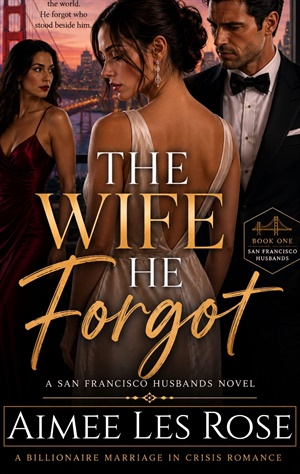
The Wife He Forgot (The San Francisco Husbands Marriage In Crisis Romance #1)
Chapter 1
Viv
“Life is seriously perfect or is it?”
If I stood on tiptoe at the corner window of our Pacific Heights house, I could see the roof garden of the beautiful Sutro Tower winking over Twin Peaks, bright and distant as a sunbeam slicing through fog.
I measured the day’s progress by the way the city lit up: honey over glass in the late afternoon, then blue, then pure electricity once the street lamps ignited.
It made a person want to invent metaphors.
It made a person want to matter. I suppose that’s why I spent ninety minutes arranging my hair, then another forty-five perfecting the line of my eyeliner, as if contour and persistence could will someone’s gaze to land and linger.
But tonight, I was invisible.
“Vivi, have you seen my cufflinks?” Adrian’s voice carried up the staircase, not urgent but expectant—the cadence of a man unaccustomed to waiting for anything, least of all answers from his wife.
“They’re on the tray by the espresso machine,” I called back, stifling the urge to remind him that this is where I always set them, every evening, after the cleaners left.
Tonight the tray was especially well-appointed, flanked by a trio of Nespresso capsules and a single-stemmed gardenia, which Adrian would not notice or comment on.
He hadn’t remarked on the new marble backsplash in the kitchen either, which had been replaced while he was in Tokyo last month.
Downstairs, I heard his footsteps cross the floor: deliberate, even.
There was something about the way he moved—like a man walking into a boardroom he’d already decided to acquire.
Adrian’s parents sent him to the kind of prep school that believed personal charisma could be taught if you paired the right Latin phrases with early-morning cold plunges, but I think he came out of the womb ready to charm a roomful of strangers and render his wife invisible.
Not out of malice, never that, just an innate confidence that everyone would orbit him, and why wouldn’t they? He had a way of making any meeting—social, business, or marital—feel like it existed solely for the pleasure of his company.
I fastened the necklace at the nape of my neck and adjusted my dress in the gilt-framed mirror, letting my eyes linger over the fabric.
Pale gold silk organza, layered with enough structure to smooth but not constrict.
I’d sketched it myself, years ago, before I let my own aspirations get folded and shelved behind his.
The original was meant for a model, not a wife, and certainly not for this anniversary event. But I wore it anyway.
“Five minutes,” Adrian called, his tone half warning, half playful.
“Five minutes,” I echoed, and applied one last coat of lipstick.
By the time I came downstairs, he was already speaking into a Bluetooth earpiece, scrolling something on his phone while fastening the cuffs.
He wore a black Tom Ford tuxedo, the jacket tailored so precisely it made the rest of the men in our circle look like they’d raided a department store sale.
There was a cut on his jaw, probably from the hastily wielded razor he used between Zoom calls, and a little sun-creased line at the corner of his left eye.
It was a face that had lately appeared on the cover of every local business magazine, not because Adrian Laurent was the city’s richest man, but because he was the best-looking one who also happened to be brilliant, scandal-proof, and—until a few years ago—intensely private.
I paused at the threshold of the kitchen and waited for him to finish the call, something I’d perfected over fourteen years. Not hovering, just present. A glass of sparkling water in hand, one sandal crossed neatly over the other. The way a hostess at a three-star restaurant might stand.
“Vivienne, you’re glowing,” he said as soon as he pressed the button to end the call. He set his phone down and crossed the room in two strides, pausing to admire me the way a patron admires a painting in a gallery he already owns. “Is that a new dress?”
“You could say that,” I replied beaming.
He leaned down to kiss my cheek, just above the jawline. His lips were warm, cologne-tinged, precise. “Perfect. What time did the car say it’s coming?”
“Six-fifteen. I put your speech in the folder by the door.”
Adrian nodded, satisfied, and reached for the glass of water. He sipped, then set it down without comment, and began reading an email on his phone.
“Did you remember to RSVP for the TechBridge luncheon next Thursday?” he asked without looking up.
“Yes,” I said, because I had. I also remembered that his assistant, Savannah, had reminded me by email at least twice, with a calendar link attached and a polite bullet list of the event’s expected outcomes.
Lately it felt as if Savannah knew more about my husband’s day-to-day existence than I did, and maybe that was the point.
The silence stretched between us, companionable but laced with something else—a static I was only just learning to name.
He looked up at me and smiled, something genuine flickering in his eyes. “You look beautiful, Vivienne. I mean it.”
This should have landed differently. Maybe it did, once. But tonight, I couldn’t help but note that he didn’t recognize his wife in her own creation.
“You look beautiful, too,” I replied, and we left it at that.
The Laurent Technologies anniversary gala was being held at the De Young Museum, which meant a predictably inconvenient amount of parking, a garden-level tent that threatened to blow away in the city’s evening wind, and a guest list that required three check-ins and a body scan.
There was a velvet rope for the first batch of arriving celebrities, which included two former mayors, a Nobel laureate, and someone who’d once guest-judged a cooking competition on TV.
Inside, the main gallery was already filling with men in charcoal suits and women in sculptural cocktail dresses, all of them clutching stemware and mouthing greetings to people they’d already seen three times this week.
Our luxurious Maybach rolled up to the curb and immediately, a red-jacketed attendant opened Adrian’s door.
He stepped out and pulled me gently behind him, as if he were my usher and not my husband.
A photographer snapped our photo, catching Adrian’s hand curved protectively around my waist, and his perfect hairline, and the way my gown shimmered gold even in the last, sullen hour of daylight.
Inside, there were more flashes, more hands to shake.
The reception line for Adrian was longer than the one for the mayor, and by the time we’d made it halfway to the bar, three different people had congratulated me on my “fairytale” life, as if there was no possible story where I’d written the ending myself.
I smiled and demurred, repeating lines I’d rehearsed so often they had muscle memory.
“Yes, it’s such a pleasure to be back in the city.”
“We’re very proud of the new project in Dog patch.”
“It’s been quite a journey, yes.”
I accepted a champagne flute, and then we moved through the gallery, greeting board members, venture capitalists, and a few legendary programmers who looked as if they’d rather be at home in their pajamas.
There were a few familiar faces from my own past—fashion school, a short-lived internship at an arts foundation—but in this context, everyone seemed slightly out of focus, as if I were looking at them through tinted glass.
Adrian never let go of my hand for longer than necessary.
He had mastered the art of including me in every conversation, even if my contributions were limited to a small, strategic laugh or a well-timed anecdote about the weather in Palo Alto.
Occasionally, someone would ask about my own work—always a little tentatively, as if they were surprised I had any.
I explained that I’d taken time off to help with our daughters (plural, though there were no children in the house anymore), and that I sometimes still sketched, but mostly I was enjoying the freedom to travel.
Travel, I’d learned, was what people with expensive marriages said when they didn’t want to talk about themselves.
Adrian excused himself to speak with the museum director, and I found myself standing alone in the center of a room filled with people who were all, in some sense, auditioning for the role of next billionaire.
I glanced at the exhibit on the far wall—contemporary sculptures rendered in black resin, hard and glossy and a little menacing.
They reminded me of something I couldn’t name, but the feeling stuck.
A waiter passed by, and I traded my empty flute for a fresh one.
The glass was cold in my hand, leaving condensation on my fingertips.
I watched Adrian work the room, his profile sharp and handsome against the white gallery walls.
He laughed at the right intervals, clapped the mayor on the shoulder, gave a generous, humble wave when someone praised his “visionary” leadership.
Everyone loved Adrian Laurent, and I’d long ago decided that this was both his greatest asset and the secret reason for every fight we’d ever had.
A tap on my shoulder startled me. I winced and turned to see a woman, maybe early forties, with silver-streaked hair and a navy dress so simple it had to be custom. She wore a single, oversized ring on her right hand.
“Vivienne Laurent?” she asked, her voice precise.
“Yes?” I replied.
“I just wanted to say how much I loved your collection, the year before you—” She paused, uncertain whether to say “disappeared,” or “got married,” or “became a philanthropist’s wife.” I could tell she was trying to remember the last time she saw me in the news, and what context it was in.
“Thank you,” I said. I didn’t correct her. I’d learned to absorb compliments like this: take them in, set them aside.
She smiled, but it looked a little sad. “Will you ever come back to design?”