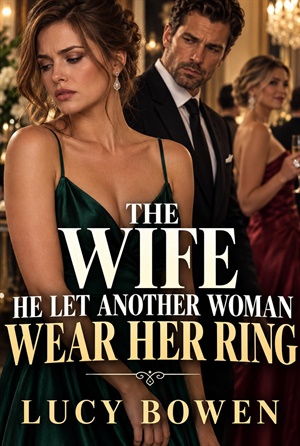
THE WIFE HE LET ANOTHER WOMAN WEAR HER RING (Marriage in Crisis, Grovel & Redemption #28)
Chapter ONE
VICTORIA
The prong had been loose for three weeks before I said anything about it.
I noticed it on a Tuesday, turning the ring on my finger the way I did without thinking while I waited for coffee to brew, and felt the diamond shift under my thumb.
Just a fraction. Enough that when I held my hand up to the kitchen window, I could see the setting had opened at one corner, the metal no longer flush against the stone.
I didn't panic. My grandmother's diamond had survived sixty years in her own ring before Trevor had a jeweler pull it free and set it into mine, and it had survived eleven years in this one. It wasn't going anywhere in the time it took me to mention it to my husband.
I mentioned it at dinner that Friday, mostly because Trevor asked why I kept touching my ring.
"The prong's loose," I said. "I need to get it looked at."
He reached across the table and took my hand, tilting it toward the candlelight the way he still did sometimes, like the ring deserved its own moment even after all these years. "I'll take it in Monday. Foster's still doing our repairs?"
"Foster's still doing our repairs." Foster had made the ring in the first place, back when Trevor came to him with a rough sketch and my grandmother's diamond wrapped in tissue paper, asking him to build something worthy of both. Foster knew the stone's history better than most of my own family did.
"Good. I have a lunch near there Monday anyway." Trevor turned my hand over, pressed his mouth to my knuckles, the kind of small automatic tenderness that had stopped registering as remarkable years ago and had only become more solid for it. "I'll drop it off, pick it up, done by dinner."
That was Trevor, always solving things. He'd solved things since the day I met him, back when I was twenty-six and overwhelmed by a wedding my mother wanted bigger than we could afford, and he'd quietly handled three vendors without telling me until it was done.
I used to find that unsettling, a little, the way he moved through problems without asking whether I wanted him to.
Somewhere in the last decade I'd stopped finding it unsettling and started finding it restful.
He solved things so I didn't have to hold every thread of our life at once.
I didn't think of that as a trade. I don't think either of us did.
Sunday night, before I went to bed, I found myself standing at the bathroom sink turning the ring in the light, the way you look at something harder right before you're about to be without it for a while.
The diamond had been my grandmother's for most of her adult life.
She wore it on a thin gold band that had worn down to almost nothing by the time she died, and when Trevor asked what I wanted to include in my own ring, I didn't have to think about it.
I brought him the stone in an old velvet pouch and told him what it meant, and he built the rest of the ring around it like the diamond had always been the point and everything else was frame.
I don't remember if I ever told him how much that mattered to me, precisely, in so many words.
I think I assumed he knew. I think I assumed a lot of things got understood between us without needing to be said, because we'd been together long enough that saying things out loud sometimes felt redundant.
"You're doing the thing," Trevor said from the doorway, watching me turn the ring under the light.
"What thing?"
"The thing where you look like you're saying goodbye to it instead of sending it to Foster for two days."
I laughed, a little embarrassed. "It's silly."
"It's not silly." He came and stood behind me, meeting my eyes in the mirror, his hands settling on my shoulders. "But you know I'll take care of it."
"I know."
"You don't sound like you know."
"I know," I said again, and meant it more the second time. "I just don't love not having it on my hand."
"Two days." He kissed the top of my head. "You'll survive."
I did know he'd take care of it. That wasn't in question.
If someone had asked me that night to list every person on earth I trusted with something irreplaceable, Trevor's name would have been first, less from having weighed the others than from the simple fact that there wasn't really a competition.
Fourteen years of marriage does that. It stops feeling like trust you extend and starts feeling like ground you stand on.
I worked the ring off my finger the next morning at the kitchen counter, watching Trevor knot his tie in the hallway mirror, and held it out to him without ceremony because ceremony would have made it strange.
He closed his hand around it and slid it into the small pocket inside his jacket, the one he used for cufflinks and the emergency twenty he kept for tolls. "Foster on the way to the Kessler meeting. Pick it up on my way back. You won't even have time to miss it."
"You say that like I'm dramatic about my own wedding ring."
"You are, a little." He said it fondly, the way you tease someone about something you actually love in them. "You trust me, don't you?"
"Of course I trust you."
"Then it's fine." He kissed me quickly, already reaching for his coffee, already halfway into the day ahead of him. "I'll text you when it's done."
I watched him leave from the kitchen window, the way I had most mornings for years, his car pulling out of the driveway with the particular economy of motion Trevor brought to everything, no wasted movement, no wasted time.
I looked down at my bare hand on the counter and felt the absence of the ring more than I expected to, a small blank patch of skin slightly paler than the rest, the ghost of fourteen years sitting right there where the metal used to be.
It was strange, the things a marriage teaches you to carry lightly.
I'd stopped remarking on the way Trevor rearranged our vacation dates around his quarterly earnings calls, stopped mentioning it when he accepted invitations on our behalf before checking with me first,
stopped keeping a private tally of the small accommodations that made up an ordinary week of being married to a man whose calendar ran the both of us.
None of it had ever felt like sacrifice while I was doing it.
It felt like marriage. Two people build a life, and someone ends up holding more of the flexible pieces than the other, and I had simply always been the one with more give in me.
I called Talia around eleven, mostly to complain, mostly for the pleasure of complaining about something small enough not to matter.
"I feel naked," I told her, holding my bare hand up even though she couldn't see it. "Is that dramatic?"
"Extremely dramatic," Talia said, and I could hear her smiling through the phone. "You've been married fourteen years and you're acting like he took your kidney."
"It has my grandmother's diamond in it, Tal."
"I know what it has in it. I was at your wedding when he explained the whole thing to your mother and made her cry." A pause, the sound of her shifting something on her end, probably a stack of contracts she was pretending to review while we talked. "He's had it, what, six hours?"
"He's getting it fixed. The prong was loose."
"So he's fixing the thing that would've made you lose the diamond eventually anyway. You should be thanking him, not moping around your kitchen."
"I'm not moping."
"You called me to talk about your ring finger. That's moping with extra steps."
I heard her laugh, warm and unbothered, the particular ease of a friendship old enough that neither of us needed to perform anything for the other.
"You'll have it back tonight. Go do something. Or don't, and keep being dramatic, I genuinely don't mind either way."
I hadn't always understood the ring as something quite so central to how I thought about myself.
In the early years, right after the wedding, I mostly just liked how it looked, the unusual asymmetry of the setting, the way Foster had made something that felt entirely unlike anything my friends wore.
It took time, actually, for it to become the specific weight it carried by year fourteen, each anniversary adding a little more history to the object until it stopped being simply a ring and started being something closer to a small archive of everything we'd built.
I thought about that shift, standing at the bathroom sink that Sunday night before Trevor took it to Foster, turning it slowly under the light.
Fourteen years of dinners and arguments and reconciliations and ordinary Tuesdays, all of it somehow folded into a single object small enough to close inside a fist.
It seemed strange, put that way, that something so small could carry that much weight, and stranger still that I'd never once really examined what would happen if that weight were ever tested.
My mother had worn a plain gold band her whole married life, nothing elaborate, and she'd told me once that she preferred it that way, uncomplicated, easy to forget she was wearing at all.
I'd never quite understood that preference, not fully, until years into my own marriage, when I noticed how rarely I thought consciously about the ring on my hand precisely because it had become so completely a part of me.
It was only in its absence, that Monday, that I understood how loud its ordinary silence had actually been.
Trevor and I had met the ring's actual creation with a kind of shared ceremony neither of us repeated for anything else in our marriage, not even the wedding planning itself, which had mostly fallen to my mother and a coordinator while we both stayed peripherally involved.
The ring was different. He'd sat with me for two full evenings while I explained everything I wanted him to know about my grandmother, stories he'd never have heard otherwise, details about her stubbornness, her specific brand of humor,
the way she'd raised me through the years my own mother worked double shifts to keep us afloat.
I found myself missing that version of him, sitting at the kitchen counter that Sunday night, the man who'd listened that carefully to stories about a woman he'd never met, who'd taken those stories and built something physical and lasting out of them.
I didn't yet understand that I'd get to compare that memory directly against its opposite within the week, that the same capacity for careful attention I was remembering fondly would prove itself, so soon after, capable of disappearing entirely under the right kind of pressure.