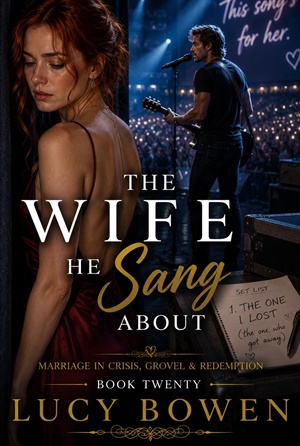
THE WIFE HE SANG ABOUT (Marriage in Crisis, Grovel & Redemption #20)
CHAPTER ONE
LARKIN
The grocery store played "The Light She Left On" over the ceiling speakers, and I stood in the cereal aisle with a box of oatmeal in my hand and listened to my own marriage set to a four-four beat.
I knew the song by then. Everybody knew the song by then.
It had been on the radio for three months, and it played in coffee shops and gas stations and the dentist's waiting room, and every single time it started I had the same reaction.
My stomach dropped first. Then my ears went hot.
Then I made myself keep breathing normally in case anyone was watching, even though nobody was ever watching, because nobody knew.
A woman near the register hummed along under her breath. She had a toddler on her hip and a phone wedged between her shoulder and her ear, and she swayed a little to the chorus without seeming to notice she was doing it.
"He wrote that after his divorce, I heard," she said to whoever was on the phone. "Broke him wide open. You can hear it."
I put the oatmeal in my cart and did not correct her.
There was no divorce. There was a marriage, currently intact on paper and currently disintegrating in every other way, and there was a man who had turned one of the worst nights of it into two minutes and forty seconds of pedal steel and pretended it belonged to a stranger.
The lamp in the second verse was our lamp.
The kind that lived on the desk in Townes's writing room and burned amber all night whenever he worked past midnight, which by that point in our marriage was most nights.
The narrator's wife left it on for him even when she'd stopped waiting up.
That detail alone would have told me everything even if I hadn't recognized the rest.
I had recognized the rest.
I stood there through the whole chorus, the one about a man learning too late that a woman can love someone and still be leaving them a little more every day, and a teenage boy stocking the cereal shelf beside me mouthed the words without looking up from what he was doing.
He knew every syllable. Strangers three states away knew every syllable.
My husband's best friend had recorded our worst fight and turned it into something people used to feel their own heartbreak more precisely, and none of them would ever know that the woman standing in the wreckage of it was buying oatmeal ten feet from a display of his face on a magazine cover.
Townes hadn't asked me before he wrote it. He hadn't asked me after, either. He'd told me, the way you tell someone something you've already decided is fine, three weeks after Rhett Callahan cut the demo, when it was too far along to be anything but finished business.
"It's not about us specifically," he'd said. "I changed things. Nobody's going to know."
I had wanted to ask him since when not being caught had become the same thing as not doing anything wrong. I hadn't asked. At the time I still thought if I let it go quietly enough, it would stay a small thing between us instead of becoming the biggest thing either of us had ever done.
It hadn't stayed small. It had gone to number one.
I finished the shopping on autopilot, and by the time I got to the truck the song had ended and something else had come on, something forgettable, and I sat behind the wheel in the parking lot for a minute before I started the engine.
I thought, sitting there, about the woman who'd said broke him wide open, and the odd, quiet violence of that phrase applied to a man who had done the breaking rather than suffered it.
Nobody imagined the songwriter as the one who'd swung the hammer.
The whole architecture of the industry assumed the opposite, that a man who could write something that raw must have survived something that raw, that pain of that caliber only came from having been on the receiving end of it.
It never occurred to anyone standing in a checkout line that a person could manufacture that same ache in someone else and then turn around and describe the wreckage so precisely that strangers mistook him for the casualty.
I drove home along the same route I always took, past the guitar shop where Townes had bought his first decent instrument on credit, past the diner where we used to split a plate of biscuits and gravy because we couldn't afford two, and I found myself doing the thing I'd started doing lately without meaning to, cataloging the versions of him I'd known in order, trying to locate exactly where the boy who wrote me napkin lyrics had turned into the man who wrote strangers' hearts out of my own.
Six years ago Townes wrote songs on a legal pad at our kitchen table with a coffee ring soaking through page after page, and I sat across from him doing the books for the two of us because neither of his jobs paid enough to cover rent alone.
He'd read me a verse and watch my face while I heard it, and if I got quiet in the wrong way he'd scratch out the whole thing and start over.
He used to say I was the only critic whose opinion he trusted, because I was the only one who'd tell him the truth even when it wasn't the answer he wanted.
He didn't ask me anymore. He hadn't asked me in longer than I wanted to add up.
At home, the house was empty in the particular way it was empty when Townes was in his writing room with the door shut, which was different from the way it was empty when he was actually gone.
I could feel him back there. I put the groceries away and I didn't go check on him, because in the last year I had gotten very good at moving through our house like a woman who lived alone and simply happened to be married.
I made dinner for one and put half of it in the refrigerator for him to find later, the way I always did, and I sat at the table where we used to work on his songs together and I ate by myself with the radio off.
Around nine, he came out of the writing room rubbing his eyes, looking the way he always looked after a long stretch of work, loose and a little dazed, like he'd surfaced from somewhere deep.
He saw the plate in the refrigerator and heated it up and ate standing at the counter, and he told me about his day between bites, something about the label wanting another single by spring, something about Rhett's tour schedule shifting, something about a young singer named Beau Whitaker who'd asked Townes to write for his new album.
I listened and nodded in the places where I was supposed to nod.
"You're quiet tonight," he said.
"I heard your song at the grocery store," I said.
Something crossed his face, quick, there and gone. "Yeah?"
"The whole store knew it," I said. "A woman thought you wrote it after a divorce."
He set his fork down. "It's not literal, Lark. You know that."
"I know what it is," I said.
He looked at me for a second like he wanted to say something else, and then he didn't, and he picked his fork back up, and that was the whole conversation.
That had been the whole conversation about "The Light She Left On" more or less since the day he told me he'd sold it.
We circled it. We never addressed it directly.
I had asked him, more than once, in more than one way, to sit down and actually talk to me about what our marriage had turned into, and every time he told me he didn't know how, and every time I believed him a little less.
He used to know how to talk to me. He'd forgotten, or he'd stopped needing to, once he found out he could put it in a song instead and let somebody else's voice carry the weight of it to people who would never trace it back to us.
I did the dishes while he went back to the writing room, and through the door I could hear him picking out something on the guitar, low and unhurried, the sound I used to fall asleep to before I started noticing that whatever he played after we fought usually turned into something else two weeks later.
I dried my hands and stood in the hallway outside his door for longer than I meant to.
I didn't go in.
I went to bed instead, on my side, near the edge, the way I'd been sleeping for longer than I wanted to admit, and I left the hallway light on so he wouldn't stub his toe when he finally came to bed, the same as I always did, the same small habit of care that had somehow ended up in his song without ever once being asked.
I lay awake longer than I meant to, thinking about the early years, the ones nobody at that grocery store or that magazine stand would ever know anything about.
Before Townes was Townes Barrett the songwriter, back when he was just a boy from a town outside Knoxville with a guitar he'd bought secondhand and a stubborn belief that he had something worth saying, we used to sit up until two in the morning at a rickety table in our first apartment, the kind with a wobble you fixed with a folded napkin under one leg, and he would play me half-finished songs and ask, every single time, is this true.
Not is this good. Is this true. He trusted my ear for the difference more than he trusted his own, back then, and I had loved being the person he trusted with that question.
Somewhere in the climb, the question had changed on him without either of us noticing exactly when.
He stopped asking if a thing was true and started asking if it would connect.
Connection and truth had started to feel like the same thing to him, I think, because the songs that connected most deeply usually were true, at least on the surface, at least in some recognizable form.
He had forgotten, or maybe never fully understood, that there is a difference between a truth a person has earned the right to tell and a truth he has simply overheard because he happened to be standing close enough to somebody's heart to catch it falling.
I thought about all of that lying in the dark, and I thought about the woman in the cereal aisle mouthing the words to a stranger's supposed heartbreak, believing with her whole chest that she was witnessing an act of bravery, when what she was actually witnessing was a private theft dressed up so beautifully that nobody watching could tell the difference.
I fell asleep somewhere in the middle of that thought, and if I dreamed anything, I didn't remember it by morning.