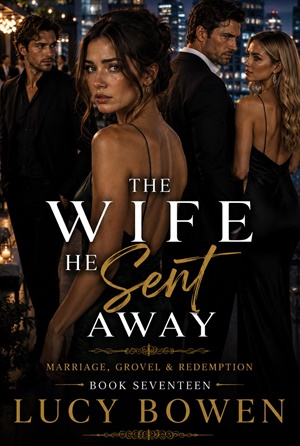
THE WIFE HE SENT AWAY (Marriage in Crisis, Grovel & Redemption #17)
CHAPTER ONE MAREN
The security camera above our front door had a blind spot exactly four feet wide, and I knew because I’d spent the better part of a year mapping it, standing in different spots on the gravel with my coffee until I found the one place on our entire property where nobody was watching me.
Rhodes didn’t know I knew. He thought I stood there because I liked the view of the garden, the roses climbing the east wall, the stone birdbath his mother had given us as a wedding gift and that I’d never had the heart to move even though it collected more leaves than birds.
Really I liked being invisible to him for ten seconds at a time. I had nothing to hide. It was simply that in a marriage built on cameras and access logs and a small army of men who knew my schedule better than I did some weeks, those ten seconds were the only truly private thing I owned.
“You’re doing it again,” Rhodes said from the doorway, arms crossed, dress shirt open at the collar because it was Sunday and Sunday was the one day he let himself look unfinished.
His hair hadn’t been combed since he’d rolled out of bed, and there was a crease down one cheek from the pillow that he would have found mortifying in front of anyone from his board.
“Doing what?”
“Standing exactly where Bram’s cameras can’t see you. It makes the whole system twitchy for about an hour afterward. He called me about it once, you know. Very seriously. Asked if I wanted to reposition the unit.”
“What did you tell him?”
“I told him my wife has a favorite four feet of gravel and he should leave it alone.” He crossed the driveway in his socks, wincing when a piece of gravel found its way under his heel, and pulled me against him anyway, because Rhodes Vossler had never in six years of marriage let a small discomfort interrupt him from doing something he wanted to do.
“It makes the whole team twitchy. Not just Bram.”
“Good,” I said, tipping my head back to look at him. “Let it be twitchy. It’s earned a day off.”
“You’re the only person on this property who thinks a security system is entitled to rest.”
“Everyone’s entitled to rest, Rhodes. Even your cameras.”
He laughed, a real laugh, the kind that still surprised me sometimes because so much of the rest of his life ran on careful, measured amusement, boardroom charm calibrated to put people at ease without ever revealing anything real.
I got the real laugh. I’d gotten it since our second date, when I’d told him his security detail’s earpieces made them look like they were all listening to the same terrible podcast, and he’d laughed so hard he’d nearly choked on his wine.
“Come inside,” he said. “I made the coffee wrong on purpose so you’d fix it and feel useful.”
“You did not.”
“I absolutely did. I’ve been standing in that kitchen for ten minutes feeling extremely pleased with myself.”
I let him pull me back toward the house, my head resting under his chin the way it had for six years, the fit still exactly right despite the four inches he had on me and the fact that I’d told him on our wedding day that I refused to wear heels for a man who was already unreasonably tall.
Rhodes Vossler ran a company that built security systems governments bought in bulk, satellite monitoring and encrypted communications and the kind of physical hardening that kept embassies standing after attacks that would have leveled ordinary buildings, and he’d built our marriage on the same underlying principle without ever seeming to notice he was doing it: cover every angle, eliminate every risk, and love fiercely enough that the effort never looked like control.
Most days it didn’t feel like control either.
Most days it felt like being cherished by a man who happened to own more cameras than the average person owned throw pillows, a man who remembered that I took my coffee with too much cream and not enough sugar, who still opened doors for me knowing full well I could open them myself, simply because it gave him something small to do with his hands when he loved someone and didn’t know how else to show it in the moment.
The coffee, when I fixed it, was in fact terrible. I told him so. He looked wounded in a way that made me laugh so hard I had to set the mug down.
“Six years,” he said, mock devastated, “and you still won’t pretend for my sake.”
“I love you too much to lie to you about coffee.”
“That’s not what marriage vows say.”
“It’s what mine say. I workshopped them myself.”
We ate breakfast at the island the way we did most Sundays, him reading something on his tablet with his glasses pushed up into his hair, me doing the crossword from the paper he still had delivered even though nobody else on our street got a physical newspaper anymore.
He liked the ritual of it. I liked that he liked it.
Somewhere in the last six years those two facts had become difficult to separate from each other, the way it becomes difficult, eventually, to separate the taste of a dish from the person who taught you to make it.
“Seven letters,” I said. “Clue is ‘unwavering devotion.’”
“Fidelity.”
“That’s eight.”
“Loyalty.”
“Also eight. Somebody clearly needs a refresher on counting before they write these things.”
“Constancy,” he tried, and I counted it out on my fingers and found it fit, and wrote it in, and felt the small satisfaction of a Sunday morning that belonged entirely to the two of us, no board meetings, no threat assessments, no cameras except the ones neither of us thought about anymore because they’d become as unremarkable as the walls that held them.
“You know what I promised you at that altar,” he said, apropos of nothing, watching me fill in the last few squares. “Whatever happens, we face it together. I still mean it exactly as much as I did that day, in case six years has made you wonder.”
“I never wonder. I just like hearing you say it.”
“Then I’ll keep saying it. Whatever happens, we face it together. It’s the only vow I actually remember correctly. I butchered the rest of them, apparently, according to your mother.”
“You did not butcher the rest of them.”
“I definitely called you my ‘anchor and my compass’ in the same sentence, which Hollis has never once let me forget.”
I laughed, and the sound of it filled the kitchen the way it did on the good mornings, easy and unremarkable and entirely ours.
Delphine called at eleven to confirm she was still coming for dinner, and Rhodes put her on speaker while he answered emails at the kitchen table, the three of us falling into an easy rhythm that had existed for as long as I’d known either of them.
She asked about the gala planning. She asked whether I’d found a caterer for the spring fundraiser.
She asked, gently, whether Rhodes had been sleeping, because she’d noticed him looking tired at the last board dinner and worried about him the way old friends worry about each other, plainly and without an agenda I had any reason to suspect.
“He’s fine,” I told her. “He just refuses to go to bed before midnight even when he has a seven a.m. call.”
“Some things never change,” Delphine said, and I could hear the smile in it. “Tell him I said to sleep like an adult.”
“Tell her I can hear her,” Rhodes called toward the phone, not looking up from his tablet.
Dinner that evening ran long and easy, the way dinners with Delphine always did.
She arrived a little after six, right on schedule, because Delphine was never late and never early, and she kissed my cheek at the door and handed me a bottle of wine she knew I liked, a small perfect gesture, the sort she’d been making for as long as I’d known her.
She wore her hair down for once instead of the sleek chignon she favored for company events, and she looked younger for it, more like the childhood photographs Rhodes kept in a drawer somewhere, two kids squinting into the sun at some family estate neither of them had visited together in years.
“You look tired,” she told me over the appetizers, tucking a strand of hair behind my ear the way she might have done for a sister. “Rhodes been working you too hard keeping up with him?”
“He’s been fine,” I said, and meant it. “It’s the gala. I’ve been up late arguing with a florist about whether peonies photograph well under the ballroom lighting.”
“And do they?”
“Apparently not, according to a woman who has strong opinions about lumens.”
Delphine laughed, delighted, and told a story about a merger that had nearly fallen apart over a disagreement about fonts on the letterhead, two entire legal teams held hostage for three days by a font nobody could agree looked sufficiently trustworthy, and Rhodes laughed harder than I’d heard him laugh in weeks, wiping his eyes with his napkin, and I watched the two of them finish each other’s sentences the way people do when they’ve known each other since before either of them had a personality that wasn’t shaped by the other’s presence.
It didn’t bother me. Rhodes had told me the history plainly, early in our relationship, the summers at each other’s family estates, the assumption their parents had once carried that the two families would eventually merge the way their companies already had, an assumption Rhodes had never shared and had told me, more than once, he found faintly ridiculous.
I believed him because I had no reason not to, and because Delphine had never once given me cause to look at her twice.
“To Maren,” Delphine said, lifting her glass near the end of the meal, “for putting up with both of us for this long. I don’t know how you do it.”
“Practice,” I said, and drank to that, and felt entirely, uncomplicatedly happy.
Later, walking her out to the car, she paused with her hand on the door and looked back at the house, lit gold against the dark like something out of a catalog for lives other people got to have.
“He’d burn the world down for you,” she said. “You know that.”
“I know.”
“I mean it as a warning as much as a compliment,” she said, and smiled, the kind of smile that could mean anything or nothing, and got in her car and drove off into the dark, and I stood in the driveway turning the sentence over without finding the seam in it.
I decided it meant nothing. Delphine said things like that.
It was part of her charm, the slightly theatrical edge she gave to ordinary observations, the same edge that made her stories about font disputes sound like corporate thrillers.
I was still standing there, arms crossed against the evening chill, when the sedan came down the road for the second time that night.
It wasn’t the make that caught my attention, some dark, unremarkable model I couldn’t have named if asked.
It was the speed, slow enough to notice, and the way it didn’t turn into any of the three driveways it passed before reaching the end of the cul-de-sac and coming back around, headlights sweeping briefly across our front windows before it continued on.
I watched its taillights recede into the dark and told myself it was someone lost, someone looking for a house number, someone with every reasonable explanation in the world for driving down a quiet residential street twice after eleven at night.
I didn’t mention it to Rhodes when I came back inside.
He was already half asleep on the couch, a hand thrown over his eyes, and I sat beside him and let him pull me down against his chest without saying anything about the car at all.
It seemed like nothing. It seemed like exactly the kind of small, forgettable detail that fills the space of an ordinary evening and disappears by morning.
I wish, now, that I had said something. I wish I had understood, standing in that driveway with the last of Delphine’s headlights fading down the road, that the evening I would later think of as the last entirely peaceful night of my marriage was already, quietly, ending.
Inside, Rhodes had fallen asleep on the couch with a folder of quarterly reports still open on his chest, his reading glasses pushed up into his hair the way he wore them when he’d forgotten he was still wearing them at all.
I stood in the doorway for a moment just looking at him, this enormous, careful man who ran a company that protected other people’s secrets for a living and still fell asleep on his own couch with his shoes on, like anyone’s husband, like nothing about our life was unusual at all.
“You’re going to wreck your neck,” I said, nudging his shoulder.
He woke slowly, blinking up at me with the particular confusion of a man surfacing from a nap he hadn’t meant to take. “What time is it?”
“Late enough that Delphine’s already home and you’ve drooled slightly on your own financial report.”
“I have not drooled.”
“You absolutely have. There’s a spot right on the fourth quarter numbers. Very fitting, honestly, given how the fourth quarter actually went.”
He laughed, dragging a hand down his face, and reached for me instead of the folder, pulling me down onto the couch beside him with the same unhurried certainty he did everything, as though he had all the time in the world and intended to spend a portion of it exactly like this.
“Stay a minute. I’ve barely seen you all week. ”
“You’ve seen me every single day this week, Rhodes.”
“Seeing you across a dinner table while Delphine tells stories about corporate fonts isn’t the same as seeing you.
” He tucked a strand of hair behind my ear, an echo of the gesture Delphine had made at the door hours earlier, though his version felt entirely different, quieter, without any theater in it at all.
“I like this part of the night best. When it’s just us and nobody needs anything from either of us. ”
“Careful. If you keep saying things like that I’m going to start expecting it.”
“Good,” he said. “Expect it. I intend to keep saying them for the next fifty years, minimum.”
I fell asleep against his chest an hour later, the two of us still on the couch, the reading light left on until sometime near dawn when one of us, I never learned which, finally roused enough to stumble upstairs to bed.
It was, in its unremarkable way, one of the last ordinary nights we would have for a long time, and I have thought about it often since, the particular, unguarded ease of it, the complete absence of anything in either of our minds beyond the simple fact of being tired and together and safe.