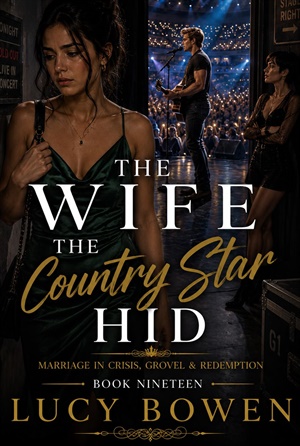
THE WIFE THE COUNTRY STAR HID (Marriage in Crisis, Grovel & Redemption #19)
Chapter 1
Savannah
The gown had cost more than my father made in a month back when he still worked the county line, and I stood in front of the mirror in our Nashville home smoothing the fabric over my hips, waiting for Rhett to tell me I looked beautiful before I had to ask him.
The house was quiet in the particular way it got before one of his big nights, staff cleared out an hour early, the security detail waiting at the gate instead of the front door, every surface in our bedroom lit by soft gold lamp light a stylist had picked out for photographs that would never actually be taken here.
I turned sideways to check the line of the dress against the mirror and thought, not for the first time, that a woman could learn to love a room and still feel like a guest inside it.
Downstairs I could hear the low murmur of the production team setting up in the front hall, the sound of garment bags being unzipped, someone laughing at something on their phone.
This part of every awards season had its own choreography by now, familiar enough that I could have walked through it blind.
The stylist would arrive at four, the car at six thirty, and somewhere in between Rhett would ask my opinion on his tie three separate times and then wear the one I picked first anyway, a small ritual neither of us had ever bothered to name out loud.
Rhett came out of the closet still buttoning his cuffs, dark suit, no tie yet, hair still damp from the shower.
For a moment he just looked at me the way he used to look at me before any of this started, before the house and the awards and the private jet parked out at the airfield with his name painted on the tail in letters six feet tall.
"Turn around," he said.
I turned. He crossed the room and fixed the clasp at the back of my neck that I had already fixed twice myself, his fingers warm against my skin, unhurried, the way he used to fasten it back when we had exactly one nice outfit between the two of us and getting it right mattered because there wouldn't be a second chance to look presentable that week.
He rested his chin against my shoulder for a moment, as though he had been waiting all day just to stand still with me.
"You are the only good decision I ever made," he said.
I laughed, because that was the version of Rhett Callahan I had married.
Not the one on the billboards or the one the label had built out of him one calculated appearance at a time.
This one. The one who still asked me what I thought of a bridge he had written before he played it for anyone else, the one who paced our kitchen floor at two in the morning trying out a lyric on me before he trusted it enough for the world to hear.
"You'd have found somebody else eventually," I said, teasing him the way I always did when he got sentimental before a show, because it was easier to deflect than to sit inside how much I felt it too. "Some girl who actually knew how to iron a shirt."
"I've been ironing my own shirts since I was nineteen, Savannah."
"Badly."
"Passably," he corrected, holding out an arm for me to inspect the sleeve, and I found, as I always did, exactly one wrinkle he'd missed near the cuff.
"There it is," I said, tapping it. "Every time. Right there."
"You'd think after six years I'd learn."
"You'd think," I agreed, and reached up to fix it myself, the small domestic argument as familiar as breathing, a joke we'd been running since our first apartment, back when he really did iron his own shirts, badly, on an ironing board balanced across two kitchen chairs because we couldn't afford a proper one.
"Do you remember the fight we had about the ironing board?" he asked, watching me work the fabric flat.
"We didn't fight about the ironing board. We fought about the seven dollars it cost."
"We had six dollars to our name that week."
"Which is exactly why it was a fight," I said, "and exactly why you went out and bought it anyway, because you said a man who couldn't afford an ironing board had no business dreaming as big as you did."
"I still believe that, for the record."
"You believe a lot of things you've never once said to a reporter," I said, lighter than the words probably deserved, and watched something flicker across his face before he covered it with a laugh.
He caught my hand before I finished and held it there a moment, his eyes serious in a way that cut through the teasing.
"How's the set feel?" I asked, mostly to give him somewhere to put the feeling.
"Feels big," he said, working the second cuff. "Feels like tonight changes things."
"Good big or nervous big?"
"Both. Ask me again after the ballad." He caught my eye in the mirror. "I moved it to the opener. Told the band this morning."
"You changed the opener the day of the show?"
"The ballad's the truer song," he said. "I want to walk out there and mean something before I get to the part where I have to sell tickets."
"You've never needed to worry about selling tickets."
"I always worry about it," he said, his voice carrying enough weight that I believed him. "You stop worrying about it, you start writing songs for the wrong reasons."
"You wrote that ballad at two in the morning at our old kitchen table," I said. "I remember because you kept humming the bridge until I made you write it down so I could sleep."
"You remember the exact table."
"I remember the exact table had a wobble on the left leg and you fixed it with a folded napkin that stayed there for two years."
He laughed, a real laugh, and his shoulders relaxed. "Nobody else on earth would remember that napkin."
"Nobody else on earth had to eat dinner at that table every night," I said. "Somebody had to notice."
It was these moments, small and unremarkable to anyone watching from outside, that told me who he actually was underneath the version everyone else got.
The magazines wrote about a self-made man who'd clawed his way out of nothing, and that was true as far as it went, but they never wrote about the man who still remembered the words to a jingle from a commercial we'd auditioned him for and lost, who sang it under his breath sometimes while he did dishes, off-key and delighted with himself.
I did not know yet how right he would turn out to be about meaning something, or how little that would end up costing him where it actually counted.
He talked while the stylist touched up his hair for the third time that afternoon, about the song order and the lighting cues and how he wanted to walk offstage tonight and find me first, before Troy, before Kendra, before a single camera got near him.
He talked about it the way a husband talks to a wife when there is no one else in the room to perform for, easy and unguarded, and I let myself believe, the way I had let myself believe for six years, that this was the real Rhett and everything else was the costume.
"You'll be right there when I come off," he said. "Promise me."
"I'll be there."
"West wing, second curtain. I already told security."
"You told them, or Kendra told them?"
He paused for half a second, just long enough that I noticed it. "I told them to tell her. Same thing."
"It's not exactly the same thing."
"Savannah."
"I'm just saying." I smoothed the front of my dress, not looking at him. "You used to tell me things yourself. Now everything comes through three other people first."
"That's just how big shows work. Logistics."
"Sure," I said, and let it go, because arguing about it on a night this important felt petty even as some small unexamined part of me filed it away, the way I had filed away a hundred small moments just like it, telling myself each time that it didn't add up to anything on its own.
I did not know yet that the arrangement would change three separate times before the night was through, each time moving me a little farther from the second curtain and a little closer to a door I had never used before.
Before Kendra arrived, Rhett had pulled me into the small sitting room off our bedroom to play me a rough recording of the ballad's final mix, holding his phone between us the way he used to hold his old recorder in our first apartment, waiting for my reaction before he'd let himself trust his own.
"Well?" he asked, watching my face too closely.
"The bridge is still too crowded," I said. "You buried the vocal under the strings again."
"The producer loved the strings."
"The producer doesn't have to stand in a room and listen to you fight your own arrangement for three minutes," I said. "Trust me. Strip it back."
He was quiet for a moment, and then he laughed, the tension easing out of his shoulders. "Nobody else tells me that. Not the producer, not the label, not the band. You're the only person left who still argues with me about a mix."
"Somebody has to," I said. "You'd drown in agreement otherwise."
Kendra Vale let herself in without knocking the way she always did, tablet already in hand, publicist smile already fixed in place before she'd said a word.
She had a way of entering a room like she owned the air in it, heels quiet on the hardwood, eyes already moving to the next three things on her list before she'd finished the first.
"Car's out front for you," she told Rhett, then turned to me with the practiced patience she used when speaking to something that was not quite an obligation and not quite a person. "Savannah, your entrance tonight is through the west door. Security will walk you back after the carpet clears."
"The west door," I repeated. "Rhett said second curtain."
"That was before the network moved the award placement," Kendra said, glancing at Rhett rather than at me, as though the correction belonged to him and not to her. "We'll get you back there for the after, promise."
Rhett did not correct her. He was checking his phone, half listening, the distracted half-listening of someone when they've learned to trust that someone else is handling the details so they don't have to.
I watched him not notice, and some old, tired part of me registered it and let it pass, the way I had let a hundred small moments pass before it, telling myself each time that none of them added up to anything on their own.
It had not always been the west door. Six years ago it had been my hand in his walking up a similar carpet at a much smaller show, a local station covering a regional award nobody outside Tennessee had ever heard of, and Rhett had held my hand up high enough that the one photographer there could get a clean shot of my ring.
He had been so proud of that ring. He had saved for four months to afford it and told the story to anyone who'd listen, including, more than once, the photographer himself, standing there in the parking lot afterward describing the layaway plan at the jewelry counter like it was the most romantic thing he'd ever accomplished.
Rhett left for the carpet twenty minutes later, pausing at the door with his hand around mine before he turned toward the car.
I watched him go from the window, watched the black SUV pull down our long drive and out onto the road that would take him toward the arena and the cameras and every version of himself that was different from the one who had just teased me about ironing.
Security drove me the back way an hour later, through a service entrance that smelled like diesel and popcorn butter, past a loading dock where two men were unloading crates of bottled water, past a wall of cardboard boxes stacked higher than my head.
I turned on the small television bolted above the greenroom door while I waited for someone to walk me to my seat, and the pre-show coverage had already started, two hosts in sequined jackets running down the night's biggest names.
When they got to Rhett's picture, the woman host put her hand over her heart in a gesture that looked rehearsed because it probably was.
"Rhett Callahan, ladies and gentlemen. Still single, still breaking hearts, and if the rumors are true, still very available."
Her co-host laughed, an easy practiced laugh.
Neither of them corrected it, because nobody outside a very small circle knew there was anything to correct.
I had gotten used to hearing sentences like that over the years, the way you get used to a low hum in an old house, background noise you stop registering until one night, for no reason you can name, you hear it again as though for the first time.
A production assistant stuck her head into the greenroom to tell me my escort was five minutes out, and I sat alone with the television and my own reflection in the dark window beside it, my dress catching the studio lights in a way that made me look, for one strange moment, like someone I didn't fully recognize.
I looked down at my ring, the one Rhett had put on my finger in a courthouse in Georgia before he had a single hit to his name, back when we did not have enough money for a real wedding and did not care because we had each other and that had felt like plenty.
A stagehand knocked on the greenroom door to tell me it was time, and I stood, smoothing the front of my dress one more time out of habit, though there was nobody left to check my appearance for.
I thought, walking toward the door, of the local station broadcast years earlier, the one photographer, the clean shot of my ring, and wondered when exactly the distance between that night and this one had grown so wide that I'd stopped noticing it happening at all.
There had been no single day when the west door replaced the second curtain.
There had only been a thousand small agreements, each one reasonable on its own, that had somehow added up to a woman standing alone in a greenroom while her husband's face filled every screen in the building.
The composure I had held onto for years began to crack.