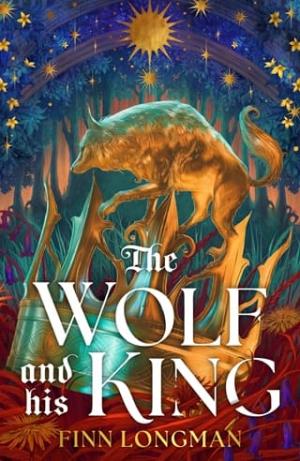
The Wolf and His King
Chapter 1
Him
He isn’t a knight.
He’s not even a man, these days – not always, not in the ways that matter.
The wolf comes often enough to rob him of a future, but not so often as to rob him of his name.
Yet. It tugs at the frayed edges of his mind, pulling loose the threads, and one day, he’s sure, the gnawing insanity of his animal skin will win.
He’ll lose himself, become fully beast: this he knows the way he knows the ache of change when it settles into his bones.
Part of him fears it. Part of him welcomes it. It would hurt less, he thinks sometimes, to lose everything than to bloody his fingers trying to hold onto something already shattering.
For now, he knows himself. Knows when the fragile wonders that are his fingers warp into claws.
Knows when his spine shatters, his neck breaks, and his body remakes itself into something unholy.
He’s grown to recognise the signs – the swelling soreness of his joints, the bite of his teeth against his lips, the taste of his own blood like salt in his mouth – but he still slips out of his skin suddenly enough to be caught off guard and slowly enough to hurt.
It has always been this way.
Bisclavret is used to it.
He lives his life in exile. Quarantine, almost, keeping the wolf-sickness away from the markets and the towns and most of all the court, where once his father performed great deeds as baron and knight of the king.
So his mother told him, anyway, when he was a child and there was still hope of a cure.
Not forever, she promised, would they live here on her meagre estate in the shadow of the hills and on the edge of the woods, as far from the salt of the sea as any could be in a land shaken and pummelled by waves.
One day, he would receive his father’s sword and the gift of his lands, and all would be restored: he to knighthood, she to joy, the wolf to memory and nightmares and half-forgotten tears.
But now she is dead, and the sickness has not left him, the possession not yet undone.
Once, when he was young, there was a priest who saw the damnation that thrust itself into his skin, but did not flee.
Nor did he try to exorcise him with rituals and candles, scourge and invective and pain.
Instead, he took the bruised, childish hands of the boy in his own and prayed, earnest and terrified.
And after a few weeks in his own body, the boy thought, perhaps, that it had worked.
But the wolf came back. It always comes back.
The same priest warned him not to speak of it, as though he needed warning. ‘If they know what you are,’ he said – clutching his prayer beads, white-knuckled, his mercy only just outweighing his fear – ‘they will never let you be anything else.’
He is not sure, in truth, whether he is anything else.
Just a wolf-sick boy, exiled and unwanted.
Bisclavret cannot remember a time before the plunging agony of transformation, but as a child it came infrequently, once a month at most. He’d have weeks to forget how it feels to wake with blood under his nails and fogged memories of how the night was spent and a growing fear: don’t let me have hurt anyone.
Now, though, now he loses himself a day each week, sometimes more; he’s afraid to keep too close a count of it, for fear he’ll find himself calculating how many more years he’ll have with a voice before he’s robbed of it entirely.
So, no, he’s not a man. Just enough-man, enough-human, to know what he’s missing.
Enough to remember his mother’s tales of adventure and feel a hollow grief for something that never was.
Enough to know that the secrets written into his skeleton have shaped him into something that can never see the light.
Enough to long for knighthood: a glittering, unattainable dream.
Once, as a child, he saw the knights passing by, the king in their midst and his son at his side and laughter in the air.
They hardly seemed like men themselves – they were some new creature, shimmering silver skin like fish scales, as Other as himself, but entirely unlike him.
Their eyes were bright; their joy, their brotherhood, was an ache to witness.
Childhood is a distant memory now. And the fair beardless youth amongst those knights, seeking the first thrills of chivalry, is long grown into a man.
A man and half an exile himself – even here, Bisclavret has heard tell of the king sending his son and heir to foreign courts to learn better the violence of ruling, the art of war, fearing the quiet prince might be more naturally inclined to the monastery than the battlefield.
If he has yet returned, word of it has not reached this place.
But even if the prince is ill-suited to war, he is better suited to the crown than a wolf-man to knighthood.
Bisclavret cannot fathom why the Almighty formed him in this body; he wonders, sometimes, if his nature is a test and a trial, the Adversary at work to torment his mother like Job.
If so, she did not live long enough to receive her reward on earth, for she died believing him possessed and his future bleak.
Perhaps she was right. It is not for him to pretend to be something blessed.
It would be presumptuous – blasphemous, even – for such a creature to shrive himself in the chapel and let them paint the cross on his forehead before raising him to sword and horse and brotherhood.
And even if it were not a sin and a lie, the risk is too great. One day he may lose his mind along with his body, and then what? Would he kill, or only maul? Without human reason to restrain his actions, would he reveal himself to be the monster he’s always feared, secretly, that he is?
No. Bisclavret knows his place, and he is not a knight. He will never be a knight.
But he will dream of them, all the same.
‘He’ll be crowned in a week, and there’ll be a hunt to celebrate.’
His cousin. Resplendent in court garb, all bright colour over gleaming mail, the finest armour his lord can bestow upon him.
When, as children, they played at knighthood together, it was not to a landless life of service to another lord that either aspired – but his cousin is a younger son, an inconvenience, sent here to this estate as a companion to his infirm kinsman and only later to court.
By then there was no money to equip him, but he’s found a lord, and a part to play, which is more than can be said of Bisclavret.
His cousin is still travel-stained from his long journey, but his eyes gleam with possibilities.
Two days’ hard riding to bring word: the king is dead, the prince recalled from distant courts, the kingdom altered.
An accident, a terrible shock, of course, but amidst the mourning many perceive the jewel of opportunity.
The young prince – now king – has been gone long enough that none at court may yet claim his favour, and it is a rich fruit to be plucked.
‘I cannot see what this has to do with me,’ says Bisclavret, folding his arms. He has lost weight this summer. The wolf takes it from him, punishing him for keeping it from hunting the way it craves.
‘You owe him oaths,’ his cousin reminds him. ‘Your mother’s land is yours. You are a noble, however pitiful your estates. You will be expected at the coronation to swear your fealty.’
Bisclavret’s heart sinks. He inherited his land some four years past, and ought by rights to have sworn to the old king, but the man was cantankerous and disinterested in the doings of minor gentry, so long as they held back from poaching in his forests and parks.
His cousin is right, though: he will be expected at the coronation.
Three days’ journey, at the least, if he doesn’t want to torment his horse the way his cousin has done these past two days; a night or several in the king’s hall; the same journey in return.
Too much entirely for a man with a wolf in his skin.
‘It’s not possible,’ he tells his cousin. ‘I will have to send my apologies. Meet him when next he takes a circuit. Tell him I am infirm, or injured, or—’
‘But this is your chance,’ his cousin interjects. ‘Did your mother not always plan to present you at court and reclaim your inheritance? The new king will be seeking loyal barons. No doubt he will be more than ready to restore your land, in exchange for your gratitude and good favour . . .’
‘A nice idea,’ says Bisclavret drily. ‘You have forgotten the wolf.’
‘I have forgotten nothing,’ says his cousin.
He was all of twelve summers old when he learned the true nature of Bisclavret’s infirmity and has kept faith with him in the years since, when most would have turned their back.
‘But you can’t mean to spend the rest of your life here.
Your father was a knight. A baron. His place should have been yours. ’
And if his father had waited just a month or two longer to die in the old king’s service, it would have been. As it was, he died without sons, Bisclavret still in his mother’s womb, and his land reverted to the crown.
‘Then perhaps the king will grant me lands on his next circuit, but I cannot travel that long. The wolf—’
‘Surely you can manage a week,’ says his cousin, but he must read the answer in Bisclavret’s expression, because concern crosses his face for the first time. ‘Does it truly come so often, now?’
Bisclavret looks away. He has done his best to create the impression of the wolf as an infrequent visitor – an occasional lapse, not a constant haunting. All men, after all, have moments of weakness. But weekly . . . weekly starts to look like a habit.
‘Sometimes,’ he says. ‘Especially in the winter. I think the cold . . .’