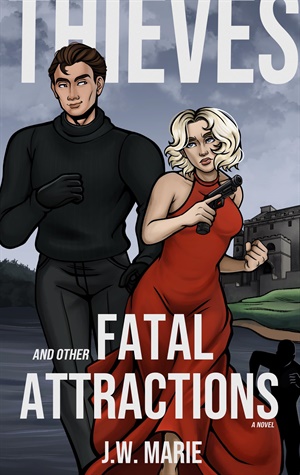
Thieves and Other Fatal Attractions
Chapter 1
CHAPTER
ONE
I don’t remember the last time I made a decision about my life.
The thought occurs to me as I’m perched on a half-broken bar stool in some dirty pub stinking up the outskirts of South London.
Not my typical haunt, and I’d caught more than a few curious stares at the beginning of this evening.
After a sip of my Old Fashioned—cheap whiskey that tastes like rubbing alcohol—I frown at the blood smeared across the bar-top and distractedly wipe it with my tiny napkin.
I have a guess, of course. About the decision making.
Four months ago, or maybe five, I was negotiating for the life of a trust fund twenty-something who’d been hilariously duped by a scam promising twelve acres of prime real estate on the North African coast. Except it was the idiot’s first day on earth, and he flew all the way to Morocco to survey the land—only to be kidnapped and held for ransom by the same group.
I mean, at that juncture, I couldn’t even blame them.
But that’s not the point.
In the blazing heat of the Sahara Desert where I’d chased them, at the peak of summer, when the granules of sand felt like microscopic hot coals against my skin and crunching between my teeth, I made a decision.
Dehydrated, sun-scorched, and exhausted, the money finally changed hands and the hostage was safe.
With a broken nose from yours truly. Safe, though. Alive.
Anyway, that measly punch is what landed me here. Huh.
A gob of spit hits my cheek and sticks there, followed by a drunken laugh.
I flick it away and twist to see the man whose head I broke my stool on. Gold tooth, meaty shoulders, poorly executed tattoos climbing from his neck to a bloodied and bald head.
“Sorry, ma’am,” says the faceless National Crime Agency officer holding my saliva assailant’s cuffed wrists.
The criminal—let’s call him Jack, he looks like a Jack—sneers. “I ain’t sorry,” he drawls in a thick accent. “Traitor.”
I can’t help the smile that curls my lips, painted an obnoxious shade of coral.
“I can see you’re having an issue forming coherent thoughts,” I reply, waving lazily around the pub, where his comrades lay beaten, shot, or being hauled outside in cuffs.
“Whether that’s due to the head trauma—looks nasty, by the way—” Jack lurches in the NCA officer’s grip at my feigned concern.
“—that’s beside the point. I’m in a good mood, so I’ll toss you a hint: my name is not Ruby. ”
Jack’s outrage as he’s dragged away, broken glass scraping underfoot, only deepens my smile. I wince at the flashing blue lights pouring in through the gaping holes where a window used to be. The word clandestine shriveled to a pulp once the police showed up to assist the NCA.
No matter, I think as I down my Old Fashioned and slap down a tip for the barman I shielded from the carnage.
When we were huddled behind the bar together, bullets whizzing and furniture flying, I took the bonding moment to ask if he could make a good drink.
He said yes—who wouldn’t in the situation?
—and I told him to hold tight. It ended up being a lie, but the man still deserves a nice tip.
He’ll be back on the job market tomorrow with the state of this pub.
He takes the fifty pounds and my empty glass, too stunned to string a sentence together.
I smile and offer a half-wave, slip from the stool, and we both watch as it teeters over onto the floor beside a broken-off chair leg I’d used as a makeshift bat.
The thing all-but disintegrates from the impact.
“May want to get that fixed,” I mutter.
I breeze past a particularly over-eager NCA officer whose wide eyes locked onto me the moment I stepped outside the pub.
Casting a furtive glance to my surroundings, I slink into the shadows and wipe the garish lipstick off with the back of my sleeve, pretending not to hear the slew of questions directed at my back.
To some feds, spotting the International Security Agency in the wild is like stumbling upon a pot of gold at the end of a rainbow they don’t even know exists until it peeks through the clouds.
To others, we’re a thorn in their side—the shadowed, nameless figures who are always better, always faster, always smarter. Tonight’s just another example of it.
I’m positive I’ve saved that particular Agent from a lecture about her newfound personality as an ISA fangirl.
Unfortunately for her—and maybe one day she’ll discover this, when her admiration turns to resentment—the ISA’s never been in the business of recruiting federal agent types. She’ll return to a nice suburban flat, walls lined with family photos, and I’ll slither away to wherever I’m needed next.
About a block away, parked under a broken streetlamp in a narrow alley squashed between another pub and a shuttered butcher shop, sits my Ford Puma with a dented bumper and a cracked windshield.
Thankfully not mine for much longer. The engine putters to life, and I take a moment to relish the fact that I can finally pack Ruby away into my ever-growing deck of identities.
My phone connects to bluetooth.
“The woods are lovely, dark and deep. But I have promises to keep,” I speak first, voice droning. “That had better been the last one.”
A shuffling sounds on the other end. Ximena, my handler, always picks up on the first ring, no matter where I am in the world or what phone I’m dialing from. Her number is a well-kept secret to everyone else on the planet, although there’s always a slim chance someone could get it out of me.
Slim.
“Drop the accent, Sloane,” Ximena replies, ignoring me completely.
I roll my eyes and have to consciously force myself back to pronouncing my T’s more like D’s and flattening my vowels. How I grew up speaking. Sometimes I forget where I’m from and, occasionally, who I am. No big deal—Ximena’s job is to bring me back to reality.
You’re an American, I tell myself. From Oregon, I add, though I don’t know why. I haven’t thought of sweeping plains and lush forests in months. Stuffing it down has been going well. Was, I guess.
“Is this better?” I ask.
“Better.” Ximena clears her throat as I pull out from the alley, brick walls opening to the main street, where gawkers have already begun to gather on the sidewalks up ahead.
Clusters of awestruck faces flash blue in the shadows.
“I suppose I don’t need to ask if it was mission success—it’s all over the news. That was messy, cari?a.”
“London is rid of the Lambeth Boys, I’d say that’s worth it.”
Saying it out loud doesn’t make it any more convincing. I suck my teeth as a third ambulance wails up the street, swerving out of the way and honking at the rubbernecker ahead of me.
She sighs. “What was meant to be an eight-week op, you turned into four.”
“Efficiency.”
“No, carelessness,” Ximena corrects. I roll my eyes at her motherly tone—we’re closer in age to sisters than anything else. Although I frequently have to remind myself that we are not, in fact, sisters. I’m alone. “And it isn’t helping your case,” she adds.
My fingers grip the wheel until my knuckles whiten. “Maybe if Raffaele pulled his head out of the sand and took me off the bench, I’d go back to being their perfect little agent.”
“You’re not on the bench—you just finished an op.”
“Being sent to take out a small-time London gang is another time-out in a string of increasingly awful time-outs,” I reply with a mirthless laugh, forcing my eyes forward once I finally pass the scene.
Ximena mumbles something in Spanish that sounds like it wasn’t meant for my ears. Except she knows I’m fluent. “Have you ever thought that in order to get back in the game, you might need to start behaving? Show them that there won’t be a repeat of Chelyabinsk?”
I shudder, as if the words are shocking. As if there’s not a permanent reminder on my skin.
“Nothing I can do will prove that until they put me back under pressure.” I stare at the red light of the intersection, debating running it, but decide to pop out my fake piercing in the meantime.
My hair—bleached into a white-blonde and chopped bluntly right beneath my chin—is a souvenir from this assignment that I won’t be getting rid of as easily.
“They don’t seem to understand that I operate best on nights like tonight—not when I’m pushed into a corner and asked to twiddle my thumbs indefinitely. I need distractions, Ximena.”
She sighs a second time.
We both know she’s the only one I’d ever admit that to. But when you rely on the same person to keep you afloat while you risk life and limb for over a decade, no one can prevent the bond that develops.
When the light finally flicks to green, I press the gas to the floor and frown as the engine struggles to get up to speed.
My fingers rub at the fake tattoo plastered on my neck, severe against the pastiness my already-fair skin took from being cooped up in London, and succumb to my need to fill the silence.
“And I miss driving nice cars,” I continue.
My tone’s taking on an embarrassing whine, but the woman’s used to receiving my complaints.
“And I miss proper Mexican food—I mean, I’m chilled to the bone here, and I’d actually kill for a bowl of pozole.
And I’m going to have to burn any of my own clothes that have touched that damp cardboard box of a flat I’ve been staying in for four weeks. ”
The last part was a stretch. Everything I’d brought was Ruby’s, not mine, and would be promptly returned to the ISA for reuse.
Ximena laughs, the tension diffused. “You’ve been spoiled.”
We fall silent for a few moments. That flat’s better than half the places I lived growing up. And yet, if I stop long enough to think about it…
That’s why I don’t stop.
“Tell me there’s a clean hotel and mold-free travel in my future,” I groan.
“Let’s just say… I think you’re going to like your next assignment.”