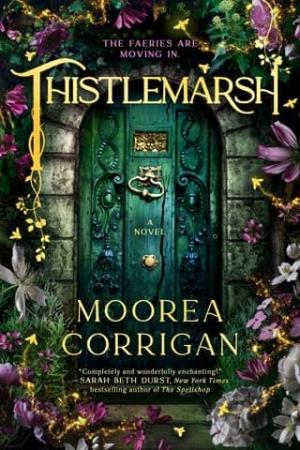
Thistlemarsh
Chapter 1
The war did not bring the Faeries back to England.
As boys languished in the trenches, they still spoke in hushed what-ifs until all hope ran out.
The belief in magic was replaced by the reality of mustard gas.
It was only the very foolish, or the very determined, who still held on to hope.
Despite herself, Mouse was one of those few.
Faeries disappeared over one hundred years before, as suddenly as slipping through a doorway.
At the beginning of the war, when the army was still sending horses to fight against tanks, there was talk that if the Faeries did return with their magic, the bloodshed might end.
The new sciences allowed for wild speculation as to where the Faeries had gone.
Biologists turned to the microscopic world, looking for Faeries at the end of a lens.
Spiritualists claimed that the creatures had dematerialized into ectoplasm, walking invisible alongside mortals, like ghosts or spirits.
As Mouse’s cousin, Bertie, and her brother, Roger, were summoned to France, she returned to the tales of her childhood.
She pored over the tattered pages of her inherited copy of Lady Blakeney’s Tales of Faerie: Stories for the Modern Traveler, hunting for any clue on how to bring the Faeries back.
Despite her uncle’s disapproval, she passed the exam to study Faerie anthropology at university.
The study was not just for her, she convinced herself; it was for the war effort. It was patriotic.
Then, with one telegram, her world shattered.
At the Somme, Bertie’s body disappeared into the mud, and even months after they found Roger, his teeth chattered at any sound louder than the clink of a teacup in its saucer.
When Mouse arrived at the auxiliary hospital in France, he could not remember her.
It was time, she knew, to put aside childish things.
The book of Faerie tales sank to the bottom of her trunk as she took up her duties as a nurse at her brother’s side.
The Faeries did not return to England, but after the war, Mouse did.
The ornate ceiling of the train car made Mouse think of the hospital.
Faerie faces smirked down at her, just as they did in her quarters on the Front.
In France, the Faerie images were part of the caved-in ceiling of a bombed-out church.
She stared back at the ones above her now, both annoyed and relieved that the Fae still had the power to interest her despite the horrors she’d seen over the last few years.
Their smiles were as sharp as their teeth, angular and inhuman.
Bundled into her coat, Mouse curled around her tin thermos of tea and kept her elbows tucked in tight against the spring chill.
Men crowded the corridor and yelled to one another around the other passengers.
Mouse could spot which of the men were soldiers, fresh from the Front.
The war may have ended months before, in November, but it took time to bring the soldiers back to England.
Hope and pained longing battled in their eyes.
Would home be the same, or was it another casualty?
Mouse knew the answer waiting for her at the end of the tracks, but she hoped these young men had better luck.
Three other passengers filed into Mouse’s cabin just before the train departed Victoria Station, smelling strongly of coffee, chocolate, and tobacco.
As they pushed in, Mouse folded herself further into the window seat, silent enough that they eventually forgot she was there.
They balanced a crisp map between their knees, their fingers skimming along the train tracks and stopping at each little blue triangle that stood out on the paper.
“Look here, Charles,” said the young woman in the group, her carefully styled blond hair curling out from beneath her hat. “There are at least ten Faerie cultural hot spots in Dartmoor.”
The young man across from her leaned closer. “Devonshire is littered with them. We must be selective about where we stop.”
His cheeks were pink, his smile full of life, and Mouse had to avert her eyes to keep them from stinging. Looking at him was too much like staring into the past, but the faces Mouse remembered were long gone. He could not be more than seventeen.
The man at Mouse’s shoulder hummed. He was a bit older, perhaps in his twenties, but the hunch of his shoulders aged him significantly. She noted the tension in his frame, the restlessness radiating from him like the halo of an electric light. His nicotine-stained fingers bounced against the paper.
“Why aren’t we stopping at Tithe village?” the woman asked. She turned to the man next to Mouse. “The Browns told me that it is full of Faerie history, James.”
The man jerked. His fingers kept up a steady rhythm. “Indeed?”
“Yes. The great house there even had ties to the Faerie King,” the woman continued.
Charles laughed. “Every village in England claims to have at least one manor house with ‘ties to the Faerie King,’ Dorothy.”
Dorothy frowned. “You know that is not true. They keep some old Faerie artifacts in the house. Why don’t we stop and see?”
“The lord of the manor died recently,” Charles cut in, his tone tight for the first time. He cast an anxious look at James. “I don’t know if we’ll be able to go into the house itself.”
“Well, perhaps the new lord will have sorted everything out by now.”
Mouse snorted at the words. All the heads in the cabin turned toward her. She dug her handkerchief from her coat pocket and buried her face as though muffling a cough. Cheeks flushed, she looked outside, willing the passengers to forget about her again.
Beyond the train window, the world rolled back through time, dissolving from the hard dark lines of the city to softer, pastoral shapes. It was not long before the scene was all waves of green, spotted with the odd cross-helmed village.
Twists in tree branches took on a friendly bend, beckoning Mouse home, and stone walls slumped toward the railway tracks in greeting.
Despite their welcome, she had to fight against the dread tightening around her heart like a band.
How bad would the damage be when she arrived?
It had been nearly three years since she left England, and even then, everything was in a dire state.
Grasping for a distraction, Mouse forced her attention back to the conversation of the three other passengers.
“There is no new lord. Word at the club is that he left the house to a distant heir,” Charles continued.
“Didn’t the lord have any children?” Dorothy asked.
“A son, but he died,” Charles said sharply.
Mouse watched as the other passengers stiffened. She felt her own grief like a bullet in her chest.
Charles blustered on, as though speaking quickly would prevent the wound of the war from festering.
“Lord Dewhurst had a sister who disgraced herself years ago by running off with an Irish gardener. She even married him. Her father, the old lord, disinherited her, but after the death of the heir, her son was next in line. He’s no longer in the running either. ”
Mouse felt a prick of indignation, but she pushed it down. The carriage was silent for a moment, each person aware of the presence of the war, but unwilling to broach it. Beside Mouse, James’s breath hitched.
Finally, Dorothy spoke. Her tone was hollow. “So, it is to be demolished, then?”
“I don’t know. I understand that the disinherited sister had another child, a girl.
I could not find any information in the society papers.
And considering that she is half Irish and a gardener’s daughter, who could blame them for not printing anything?
” He shook his head, his tone brightening.
“Anyway, I chose not to include it in our itinerary—too much scandal, not enough fun. Don’t you agree, James? ”
James did not respond. Against Mouse’s side, she felt a quiver run through his body. His eyes bulged, and he gasped like a rabbit caught in a trap. Dorothy shrieked as he slumped in his seat.
“Good God, James!” Charles cried, crumpling the map as he rushed to his friend’s side. Mouse’s instincts flared, and she was on her feet.
“Take his arm and have him drink this,” Mouse barked, forcing her thermos into Charles’s hands. Dorothy and Charles stared at her, their mouths agape. She fought the urge to snap at them. “If you want to help him, do as I say.”
Mouse pulled her bag down from the rack above, digging through it even before it landed on the seat.
None of her sedatives came with her to England, but she had an unopened pack of cigarettes tucked between her socks.
It would have to do. She held out the packet to James.
He stared at her, his expression wide and panicked.
“Take one. It will help,” Mouse said. “Trust me, I’ve seen my fair share of shell shock.”
“I do not want to be a bother,” he gasped. His cheeks were flushed, and Mouse could not tell if it was from embarrassment or lack of oxygen.
“It’s no bother—they aren’t even mine. I confiscated them from a man in a hospital ward. Mustard gas and cigarettes do not mix well, in my experience. You would be doing me a favor by ridding me of the temptation. I do not want to fall into the habit.”
James opened the package with practiced grace, despite his trembling fingers, and tapped out a cigarette. Charles rustled up a lighter from his luggage, and soon a cloud of smoke filled the cabin.
“You are interested in Faeries,” Mouse said, keeping her voice soft as she sank back down into her seat.
“Yes,” James said.
“He studied them at university, before—” Dorothy’s sentence cut off at Charles’s warning look.
“My goal was to collect Faerie folklore from southern England. I do not know how successful I’ll be if just talking about an old house leaves me in shambles,” James joked feebly.
“I have a story, if you would like to hear it,” Mouse offered. “It is about that house in Tithe.”