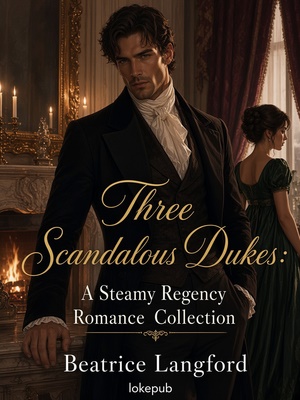
Three Scandalous Dukes: A Steamy Regency Romance Collection
Chapter One
Lydia Grantham stood at the foot of the staircase, watching the scuffed leather trunk bump unceremoniously down the steps, trailing behind Mrs. Grafton like a wounded soldier.
The house was silent, stripped of the clatter of shoes, the hiss of steam kettles, the murmured gossip of maids.
Just silence, deep and settling like dust on furniture long untouched.
“You’ll understand, Miss,” Mrs. Grafton said stiffly, adjusting the strap of her worn carpet bag. “It isn’t personal. But with your father gone, and no income...”
“No need to explain,” Lydia replied evenly, her chin tilted at the perfect angle of polite dismissal. Her voice was steady, if a little cold. “Go on then, Mrs. Grafton. I wish you well.”
There was a pause. Then a nod and the door closed behind the woman with a soft click, final and absolute.
Lydia didn’t move. Not immediately. She stared at the door, at the fading threads of sun stretching across the tiled hall, at the silence that had now taken on the weight of a presence.
So that was that, she thought to herself.
She turned and walked with quiet, deliberate steps through the wide hall, the soft echo of her slippers following her to her father’s study.
She pushed open the heavy oak door and was met with the familiar scent of old paper, pipe smoke, and lemon oil, now tinged with the unmistakable musk of abandonment.
The curtains were half-drawn, and the light slanted golden across the desk where ledgers lay undisturbed.
Lydia had not entered this room often while her father was alive.
It had always been his sanctuary, the one place he would not suffer interruption.
But now it was hers, like everything else he had left behind.
All the mess, the debts, and the scandal. Even the beautiful old townhouse with no one left to clean it.
Lydia exhaled slowly and crossed the room, her fingers brushing the spines of books and paper stacks, the carved edge of the desk, the silver penknife still resting beside the blotter. She sat down stiffly in the leather chair, which creaked under her weight, and reached for the nearest ledger.
It took time to decipher his neat, slanted script.
The columns of sums. Debts owed, debts paid.
And then the names. Names upon names. Some she recognized from hushed conversations over breakfast, from invitations to parties they had never accepted.
Others were strangers. Men of means, she supposed.
Business associates. Aristocrats. Gentlemen who had no intention of paying what they owed to a merchant, even one who’d once been a king of commerce.
Her father’s empire had been built on silk and risk. His fall had come on the point of a letter opener, the one that had slit his own throat.
Lydia closed her eyes for a moment, and then she looked back down at the page.
A name stood out, circled twice in thick graphite, almost angry in its finality. Montclair, Nicholas. Duke of Hawthorne.
Her brows lifted slightly. A duke? Her father had dealings with a duke?
The sum beside his name was not small. In fact, it was enough to keep the house running for another few months. Enough to hold off the butcher. Enough to bring the servants back.
The Hawthorne name stirred something in her memory. Gossip, a mention in the Gazette. Something about debt, a crumbling estate, the absence of heirs. A proud title with a bankrupt legacy, but a duke nonetheless.
She sat back in the chair, eyes scanning the ceiling as if she might find some divine guidance in the flaking plaster.
If she were a different kind of woman, she might have wept. Might have folded under the weight of disgrace and misfortune, as society expected. As they wanted.
But Lydia Grantham had not inherited her father’s recklessness, only his iron will and inconvenient pride.
A sharp wind rattled the windowpanes behind her. She glanced toward the tall window and caught a flicker of movement, her reflection, half-shadowed and blurred by the smudged glass.
She looked tired. Her dark curls, too wild to be fashionable, were pinned back in a style that had begun the day tidy and had since given up.
Her hazel eyes, large and sharp, had always been her best feature, or so her father had told her, back when he still praised things.
She wore a simple walking dress of slate grey, mended at the hem, and gloves without buttons.
But there was something about her bearing, even now, straight spine, tilted chin, lips pressed in determined resolve, that said, No, I will not go quietly.
She turned back to the ledger. There it was in her father’s handwriting, plain and clear. The duke owed her money, which meant he owed her something.
Her gaze lingered on the name again. Montclair. Hawthorne. He was said to be reclusive. Remote. The kind of man who did not attend balls or issue invitations or pose for portraits. A man with a crumbling estate and too much pride.
“How very familiar,” she muttered to herself.
Just then, there was a brisk knock on the front door, three sharp raps in quick succession.
Lydia didn’t rise immediately. She waited, listening to the echo, knowing no one would answer it but her. That was her life now: no footmen, no housekeeper, no cheerful bustle. Only silence and her own determination.
She opened the door to find her fondest friend, Emma Carlisle, bundled in a plum-coloured pelisse, her cheeks flushed from the walk, curls escaping her bonnet in charming rebellion. A wind-blown wisp clung to her jaw as she looked Lydia up and down.
“I passed Mrs. Grafton on the street,” Emma said without preamble, stepping inside. “She was dragging her trunk and muttering about genteel poverty. I assume that means you’ve officially been abandoned?”
Lydia stepped aside to let her in. “She had the courtesy to wait until the tea ran out.”
Emma made a noise somewhere between a laugh and a sigh. “Charming. Shall I help you burn the drapes for warmth, or have we not reached that stage of desperation yet?”
“Give it a fortnight.”
They walked toward the study together, Emma removing her gloves with quick, efficient tugs.
“You look tired,” Emma said as she sat on the edge of the worn settee, her gaze sweeping Lydia’s face with affectionate concern. “And stubborn. Which is always a worrying combination.”
“I’ve been going through my father’s ledgers.” Lydia gestured to the stack of books on the desk. “There may still be money owed—debts left unpaid. I mean to collect them.”
Emma raised a brow. “From who? Ghosts? Dead men can’t pay what they owe.”
“Not all of them are dead,” Lydia said, sliding a particular page across the desk. “This one, for instance. Nicholas Montclair. The Duke of Hawthorne.”
Emma’s eyebrows shot up. “The Duke of Hawthorne? The brooding recluse who hasn’t shown his face at a single ball in three seasons? That Duke of Hawthorne?”
“The very one,” Lydia replied. “He owes my father quite a respectable sum. Enough to keep the house for now.”
Emma gave a low whistle, then flopped back against the settee with dramatic flair. “Well. I suppose if one is going to demand payment from a debtor, it might as well be a dangerously handsome aristocrat with a tragic past and a collapsing estate.”
“You left out emotionally stunted and prideful,” Lydia murmured.
Emma grinned. “I assumed that was implied. Dukes are rarely cheerful.”
Lydia leaned against the edge of the desk, arms folded, eyes fixed on the reflection in the window again, but softer now, as if she were considering her future as a chessboard rather than a cliff edge.
“No one will lend to me, Emma. Not a woman alone. And I cannot access most of what remains from my father’s holdings without a male signature. I need control. And for that, I need a husband.”
Emma sat up straighter. “Wait. Are you suggesting...?”
“I’m considering,” Lydia said carefully, “that if this duke owes me money—and is, by all accounts, also in financial ruin—then perhaps we might come to a mutually beneficial arrangement.”
“You mean to marry him?” Emma’s voice pitched upward.
Lydia gave a delicate shrug. “Why not?”
Emma stared at her. “Lydia. You are proposing to use a business debt as leverage to secure a duke as your husband. A man you’ve never met.
A man with titles and expectations and a crumbling estate full of bitter old retainers who will take one look at your merchant’s blood and faint into their porridge. ”
Lydia arched a brow. “I don’t need his heart. Or his approval. Just his name.”
Emma gaped. “And you expect him to say yes?”
“If he’s as ruined as the ledgers suggest, and I offer a substantial dowry in exchange for his name and signature, why wouldn’t he?”
“Because,” Emma said slowly, “you’re you.”
Lydia blinked. “What does that mean?”
“You’re brilliant, obviously, and stubborn beyond reason,” Emma said, throwing her hands up, “but you’re also proud. You can’t stomach insincerity. You hate being dismissed. And you are not going to enjoy being married to a man who looks at you like a balance sheet.”
“Then it’s fortunate I don’t care whether he looks at me at all,” Lydia said coolly. “Love is for girls with options. I have leverage. That’s all I need.”
Emma was quiet for a long beat.
“You deserve more than this,” she said softly.
Lydia’s gaze dropped to the floor, and for a fleeting moment, her mouth trembled before she set it straight again.
“I deserve a roof over my head. And control over my own future. If that comes with a title, well—so be it.”
Emma studied her with wide, dark eyes. “You’re serious.”
“As a banker’s final notice.”
Another gust of wind rattled the windowpane. Outside, the first hints of autumn gold fluttered from the trees along Bedford Square.
Emma rose from the settee and walked to her friend, placing a warm hand on Lydia’s arm. “If you do this, I’ll stand by you. Even when it all turns to scandal and ashes.”
Lydia smiled faintly. “I expect nothing less.”
“And when the duke throws a book at your head and refuses to marry you?”
“I shall duck, flatter his crumbling pride, and remind him his creditors won't accept brooding as payment.”
Emma shook her head in disbelief. “You’re either the bravest woman I know or the most dangerously clever.”
“Why not both?” Lydia murmured, already turning back to the desk, already reaching for a fresh sheet of parchment.