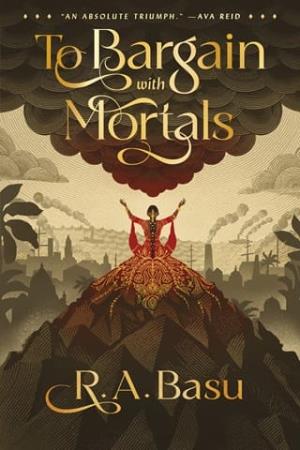
To Bargain with Mortals (The Reckoning Storm Duology #1)
Prologue Stories of Heresy
Prologue
Stories of Heresy
Seventeen Years Ago
The storm was going to tear the mansion apart.
Howling, the winds drove sheets of rain, pounding the stone walls like fists.
Outside, the sea threw itself on the beach, again and again, reaching for the house as if seeking to pull it in and drown it.
A flash of lightning outside lit up the servants’ quarters of the Sutherland mansion, revealing, for a split second, the barefoot six-year-old girl wandering through the corridors.
Though the servants’ quarters were pitch black, Poppy navigated her way deftly until she reached a door at the end of the hallway. She pushed it open tentatively.
“Nanny,” Poppy whispered as thunder shook the house, “can I sleep with you?”
Poppy’s nanny sat upright in her cot, rubbing her eyes as the sheet fell away from her. To her right, a small form stirred—Nanny’s own four-year-old daughter, Samina.
“What are you doing down here, Poppy?” Nanny asked. “You know you’re not supposed to be in the servants’ quarters.”
“Mother said I’m too old to sleep with her.” Poppy sniffled. “She said I’m a big girl now. But I’m still scared.”
Nanny sighed and patted the left side of the cot. “Come, child.”
Poppy didn’t have to be told twice. She scrambled up into the cot, tucking herself in against Nanny’s soft, comforting body.
Though her father had hired Nanny years ago with the explicit instruction to teach Poppy Welkish, sometimes, when it was just the two of them, she still spoke to her in Virian.
She did so now, her rolling consonants and vowels just as comforting as her hand stroking Poppy’s hair.
“You don’t have to fear the storm, Poppy.”
“It’s so angry.” Poppy cringed at another clap of thunder. “What if Viryana sinks?”
“It will not,” Nanny said firmly. “The rains are good, a gift to the land so that things can grow. This happens every year. We’ve had storms like this as long as our people have lived on the island.”
Even though Nanny was a servant, and Poppy’s father, the Duke of Cloudcliff, was the viceroy, she didn’t view Poppy as any different from herself. Our people, she said. Virians.
“But how come the storms never destroy the island?” Poppy asked. “How have people survived so long?”
Nanny smiled, teeth bright against her warm-brown skin. “Let me tell you a story. Once, over a thousand years ago—”
“A thousand? Was the Founder there?”
“No, child. This story takes place long before the Founder’s empire was created, before the man himself was born.”
Poppy couldn’t imagine a world before the empire, but she remained silent as Nanny continued.
“Over a thousand years ago, disasters plagued the island of Viryana. The storms raised the seas, and the skies flooded the lands, drowning the people. The volcano spewed fire and ash, burning and choking those nearby. Strong winds would catch fishermen’s boats and dash them against the rocks.
The earth itself would slide in great heaps or tremble and quake, destroying whole villages at a time.
All this was caused by divine energy, the restless nature of the gods.
“But the people of the island cried out to the gods and begged for mercy.
All they wanted was to live on the island, to be safe and prosperous.
The gods listened to the cries of the holiest few, and on them, they bestowed the gift of control over the four respective elements of water, fire, air, and earth.
Those with the gift used it to tame the sea and the sky, quiet the volcano, calm the winds, and steady the earth.
With control over the elements, humans were able to flourish on Viryana.
Those who could control the elements were considered gods-blessed, and so the people made them maharajas and maharanis, kings and queens, whose job was to protect their subjects, who did not have power of their own.
“And so, the people of Viryana lived safely and happily, with the gods-blessed maharajas of old watching over them, for many generations.”
Poppy yawned, her fear of the storm forgotten. “Nanny, isn’t controlling the elements like doing magic? Father says magic is unnatural. He says it’s heresy.” She sounded out the last word carefully, breaking it into three: hair-is-see.
“Different people sometimes see things differently, and they may use different words to describe and explain things that are actually the same. This divine energy comes from our gods, our land; it is very much a part of nature. It only came to be called ‘heresy’ or ‘magic’ under the emperor’s rule.
But for our people, ‘magic’ really isn’t bad at all—it’s a divine gift. ”
“There are no more kings in Viryana,” Poppy said. “Does that mean there’s no more divine energy?”
For a long stretch, Nanny was quiet. Poppy’s eyelids had grown heavy and had already slid shut when she heard Nanny respond. “No,” she whispered. “There are still Virians with that gift, Poppy, but many of them hide it.”
“Because it’s heresy?”
“Because the Welkish have declared it heresy,” Nanny said. “There is no gift more dangerous to them than one they cannot control. But just because they have said it is so doesn’t always mean that it is. Do you understand?”
Poppy did not respond to that; at last, sleep had pulled her under.
· · ·
Over the course of the next year, whenever Poppy was hurt or scared, Nanny would tell her a new story about the old kings and queens, or sometimes about the gods who had given them their powers.
There were the goddess of the ocean and the goddess of the volcano, who, despite their opposite natures, were sisters who had created the island of Viryana.
There was the story of the maharaja who had designed the first temples to the gods, leveling the land with his earth power to create a smooth foundation.
Nanny would explain how there used to be so many people with divine power, that those who were not royalty would become priests who would use their powers to help with tasks such as farming and fishing.
Sometimes, Samina would sit and listen to the stories too.
Each time, Nanny reminded Poppy not to repeat the stories to anyone else—not even the other girls who sometimes came to visit Poppy, children of her parents’ friends.
“You don’t have to worry about that,” Poppy grumbled. “Everyone just kind of whispers and stares, even the adults. No one really wants to play with me anyway.”
“I do,” Samina piped up helpfully.
Poppy brightened considerably at that. Dark-haired and brown-skinned, she knew she looked different from the other daughters, but she didn’t understand why that brought out such strong reactions in them.
At least she had a friend in Samina. On hot summer afternoons, the pair would go to the kitchens and steal food when the cooks weren’t looking, fruits and mince pies and tea biscuits.
They would take their loot onto the lawn behind the mansion, where they would enjoy their spoils in the shade of the pavilion, safely out of the scorching sun of Viryana’s dry season.
But the monsoon season returned again, and with it, Poppy’s old fears.
The black skies tugged on something in her chest, leaving her feeling unbalanced.
One night, when the storm’s rage was especially vicious, she remembered Nanny’s stories about the kings and queens with the ability to control water.
She opened the window and looked out at the churning sea.
The clouds snarled, lightning splitting the horizon.
Cold rainwater stung her cheeks, but she forced herself to stand tall.
Pretending she was like one of those kings of old, she shouted, “Calm down!”
The storm, of course, did not listen, but giving it a command had made her feel slightly better. Pretending she had control was almost as good as being in control itself, and so she tried again. “Rain, quiet!” She lifted her hands, waving them in the air as though dispelling the clouds.
“Poppy?” Poppy turned to see her father, Clarence Sutherland, standing in the doorway with his night-robe wrapped tight around him, his mouth pressed together in an exasperated line. “Why, in the name of the Founder, are you yelling out of your window in the middle of the night?”
He crossed the room, grabbing the window and pulling it shut.
“I’m trying to control the storm.” Poppy looked at her soaked nightgown as she spoke, feeling slightly foolish now.
Her father paused. “And who,” he asked, looking down at her sternly, “did you get that idea from? Tell the truth.”
“The old kings,” she answered. “Some of them had the power to control water. If they were here today, they could stop the storm. I want to save the island from drowning.”
A long silence filled the room. Then, her father asked, “Is Nanny telling you stories, Poppy?”
“Yes,” Poppy said, hesitating before adding defensively, “I like them.”
He nodded once, very slowly. He kneeled, picked her up, and deposited her back in her bed. “Go back to sleep, Poppy.”
· · ·
Nanny was dismissed the next day. Without so much as a goodbye, she and Samina had already left the Sutherland mansion by the time Poppy arose.
The storm from the previous night had dissipated, but turmoil roiled within Poppy nonetheless; she bawled so much when her parents had broken the news that her mother had left her room in a huff.
“Why?” Poppy asked, again and again. “Why did you let her go?”
“Because,” her father said, “when we adopted you, you could only babble in Virian. Her job was to translate and teach you Welkish. But she was teaching you things that she should not have, and for that we had to let her go.”
“They were just stories,” Poppy protested.
“Those stories were heresy,” her father corrected her sharply. “The glorification of false gods and unnatural power is a crime against the empire. Who is the ultimate power in the empire, Poppy?”
“The Founder,” she mumbled.
“And what did the Founder have to say about magic?”
“But Nanny didn’t tell me tales of magic! The kings’ powers were given to them by the old gods.”
“The Virian gods do not exist,” her father snapped. “I won’t ask you again, Poppy. What did the Founder have to say about magic?”
Poppy shrank down. “It’s corruption,” she said, repeating what her mother had taught her, what she had heard at the Marnapur Cathedral at every service.
“Those who use magic are unnaturals. They’re a danger to everyone else.
For the safety and prosperity of the empire, all must be equal in ability. ”
Her father nodded. “When I adopted you, I swore to raise you with these values. The fact that you see nothing wrong with what Nanny was teaching you reflects a failure on my part.”
He rose from the foot of her bed and paced the room slowly.
“In my life, I have triumphed over every challenge I faced,” he said.
“But when I made you my daughter, everyone told me I would fail. They told me that I could not raise a Virian orphan into a Welkish noblewoman. I didn’t listen to them, because I was so confident in myself—and in you.
After today, however, my confidence is shaken. ”
Her throat closed. What is Father saying?
“I will try, one last time, to have you educated,” he continued. “I will personally select your governess and tutors myself. But if you give me any cause to believe that it is not succeeding, I am not beyond sending you to a boarding school in Welkland for a true education in Welkish manners.”
Poppy’s head spun, the sound of her own heartbeat loud in her ears.
A boarding school in Welkland? Viryana was the only home she had known, the place she was born.
She had just lost Nanny; she could not lose everyone else in her life too.
“Please don’t,” she said, tears in her eyes.
“I don’t want to be sent away, Father, please. ”
Her father softened. He approached the bed slowly and sat down beside her.
“I don’t wish to send you away, either.” He rested a hand on her knee.
“But heed my words, Poppy: If you do not accept the Founder and his teachings and reject all that goes against them—even if it is just stories—then you have no place among Welkish nobility, and you are better off returning to where you came from. Am I understood?”
His words stunned Poppy, and the threat of abandonment dug sharp claws into her heart.
She had come from nowhere—she could not return to that.
She had to be the perfect Welkish daughter, or she would be no one at all.
“Yes, Father,” she choked out. “I understand. I won’t let you down again, I promise. ”
And she didn’t—not until the year she turned sixteen.