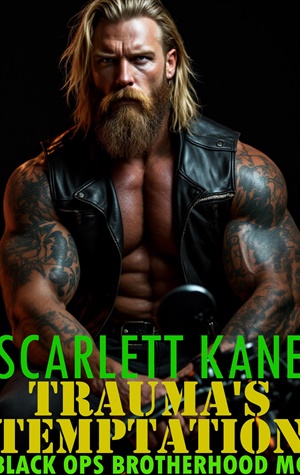
Trauma's Temptation (Black Ops Brotherhood MC #10)
Chapter 1
The diner's neon sign flickered against the Carolina pines, casting pink shadows across an empty parking lot that shouldn't have been empty.
Trauma killed his engine at the edge of the gravel and studied the scene. Tuesday night, almost midnight—Amy's place usually had at least three cars this time of night. Nurses between shifts. Soldiers sobering up. The insomniacs who needed coffee and company more than sleep.
Tonight there was only Amy's beat-up Camry and a pickup truck idling near the dumpsters. Engine running. Headlights off.
Wrong.
He swung off his bike and walked toward the entrance, keeping the truck in his peripheral vision. North Carolina plates, mud-splattered, tinted windows that hid whoever sat inside. The kind of vehicle that wanted to watch without being watched.
The bell above the door announced him.
Amy stood behind the counter, coffee pot in a white-knuckle grip, her eyes fixed on the parking lot through the windows. She startled at the sound, and something flickered across her face—relief, maybe, or fear that hadn't quite decided what to be afraid of.
"Kitchen's closed." Her voice came out steady, but her hands told a different story. "We're closing early tonight."
"Since when do you close early?"
"Since tonight."
Trauma crossed to his usual spot at the counter—third stool from the register, back to the wall, clear sight lines to both doors.
He'd been coming here for eight months, long enough to know that Amy Lawson didn't close early.
Not for weather, not for holidays, not for the drunk private who'd put his fist through the bathroom mirror last spring.
"Coffee," he said.
"I just told you—"
"You told me the kitchen's closed. Coffee's not kitchen."
She stared at him. He stared back.
Something shifted in her expression—the tight line of her jaw softening just slightly. She set down the coffee pot she'd been gripping like a weapon and reached for a clean mug.
"You're stubborn."
"Been told."
She poured without asking how he took it. Black. She'd learned that months ago, the same way he'd learned that she made the best pie in Cumberland County and worked doubles more often than not and had a smile that could make a man forget he'd spent twelve years watching people die.
He didn't see that smile tonight.
"Who's in the truck?"
Her hand jerked. Coffee splashed across the counter, and she grabbed a rag to mop it up, keeping her eyes down.
"What truck?"
"The one you've been watching since I walked in. The one that's been sitting in your lot with the engine running."
"I don't know what you're talking about."
"Amy."
She looked up. Her eyes were tired—the kind of tired that went deeper than missed sleep. The kind that came from carrying something too heavy for too long.
"It's nothing," she said. "Just some guys who've been coming around."
"What guys?"
"Nobody. It's handled."
It wasn't handled. He could see that in the way she kept glancing toward the windows, in the tension riding her shoulders, in the white marks her fingers had left on the coffee pot's handle.
Trauma wrapped his hands around his mug and waited.
The truck sat in the lot for another ten minutes. He counted the seconds, watching Amy pretend to wipe down a counter that was already clean. She refilled his coffee twice without him asking, moving with the nervous energy of someone who needed her hands busy.
When the truck finally pulled away—slow, deliberate, a message in the movement—Amy's whole body sagged.
"See?" She forced brightness into her voice. "Nothing. They're gone."
"They'll be back."
"You don't know that."
"I know trucks don't idle in empty parking lots at midnight to admire the scenery."
She opened her mouth, closed it. Something flashed in her eyes—the urge to argue, to deflect, to pretend everything was fine the way she'd clearly been pretending for longer than tonight.
"I can handle it."
"Didn't say you couldn't."
"Then why are you still here?"
Because you're scared. Because something's wrong. Because the thought of leaving you alone in this diner with that truck circling back makes my chest tight in ways I don't want to examine.
He didn't say any of that.
"Best coffee in Fayetteville," he said instead. "Figured I'd finish my cup."
He stayed until 3 AM.
Amy stopped trying to kick him out after the first hour. She went through her closing routine—wiping tables, restocking napkins, counting the register—and he watched her move through the space with the practiced efficiency of someone who'd been doing this work her whole life.
She was good at it. Quick hands, easy rhythm, the kind of muscle memory that came from years behind a counter. But tonight her movements had an edge, a tension that made every normal task feel like a performance.
"You do this every night?" he asked when she started mopping the floor.
"Most nights. Maria helps during the day shift, but closings are mine."
"Alone?"
"I've been closing this diner since I was sixteen. My aunt taught me."
"Your aunt still around?"
Something shifted in her face. Pain, old and familiar. "She passed. Two years ago. Left me the place."
"Sorry."
"Don't be. She had a good life. Loved this diner more than anything." Amy leaned on the mop handle, looking around the room with an expression he couldn't quite read. "Sometimes I think she loved it more than she loved me. But that's okay. She showed me how to love it too."
Trauma didn't have a response to that. He'd spent twelve years as a Special Forces medic, learned to read wounds and triage chaos, but he'd never learned how to navigate grief that wore itself so openly.
"You should go home," Amy said, breaking the silence. "I've got another hour of cleanup."
"I'll wait."
"You don't have to—"
"I know."
She stared at him again. That same searching look, like she was trying to figure out what he wanted. What his angle was.
He didn't have an angle. He just had a bad feeling and a stubborn streak that wouldn't let him leave her here alone.
"Fine." She turned back to her mopping. "But I'm not making you more coffee."
"Fair enough."
The parking lot was empty when she finally killed the lights.
Trauma stood outside while she locked up, watching the tree line, the road, the shadows between buildings. Nothing moved. The truck was gone.
But the feeling in his gut hadn't left.
"Thank you," Amy said, keys clutched in her fist. "For staying. You didn't have to."
"Get home safe."
"I will."
She walked to her car—that beat-up Camry with the dented fender and the bumper sticker that said Pie Fixes Everything. He waited until she was inside, until her headlights flicked on, until she pulled out of the lot and turned east toward the residential streets on the other side of town.
Then he got on his bike and followed.
Two car lengths back. Headlight off until he hit the main road. Close enough to see her turn signals, far enough that she wouldn't notice him in her rearview mirror.
He told himself it was just caution. Just making sure she got home safe. Just the same instinct that had kept him alive through twelve years of combat medicine and the kind of operations that didn't officially exist.
But when she pulled into the driveway of a small house with a chain-link fence and a porch light that barely worked, he sat at the end of her block for ten minutes after she went inside.
Watching.
Waiting for a truck that didn't come.
Something was wrong with Amy Lawson. Something she wouldn't talk about, wouldn't admit, wouldn't let anyone help her with.
Trauma pulled out his phone and scrolled to Forge's number.
He'd find out what it was.
And then he'd fix it.