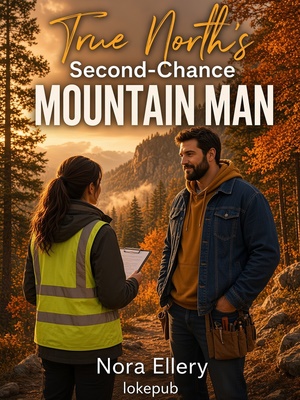
True North's Second-Chance Mountain Man
1. Nadia
one
Nadia
The mud takes my boot to the ankle and doesn't give it back until I put a hand on the hood of my truck and pull.
One sock soaked. Fourteen kilometres of washboard behind me, most of it in second gear. A gate at the bottom of the Kestrel fire road that turned out not to be locked, which is the closest thing to good news I've had in nine days.
The survey cabin sits at the end of the clearing.
Squat, cedar-shingled, a stovepipe leaking smoke sideways in the wind.
A green Ministry plate screwed to the door frame with a number on it instead of a name.
There's a folding table on the porch with a map spread across it and weighted at all four corners — a rock, a mug, a brass compass, a crescent wrench — and a man bent over it with a pencil behind his ear.
He straightens when my door slams. Doesn't call out. Doesn't come down the steps. He waits, the way you wait for weather.
Six foot one, lean the way men get when their work is walking. Grey threading his temples, more than there was. Canvas jacket, sleeves shoved up, forearms marked with the fine white lines of a life spent pushing through alder.
Creed Ellery. I know his name. I looked him up — no social media, no personal site, a business number that rolled to a service and a P.O.
box in Kamloops. He's a mystery I've been quietly obsessing over since a twenty-minute conversation by a window at a conference reception five years ago, one I could never find my way back to no matter how many search terms I tried at midnight.
I know the sound of his voice when he's talking about something he actually cares about.
I know one thing he said about maps that I've used in every project since.
I know none of that from anything he's told me since.
I know it from a version of him that existed once, in a rented suit, for twenty minutes, and then didn't exist anywhere I could find again.
He has no idea who I am. I can see it from the bottom of the steps.
"You’re here. Meridian?" he says, reading the logo on the file case under my arm. "What do you need?"
That's the whole of it. My firm's name off a letterhead he's seen on paper, and my surname because it's printed under the logo, and nothing else. No flicker. No hitch.
"I’m Nadia," I say.
"Creed." He moves the mug off the corner of the map so the wind takes the paper and he has to catch it, and puts the mug back down harder. "You drove that road in a 4Runner."
"Yes."
"Huh." He looks past me at the truck, at the mud to the door handles, and something in his face resettles. It's not approval. It's more like a measurement taken and filed. "Come up out of the wet."
I climb the steps. My legs are shaking.
Here is what nine days of my life look like: forty-one emails, eleven voicemails, one increasingly stiff letter from my managing partner, and a corridor assessment for the North Ridge that is finished except for the part that can't be finished.
The land above Silver Ridge is going to a Ministry decision in November.
My report is the one that says whether the wildlife corridor through it is continuous or broken, and every model I've built is running on 1978 aerials and satellite guesswork until somebody puts real ground under it.
The ground data is his. Three weeks of season-end survey, transects walked and pinned and recorded in his field books, and none of it counts for my filing without a certification page with a wet signature on it.
Not a scan. Not a typed name in a PDF. The Ministry's regional office was very clear about that, and Ravi Bhatt, who has been apologizing to me by phone for two weeks, was the one who finally gave up and gave me the coordinates of this cabin.
"You've been unreachable," I say flatly. It would have been much easier if this man had some sort of digital footprint. But I’d bet Bigfoot has more friends than this guy.
"I've been up here." He says it like those are the same sentence.
Then, because he sees my face: "There's no coverage past the second switchback.
Nothing at camp. I've got a satellite messenger, but the unit only syncs when I'm at the repeater on the shoulder, and I'm at the repeater when the survey takes me there.
Which is Sundays, mostly. Last Sunday I sent nine messages and got weather back. "
"I sent forty-one emails."
"I'll read them in November." He pulls out the second chair without being asked and sets it facing the table instead of facing him, so I'm looking at the map and not at his face.
I notice that. I notice it the way you notice a well-made joint in a piece of furniture.
"Sit. Tell me what you actually need, and I'll tell you if I have it. "
So I tell him.
He listens the way he listened in that corner by the window. Completely, without moving, his eyes on the map while I talk because looking at me would make me perform it. When I get to the certification page he nods once.
"You need my field books signed. You need the last four transects walked, because the certification covers the whole block and I can't sign half a block."
"How many days is that?"
"Eight. Nine if the weather turns, and the weather's turning.
" He taps the northwest corner of the map, where the contours crowd up like something clenched.
"Snow above fourteen hundred by the end of next week.
After that I'm off the mountain whether the work's done or not, and you file with a gap where the ridge should be. "
My deadline is the thirty-first. Today is the fifteenth. It's the tightest math I've ever been handed.
"Then I'll work with you," I say. "I've got the corridor model on my laptop and a generator's worth of questions.
I can take dictation, I can hold a rod, I can run your numbers against my model as they come in, so I'm not building the whole thing in November.
I'm in town at the Brooks. I'll drive up in the mornings. "
"That road, every morning?”
I nod. No amount of mud was going to stop me from getting this job done.
He looks at me properly then, for the first time since I got out of the truck. He has a way of doing it that isn't a sweep — it's the same look he gave the map, one thing at a time, all the way through, and it lands somewhere under my ribs and stays there.
"All right," he says.
I want to say it: we met, you won't remember, it was five years ago at the Marine Building and you told me something about scale that I've never stopped using. I have my mouth open to say it, and what comes out instead is: "What time do you start?"
"First light. Six-forty, this week."
"I'll be here at six-thirty."
He picks up his pencil. Puts it back behind his ear, which seems to be where it lives. "Bring better boots."
The wind comes up off the ridge and takes the corner of the map again and we both put a hand down on it at the same time, and my fingers land across the back of his hand, and neither of us moves for the length of time it takes the gust to pass.
He moves first. Sets the wrench on the corner. Says nothing at all about it.
I drive back down the fire road in the last of the light with both hands on the wheel and my heart doing something ridiculous, and I tell myself the thing I am going to keep telling myself: it doesn't matter.
He doesn't remember a twenty-minute conversation from five years ago.
Nobody would. Bringing it up would only make it strange, and I need eight days of not-strange, and anyway...
Anyway, it was nice.
It was nice to be looked at like a person he was meeting for the first time. Nothing owed. Nothing waited for. Even if my heart wishes he remembered me like I did him.