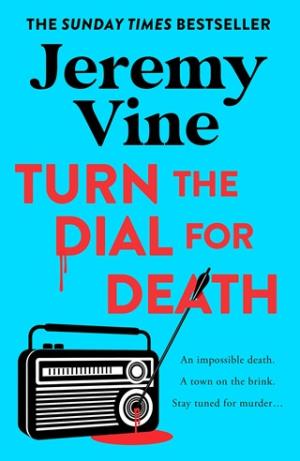
Turn the Dial for Death (The Sidmouth Murder Mysteries #2)
Chapter One
In the weeks to come, the surname of the tall man and his daughter would be spelled incorrectly by almost every newspaper and website that covered the story.
It was spelled wrongly now, and the girl’s father had to correct the man with the strange sandy-coloured hairpiece who was bending over his flight book.
‘There’s no “e” in it, sadly.’
‘So we are C-o-o-m-s, sir?’
‘No. Keep the “b”, so C-o-o-m-b-s.’
For heaven’s sake! He was always having to spell it out. Call centres were particularly bad. That ghastly American rapper had not helped – he was Sean Combs. So now Andrew Coombs got Cooms, Coomes, Coombes, and Combs as well. Even Combes! How could anyone be Combes?
Clara, in a sing-song voice, tried to help. ‘Double-o, then “m-b-s”. Thank you!’ Well, she was ten. Andrew Coombs ruffled his daughter’s hair. ‘I’m sure the nice man has got it, love.’
‘And can I fly the plane for fun, like you promised?’ said the young girl.
‘She’s joking,’ said Andrew quickly. He ruffled her hair harder, accidentally catching the ribbon, trying to convey the message: Don’t say that, darling; not in front of the chap who runs the airfield. I’m a new customer.
‘That’s not allowed, young lady.’ The other man straightened up with an audible clicking of vertebrae and looked out of the window.
He was wearing a pilot’s jacket with service ribbons arranged in a line above the left breast pocket.
He stared at the expanse of grass, mown down the middle in narrow strips to show pilots where to taxi.
Beyond the strip, six single-propeller planes were parked side by side.
Their noses faced the thick forest on the furthest edge of the apron, as if daring each other to take off in a slashing arc through the greenery.
‘We’re rather proud of this place. Devon’s finest tiniest. And you notice something?
No fence around the strip. We trust our locals here. Not like London.’
Andrew would not defend the capital city, even though it had been good to him. ‘Yup. In London those planes would get smashed up in a minute.’
‘Or be stabbed,’ added the other man enthusiastically.
‘Thank you very much, Mr …’ He saw a name badge and read the name out loud, just as the man with the hairpiece said it too. ‘Gracey.’
Gracey addressed Clara. ‘Your daddy only just learnt to fly, didn’t he?’
‘My first flight,’ said Andrew Coombs, answering over her shoulder in case Clara said the wrong thing again. ‘I did the thirty hours and now I’m cleared for take-off. Fresh in my hand, look.’
‘Still warm,’ said Gracey, taking the flying licence with Andrew’s photo.
It said his age: forty-three. Andrew felt like an obvious banker, and knew that by paying his £1,200 fee up front without hesitation, he had nailed himself.
He saw Gracey thinking: A banker with an expensive hobby who is probably raising an expensive daughter, judging by the pink ribbons in her hair.
‘As you’ll know, sir, we are a private airfield, all grass, short runways, so no Civil Aviation Authority inspections.
Unlicensed but safe is how I like to see it.
You mind me asking where you learnt your flying?
Normally people take their first solo flight at an airfield they’re known at. ’
‘Outer London. We moved down here before I could properly get my flying going. The wife wanted a decent view. There are no views in Pimlico.’
‘So you took off?’ Gracey laughed, enjoying his pun. ‘Oh, it’s beautiful down here. Proper country.’
‘We’re on the coast at Instow, and you love your new school, Clara darling, don’t you?’
The little girl wiggled a nose full of freckles.
‘She doesn’t look so sure!’
‘Daddy,’ said Clara, ‘I want to fly now.’
‘Righto, young lady. Yours will be the Ikarus. Single engine. That one in the middle.’
He pointed. They followed his gaze. The middle one of six was meaningless, but Andrew knew the plane because he had done half his lessons with that model.
They were in the airfield office, a stained-wood cabin on stilts which everyone jokingly called ‘the ATC’, for air traffic control, of which of course there was none.
Half an hour later, Andrew and Clara Coombs felt the ground beneath them give way as they took to the skies in the two-seater fixed-wing single-engine Ikarus C42 FB.
In the ATC, Joshua Gracey looked on, pressing his trusty binoculars to his face.
Something was worrying him, but he could not put a finger on what it was.
Andrew Coombs shouted, ‘Can you hear me?’ The engine was loud, so they wore caps with earpieces and wraparound microphones.
‘We are going into the clouds!’ said Clara. The October sun was suddenly dazzling. ‘It’s so small, this plane!’
‘Just us two! Hey daughter, you can have control when we get up high, if you like!’ shouted Andrew, laughing.
‘And Daddy,’ said Clara, ‘I saw a starfish!’
He eased back the throttle, not sure he had heard her right.
He pointed at the compact instrument panel, feeling his nerves abate as he recognized each control.
‘These are for the ailerons, which roll us this way and that.’ He showed her, tapping the control from the left and right.
The plane banked twice, more than he was expecting. Clara screamed.
‘And we call this the elevator – what do you think it does?’
‘Up!’
‘Up and down, yes, and this is the rudder.’
‘Rudder goes left and right,’ said his daughter.
‘What’s that about a starfish?’
‘On the ground, a long way down, behind us. In the forest. Never mind!’
He must have misheard. They flew for another hour.
The airfield was east of Chittlehamholt.
They had flown ten miles north, above miles of lush green, until the houses arrived below them in singles, pairs, then clusters and lines, and then it was the ugly greys of Barnstaple.
Easily he found the mouth of the River Taw.
They took the river line west, heading south where it started to give into the Bristol Channel.
They moved above and below the cloud cover, swapping warmth for a view of the landscape when he needed to find their way.
Appledore and Bideford were below, and he swooped the Ikarus low to show Clara the work a group of enthusiasts were doing to restore the old train station at Bideford; not that the trains would ever run there again.
Now it was the River Torridge they were following, narrower and criss-crossed with heavy bridges. ‘Heading back,’ he said eventually, in his voice a pang of regret but also triumph. He was more confident than he expected.
He heard himself explaining the workings of the aircraft to Clara, and he could almost hear his daughter not listening. ‘Roll, pitch and yaw are the three key words.’
‘What about speed?’ she asked.
‘Well, yes, okay,’ he said. ‘Speed is this handle, the throttle.’ He knew it was more complicated – the throttle was a way of controlling altitude too. ‘You want to take it?’
They were blanketed by cloud now, and the cabin had cooled.
He had the sudden sense of how mad this was, the art of flying – who ever thought you could suspend two armchairs three thousand feet in the air inside a tiny metal box, just by using an engine and some cute levers and buttons?
Don’t look down, he told himself. As they broke back through the cloud, he placed her hand on the throttle.
‘If I speed up, I can show you the starfish.’
‘Nothing sudden. Here, just a push to make it slower.’ He eased off the trim – his instructor had called trim the ‘cheap man’s autopilot’, because it enabled you to maintain a set altitude without constantly adjusting the yoke – but when he took the trim off, the yoke was harder to move than he expected, and the plane dropped fifty feet with its tail down.
Clara screamed and took her hand off the throttle.
‘That’s okay, love, all is fine.’
She calmed quickly and then, as they approached the airfield via the forested area along its northern edge, his daughter said: ‘Look! There’s the starfish!’
This time he knew he had not misheard. He looked. She was right. It was the strangest thing. A starfish lying on the forest floor … but if it was a starfish, it was six feet wide. No, that large white object below them was not a starfish.
‘What the … holy …’ he began.
He was not experienced enough to do what he wanted to do – slow the plane and take it down in a single motion, a combination of yaw and yoke, pointing the nose up with a sudden stab to lower the throttle.
He did not know the plane, but he tried it.
She thought he had cut the engine by accident, and instinctively reached for the throttle, thinking she was helping by pushing it to maximum.
The plane was suddenly upside down and she was screaming.
Andrew Coombs felt himself blacking out, with no sense of where the sky and where the ground were.
He looked furiously out of the canopy and saw trees.
He saw, in a single instant, like the snapping of an old camera shutter, that the starfish his daughter had seen was a human form.
There was a body on the forest floor dressed all in white; as the plane fell, it was as if the father and daughter were being dragged towards it.
The sound of an aircraft throttling, stalling, falling – if an aircraft can be heard falling in an empty forest – was the last noise on earth to reach the ears of Jonathan Wrigley.
Wearing his white linen suit, he lay on the forest floor, arms outstretched, legs akimbo.
Moving in and out of consciousness for what could have been minutes or hours, he knew he could not survive.
The noise of the plane reached his ears and he opened his eyes.
He strained one last time for life, but it was like using a length of cotton to stop a truck pulling away.
The crossbow bolt had been fired so close to him that it must have gone straight through his body, straight through the centre of his heart.
He had felt his torso flood with adrenaline, enough to kill him on its own.
And then the blood came, internal of course, a body drowning in its own rivers.
He wondered who would find him. That plane – could they see him? Could they see the red rose growing on his chest; would they try to get help?
He was conscious for only another second. Somewhere the plane engine cut and he felt his face move into an expression of utter calm. Then the truck in his body pulled out with a roar and he was dead.
If the world had frozen at the exact moment of Dr Jonathan Wrigley’s violent death near Chittlehamholt Airfield, the Ikarus two-seater would have been silent in the air, upside down, directly above him. But of greater relevance to the subsequent police investigation was the position of Thor.
The superhero had been tied to the ceiling of a cave by his arch-nemesis Gorr the God-Butcher. Each time Thor resists, Gorr ties him tighter with heavy gags and bonds he conjures from the air. The confrontation came one hour and nineteen minutes into Thor: Love and Thunder.
The relevance of Thor’s position to Dr Wrigley’s death was that at the exact instant Andrew and Clara Coombs hung in the air above Jonathan Wrigley, and Jonathan breathed his last, his wife Wendy was watching the scene in Gorr’s cave – in a cinema in Barnstaple.
Her unshakeable alibi, as solid as the sinews on Thor’s forearms, would be very important for two reasons. Firstly, the life insurance payable in the event of Dr Wrigley’s death was just shy of seven hundred thousand pounds.
Secondly, his wife had bought the crossbow.