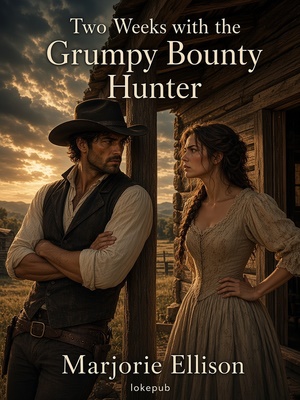
Two Weeks with the Grumpy Bounty Hunter
Prologue
The thread snapped.
Evelyn pinched the frayed end between her fingers and stared at it.
Third time today. Third time on the same stitch, the same stubborn seam on Mrs. Calloway's mourning dress, which—and this bore repeating—the woman did not need because nobody had died.
Mrs. Calloway just liked black. Some people collected spoons.
Mrs. Calloway collected grief she hadn't earned.
Evelyn rethreaded the needle, squinting against the light from the tallow candle Mr. Ridley kept on the worktable.
The man wouldn't spring for a proper oil lamp no matter how many times she asked, so by late afternoon she hunched over her stitching like some old church mouse trying to read scripture in a root cellar.
Her back ached from it. Had ached since seven that morning.
She tied off the stitch and bit the thread clean.
Done. Finally done. She folded the dress into brown paper, tucked the edges, and set it on the shelf behind the counter with the other finished orders.
Four dresses, two aprons, a set of curtains for the pastor's wife.
A week's worth of work lined up neat as headstones.
The shop bell rang.
"Evelyn."
She smoothed the paper wrapping on the last package. "Mr. Ridley."
"I reckon I ought to say somethin', and I reckon you ain't gonna care for it."
"That's generally how it goes with you, sir."
"The Calloway order. She's asked that someone else handle her fittings from here on out."
Evelyn's hands stopped on the paper. "I just finished her dress."
"I know it."
"It's good work. Better'n good."
"Ain't nobody questionin' your work." He looked at the window instead of at her. "It's, uh, well… You know what it is."
She did know. She'd known for three weeks—ever since David Morrow had stood in the middle of a Sunday social and announced his engagement to Clara Pennfield, six weeks after ending things with Evelyn.
Six weeks. No explanation that mattered.
No apology that held up under any kind of thinking on it.
Just a clean, public severing, followed by a clean, public replacement, and suddenly Evelyn Granger had become the girl who got thrown over. The girl who wasn't enough.
Springfield had a long memory and a short attention span for anything that wasn't someone else's misfortune.
"Mrs. Calloway reckons it's… improper. Havin' you handle her garments."
"I sew dresses, Mr. Ridley. I don't sew 'em with scandal."
"I ain't sayin' I agree with the woman. I'm sayin' she's a payin' customer, and she's got opinions, and her opinions got friends." He paused. "Maybe it'd be wise to take yourself some time. A week or two. Let things settle down."
"And my wages while things are settlin'?"
He looked at his boots. Adjusted his spectacles.
Looked at his boots again. Evelyn stopped waitin' for the answer because she already had it.
So, she untied her work apron, folded it with more care than it deserved because her hands needed something to do that wasn't shaking, and set it on the counter.
"Good evenin', Mr. Ridley."
"Evelyn—"
But she'd already taken her shawl from the hook and pushed through the door. The bell clanged once behind her and that, apparently, covered it.
***
Evelyn pulled the shawl tight and stepped off the boardwalk and walked.
The thing about a small town is that you had no invisible way to move through one.
Every street connected to every other street.
Every face connected to every other face.
And every pair of eyes that landed on Evelyn Granger carried the same freight of pity, judgment, or both stirred together, so you couldn't tell which was which.
Two women stood outside the general store under the painted sign that read HARLOW & SONS DRY GOODS.
Mrs. Pratt and her sister, whose name she could never hold onto.
Louise, maybe. Or Louisa. They stopped talking as she approached.
Mrs. Pratt's eyes flicked to Evelyn's bare ring finger, and then back up to her face with an expression that tried very hard to look like concern.
"Good afternoon, Miss Granger."
"Mrs. Pratt."
She kept walking. Behind her, the whispering started again. She caught a fragment—"well, what did she expect?"—and then the rest dissolved into murmur.
What did she expect? Right. Because a woman who accepted a proposal of marriage had clearly overstepped by expecting it to mean something.
Evelyn crossed to the other side of the street, stepping around a pile of fresh horse droppings.
A man tipped his hat to her, Mr. Bowen, the farrier, and the exaggerated politeness of his gesture was worse than the whispering.
That careful, deliberate kindness people offered when they figured you might break.
She'd become something fragile to these people. Something to handle.
She turned the corner toward home and almost walked straight into the Morrow boy. Thomas stammered an apology and sidestepped her so fast he nearly tripped over his own boots.
Even the Morrows couldn't look at her straight.
Soon enough, she found the post office between the land surveyor's and a vacant lot where someone had started building something ambitious and then apparently lost interest. Evelyn hadn't planned to stop.
She'd planned to go straight home, lock the door, sit in the one chair she owned, and stare at the wall until she fell asleep.
But Mr. Aldridge, the postmaster, rapped on the window glass as she passed and waved an envelope.
Evelyn stepped inside.
"Letter for you, Miss Granger. Came in on this mornin's mail coach."
He handed it over. Evelyn glanced at the return address and the knot behind her ribs came undone, just a notch. Just enough to breathe a little easier.
Sarah Cooper. Montana Territory.
***
Home amounted to two rooms above Guthrie's hardware store.
One room for sleeping, one room for everything else.
She had a No. 7 Enterprise cookstove that she'd bought secondhand from a widow on Elm Street—the kind with the cracked firebox plate that ran too hot on the left side if you didn't watch the damper.
Evelyn lit the kerosene lamp, adjusted the wick until it stopped smoking, and set water to heat on the good side of the stove.
She changed out of her work dress into the older calico she wore around the house, the one with the mended tear along the hem that she kept meaning to fix properly and never did.
The envelope bore Sarah's handwriting, that looping, confident script that hadn't changed since they'd started writing to each other at, what, eleven?
Twelve? Evelyn had to think on it. The minister at the orphanage, Reverend Callahan, had run a correspondence program, matching orphaned children with other young folks across the country for letter exchange.
Christian fellowship, he'd called it. Building bonds through the written word.
He'd hand out penny stamps and lined paper every first Sunday, and the children would write to strangers they'd never meet about lives they could barely describe.
Mostly it had produced awkward, stilted letters between children who had nothing in common and stopped writing to each other within a year.
But Sarah Cooper had written back. Every time. For twelve years.
Dear Evelyn,
I won't pretend your last letter didn't sit heavily on me.
I read it twice, and then I read it again this morning.
I'm still angry on your behalf, which I hope you'll forgive on account of the fact that I know you didn't ask for anybody's anger.
But I've got it anyhow, and it's yours whether you want it or not.
That man don't deserve the ink it took you to write his name, and the folks in that town whispering about you like you done something wrong?
Well, I've got opinions about them too. Reverend Callahan always said I ought to practice restraint in my correspondence, so I'll leave it at this.
They're wrong. Every last one of them. And you sitting there taking it day after day is breaking my heart from fifteen hundred miles off.
Evelyn pressed her lips together.
Now, I've got news of my own, and the timing is either terrible or providential depending on how you look at it.
My mother's sister—Aunt Mabel—you remember I mentioned her once or twice? She’s the one in Missouri I never met, and she passed on last month.
Left some property that needs signing over and selling.
It ain't much, but Sam and I need whatever it brings in.
The homestead needs repairs something fierce, and winter ain't never cheap out here.
Sam's gone on bounty work and won't be back for at least two more weeks, maybe longer. He's tracking someone across territorial lines, and you know how he gets—won't come home till the job's done or the money's in hand. So the house sits empty while I travel east to handle the legal business.
I'd planned to come and stay with you during the trip. Keep you company. Eat whatever you're baking these days, and tell you to your face that David Morrow has the moral backbone of a wet newspaper.
Evelyn almost smiled. Almost.
But then I got to thinking of you sitting in that town, surrounded by folks with nothing better to do than judge you for something that ain't your fault. That ain't no good, Evelyn. That's poison. And you drinking it every day ain't gonna make you stronger. It's just gonna make you tired.
So here's what I'm proposing, and I want you to think on it proper before you say no.
Come and stay at the homestead. Take my place while I'm gone.
I'll go on to your town instead, handle the legal papers from there— it's close enough—and you come out here.
Two weeks, maybe a touch longer. The house is solid.
The animals are easy. I'll leave instructions for the whole of it.
You'd have quiet. Space. Nobody knowing your name or your business.
Just mountains and sky and a whole lot of nothing, which I reckon might be exactly what you need right about now.
The place won't tend itself while I'm away, and I'd sooner have somebody I trust looking after it than leave it standing empty. Sam won't be back before I return, so you'd have the house to yourself entirely. No obligations to nobody. Just rest, Evelyn. Lord knows you've earned it.
Think on it. Write me back quick as you can.
Your friend always, Sarah.
Evelyn set the letter down.
Montana Territory.
Two weeks in a place where nobody had heard of David Morrow. She could walk down whatever passed for a road without measuring the distance between herself and the nearest whispering mouth.
The practical objections lined up immediately.
She'd lose two weeks of wages, except Mr. Ridley had just told her to disappear anyway, so that one collapsed on itself.
She'd be alone in unfamiliar territory, but when had she been anything but alone?
She'd be abandoning her responsibilities, but what responsibilities, exactly?
The wobbling table, the cracked wall, and the town that wanted her gone?
And Sarah needed someone to look after the homestead. That part mattered. An actual exchange with Evelyn's presence for Sarah's peace of mind. She could hold onto that without it feeling like charity.
But, Lord. Montana Territory. That meant the railroad west to…
where? Bismarck? Maybe Ogden, if she went the southern route through the Union Pacific line.
And then days of staging by coach through country she'd only ever read about in Sarah's letters.
She'd have to figure the fare, stretch what money she had, pack light.
The whole trip might take the better part of two weeks just getting there and back.
She chewed on that a moment. Then she reached for her pen and paper before the objections could come back around.
Dear Sarah,
Yes.
She paused. Dipped the pen again.
I'll come. Tell me when and I'll be on the first train I can manage. Leave your instructions, and I'll follow them to the letter, and I promise your chickens will survive me even if nothing else does.
I don't rightly know how to thank you for this without sounding more desperate than I care to let on, so I'll just say yes. And that you're the best friend I've ever had, which you already know, but I figure it bears repeating when somebody throws you a rope.
I'll write again with my travel dates.
Yours, Evelyn