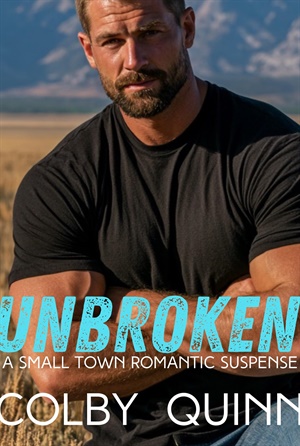
Unbroken
Prologue
FLEEING SHADOWS
My body doesn't know how to stop. It only knows how to run.
Bare feet on dirt. Sagebrush ripping my nightgown. Lungs on fire. Can't pull a full breath, can't stop long enough to try. Sweat soaking through the cotton and turning cold against my skin—burning and freezing at once. Nothing left in me but fear and adrenaline.
My nightgown tore on the chain link going over the fence. A scrap of white left on a barb in the moonlight—a flag, a pointer, a thing Brother Silas will hold between his fingers and know exactly which way to start looking.
He walks the perimeter at midnight. Has for nineteen years. He's sixty, he moves quietly, and he knows this land the way I never will.
I check over my shoulder every fourth or fifth stride. It slows me down. I do it anyway.
My side's been on fire for an hour, the kind that comes from a body that wasn't built for this and is doing it anyway. I press my palm under my ribs and run, because stopping is dying. Or worse.
My feet have been bleeding longer than I know. I see it the third time I check behind me—my own prints in the moonlight, dark where they should be light. A wet trail he won't even need a flashlight to follow.
Fine. Let him follow. He still has to catch me.
I picked tonight on purpose. Moon high enough to see by, late enough that the Brothers would be slow. The east fence, because it backs onto sage, not road. The nightgown, because anything else would've been missed at curfew. I am not the panicked rabbit they think I am.
I'm the rabbit that planned. The rabbit that ran.
A branch snaps behind me.
I freeze. Every muscle goes solid. I count to ten with my eyes wide open, listening so hard it becomes a pressure—and under it, the certainty that he's twenty paces back, that the next sound will be his voice saying Sister Mary, like he's tasting it.
God, I hate the way he says my name. Except it isn't my name. Sister Mary is what they pinned on me the day they took Sloane, and he's said it for four years, slow and certain, like he's the one who decides what I'm called.
He's never laid a hand on me—Pastor Eli wouldn't allow it, not now that I've been chosen. But his eyes have, every day for four years. Out here in a torn nightgown, there's no Pastor Eli to call him off.
I count to twenty. Nothing. Wind through the sage. Something—coyote, deer—moves through the next draw and is gone.
A sob comes up. I swallow it. Sound is what gets you caught.
I move. I move because I am not going to wear that dress, not going to drink that tea, not going to lie on that table and let Pastor Eli put his hands on me while Sister Agnes hums whatever hymn she hums for that.
I'd rather die in this sagebrush. I might. The night seems happy to oblige.
I stumble in a rabbit hole and go down hard—palms, stones, dirt in my mouth. My knee tears open. I push up. I keep running.
If they bring me back, they'll make me wish I was dead. I've watched Pastor Eli for four years. I know what he does to women who tell him no.
The moon is high and merciless. It shows me the ground, and it shows me to anyone behind me. Sage to the horizon. Black shapes that might be rocks. Might be men.
Something rattles in the brush six feet to my right. I stop so hard I almost fold in half.
Rattlesnake. Of course.
Two months bargaining with God to get me out of that compound alive, and the deal comes with a rattlesnake on the path. Because God's a comedian. And tonight, he's killing.
I don't breathe. I don't move my foot. I don't look down, because if I see it coiled I'll scream, and screaming is what gets you caught, and I will not be caught, I will not?—
The sage moves. Whatever it was, it goes.
I run again, harder, lifting my feet higher than makes sense—knees up, knees up—scanning the ground the way you scan for something you don't want to find.
Snakes. Spiders in dirt this dry. Coyotes yipping two ridges over. Mountain lion country—the Brothers talk about a cat that took a calf off the Henderson place last spring. A lion wouldn't need to scream. A lion would simply arrive.
And behind all of it, the worst one. A man with a flashlight and a patient walk.
I'd rather the snake. I'd rather the lion. Animals kill you and it's over. Brother Silas would bring me back.
I run.
The crying starts somewhere and I can't stop it.
Not loud—I won't let it be loud—but my face is wet and the breath comes out in pieces.
I'm crying because my feet are pulp. Because Hannah is still in there.
Because the fourteen-year-old in the second row of the chapel doesn't know yet what the white dress is.
Because I might not make it. Because I should have known—at sixteen, when Sister Agnes put her hand on the back of my neck and called me holy one, when they took my name, when the Blessed Ones stopped looking each other in the eye.
I have been a fool for four years, and the only thing bigger than the fear is the anger. I'm angry at all of them. Pastor Eli. Sister Agnes. Every Brother, every Elder, every white dress on every table. The girl who got in that van at sixteen. The man who made her want to.
Under the anger is everything it's holding back. I want my father. I don't know if he'll open the door.
Sloane.
My name comes up out of me before I know I'm going to say it. Out loud. Into the dark. My real one—the one that fits like a coat I haven't worn since I was sixteen.
Three-oh-seven, five-five-five, oh-one-nine-two. My father's number, stuck to his refrigerator, the one I've known my whole life and had no way to call in four years. I say it on every breath, at the cadence of my feet hitting the dirt, until the number and the running and the name are one thing.
Sloane. Three-oh-seven. Sloane. Five-five-five. Sloane. Oh-one-nine-two.
If it's still his number. If he picks up. If he still wants me back.
I am running because the better thing was a lie, and everything they called holy was a lie, and the whole place was a lie wrapped in a white dress with herbs in the tea—and in the morning they meant to make me a Blessed One.
That's the holy word for it. The real word is Pastor Eli's whore.
One of his wives, his to take on that table whenever he likes, Sister Agnes humming over the both of us.
And if I ever crossed him—burned the bread, held a Brother's eyes too long, cried on the wrong morning—he'd stop calling me blessed. He'd call me a Fallen Eve. And a Fallen Eve doesn't belong to one man.
She belongs to all of them.
The desert can have me first. I will not be his. I will not be theirs.
I slide into a dry wash, claw up the far bank through dead grass, and stop—three breaths. Not four. The fourth comes anyway. So does the fifth.
I could lie down right here. Close my eyes. Let them find me at first light, and it would be over. The thought is so beautiful I almost obey it.
Then I think of the fourteen-year-old. Bitten nails. She'd been chewing her cuffs.
I get up. I run.
Clouds swallow the moon. For a heartbeat I can't see my hand in front of my face. I tilt my head up. There's the North Star. I face east. I move.
I make a deal with the next fence post: reach it, rest for one breath. I make it. I take the breath. I make a deal with the next one. One fence post at a time.
Daddy. It comes up like my name did. I haven't called him that since I was twelve. I am twenty and I am ten and I am six and I want my dad.
And I'm furious about it—that the girl who walked out of that kitchen at sixteen, certain she was choosing something bigger than her father, is the same girl bleeding through her nightgown four years later, praying he picks up.
I deserve every step of this. What I don't deserve is for him to slam the door. But that's his to decide. I'm only the one who has to ask.
I run. My feet have stopped registering as feet. They're something at the end of my legs I'm dragging with me now.
The first yellow light I see isn't the gas station—it's a porch lamp off the road.
I stop on the asphalt, imagining a Wyoming rancher opening his door to a barefoot girl with blood to the knees and four years in her face.
He won't call the number I need, and Brother Silas will arrive before I can explain.
I keep walking.
The next yellow light is a pickup's headlights—coming toward me, from the wrong direction.
I slide off the highway into sagebrush, crouch, and hold still until it disappears around the bend.
My body trembles so hard my teeth click together.
The truck—maybe Brother Caleb, maybe someone worse—doesn't return.
The third yellow light is the gas station.
I don't trust it until I see the pumps and the payphone by the dumpster. The eastern sky has gone from charcoal to a dim, sour gray. I sprint across the gravel, nearly falling, and press my forehead to the payphone's cold metal.
No coins.
A laugh comes out of me—high, broken, not mine—and then I remember: a collect call needs none.
Thank God for the school office. Thank God for missing the bus many times in fifth grade. Thank God, I learned how to do this when I was ten.
My hands are shaking so hard I can't get the receiver off the cradle on the first try.
I drop it. It swings on its silver cord and bangs against the cinderblock, and I catch it on the upswing and try again.
My fingers are not working the way fingers work.
I have to look at the buttons. I have to look at each button and tell my finger to press it.
Zero, first. For the operator.
The operator asks my name.
Sloane, I say.
It's the second time I've said it out loud tonight.
Then the number.
Three.
Zero.
Seven.
Five.
Five.
Five.
Oh.
One.
Nine.
Two.
My finger misses the two on the first try and hits the three. I hang up. I start over. I am crying without sound and I am also, somewhere underneath, laughing at the absurdity of escaping a cult on bleeding feet and getting beat by a damn phone button.
I dial zero and the number again, slower this time, and get it right.
The line rings somewhere far off in the dark. Once. Twice. I press my forehead to the cold metal and count the rings the way I counted the buttons.
A click. The operator's voice, flat and far away, asking the question that decides everything — Collect call from Sloane. Will you accept the charges?
A pause that stretches forever. Then his voice. Steady. Awake. As if he has been waiting all these years for this call and was not going to be asleep when it came.
"I'll accept."
"Daddy?" It comes out as a crack. "It's me. I need you to come get me."
"Where are you?"
No surprise. No questions. Just that. He has never asked me why.
I tell him.
“Ninety minutes," he says. "Stay by the phone. Hide if a car comes. I'll be there."
The line clicks dead. The receiver is still warm in my hand.
I sit down with my back against the cinderblock and start to count.
I count by hundreds because counting is the only thing my mind will hold. When I lose count I start over. The eastern sky goes from sour gray to the color of dishwater. A coyote calls somewhere west of me. Another answers. A semi passes on the highway and does not slow.
Every set of headlights is Brother Silas. Every set of headlights is the white van. Every minute is a minute longer than I have. Every minute is a minute closer to my father's truck.
I lose count eleven times before the headlights come.
It is his truck. Two-tone blue, the older paint underneath showing through where the newer coat has worn. He parks crooked. He moves faster than I have ever seen him move.
I get to my feet. My legs barely hold me—they've been borrowing things for miles now—but I'm standing when his hands come down on my shoulders. His eyes go over my face, my torn nightgown, the dirt on my mouth, the blood drying on my legs. His grip is gentle.
"Daddy," I manage, and then I am collapsing into him.
He takes off his jacket and wraps it around me. He carries me to the truck—my father, who hasn't carried me since I was nine—and sets me in the passenger seat and buckles the belt across me and fires up the heater full blast. Warmth floods in where the night's cold had settled.
He doesn't ask where, now. He already knows.
He drives.
I lean against the window until he guides my head to his shoulder. His hand covers mine.
I don't remember when I last let anyone touch me without flinching.
I don't flinch.
The tears come then, silent and hot, into the worn fabric of his jacket.
I made it.
The runaway came home.
For now, that is enough.
I sleep.