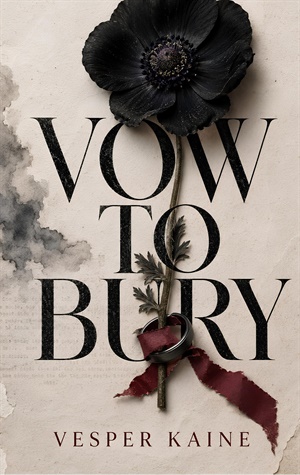
Vow to Bury
CHAPTER ONE
MINA
The dead usually arrive with paperwork.
Not this one.
At eleven forty on a Thursday night, a black van rolls beneath the porte cochère of Vassallo & Daughters with its headlights off. Two men in dark coats bring a zipped transport pouch through my service entrance, and neither asks me to sign a release.
That tells me three things.
The man inside died badly. He died outside the ordinary system. And somebody powerful thinks my license is less important than his convenience.
“Table two,” I say.
The younger man looks at the stainless-steel tables, then at me. “Which one is—”
“The one with the number two above it.”
He finds it. Grief has not made him stupid. Fear has.
The second man closes the prep-room door behind them. He is broader, older, and familiar in the way a storm warning is familiar. Felix Corso has attended six services here in ten years. He has never brought me a body himself.
“Mina.”
“Felix.” I pull a fresh pair of nitrile gloves from the box. “If this is your new approach to supporting a local business, I prefer flowers.”
His mouth almost moves. It doesn’t finish the job.
The transport pouch has no county seal. The zipper is clean, but the fabric near the left shoulder is damp. Not rain. The van came under cover, and the men’s coats are dry.
I touch the zipper without opening it. “Name.”
Felix looks at the younger man. “Wait outside, Tommy.”
Tommy leaves quickly enough to prove he was hoping for permission.
“Name,” I repeat.
“Paolo Corso.”
The cold room seems to lose another degree.
Felix looks through the observation window toward the service hall. No one waits there now. Whoever drove the van has moved it from beneath the porte cochère, leaving only two wet tire tracks and a square of darkness.
“Who else knows he is here?” I ask.
“Family. A physician. Four men.”
“County?”
“Not yet.”
“Then five people know, because I am calling.”
“Mina.”
“If the medical examiner learns tomorrow that I accepted a gunshot death without notification, this room closes. You cannot threaten a license back into existence.”
Felix presses his tongue against the inside of his cheek, thinking. “Give me ten minutes.”
“You have two.”
I call Anika’s office line rather than her personal number and leave a timestamped message with the duty clerk: private transfer received, preliminary certification pending, no embalming until authorization verified.
Enough to protect the record. Not enough to invite uniforms before I know whether they will protect anything else.
Felix listens.
“Compromise,” he says when I hang up.
“Documentation.”
“You always like this after midnight?”
“I improve when other people arrive with crimes.”
His gaze drops to the zipped pouch. The humor leaves.
“He called me at eight fifty,” Felix says. “Paolo. I missed it.”
“Why?”
“My daughter had a fever. I was finding the liquid medicine because apparently every bottle in a house becomes invisible when a child needs it.”
“Did he leave a message?”
“Three seconds. Traffic. He said my name.”
Felix does not need me to tell him missed calls are not decisions. Grief will ignore the distinction anyway.
“Save the voicemail in two places,” I say.
“Already did.”
“Good.”
It is a small thing to give him: a task completed correctly. Sometimes that is the only kindness work allows.
I know Paolo in fragments: a wide smile at other people’s funerals, expensive shoes he never managed to keep polished, a habit of standing beside his mother instead of in front of her.
Forty, maybe forty-one. Older brother to Gabriele Corso, who owns half the freight moving through Port Mercy and has a quiet interest in the half he doesn’t.
“Who pronounced him?”
“A doctor.”
“Doctors have names.”
“Not one you need tonight.”
I peel off my gloves and drop them into the bin. “Then take him somewhere that doesn’t need a license.”
Felix closes his eyes for half a second. When he opens them, they look older. “Please.”
It is the wrong word from a Corso. That makes it effective.
I put on another pair of gloves.
“You’ll give me the medical certification before I embalm. I need a signed authorization from the next of kin. I need the chain of custody, even if you have to invent a printer at midnight. And if anyone asks me to alter an injury or a time of death, Paolo leaves through the same door.”
“Understood.”
“Say the whole thing.”
“No altered injuries. No altered time. We get you the papers.”
“Good.”
I unzip the pouch.
Paolo died in a gray suit and a white shirt soaked nearly black over the chest. His tie is gone. So is the Saint Christopher medal he wore at every service, a small silver oval he used to roll between his fingers when families cried.
The first visible wound sits high on the left chest. There is another beneath the edge of his collarbone. His right hand is scraped across the knuckles. His left cuff is fastened. The right is not.
I do not touch the wounds yet. I look.
People misunderstand this work. They think the hardest part is death.
It isn’t. Death is honest. The hard part is everything the living do around it—arranging a sleeve to hide a bruise, choosing a photograph from before the marriage went bad, asking whether a mouth can be made to look less disappointed.
Paolo’s body has already been arranged to tell a story.
It is not telling it well.
“Where did he die?”
“Parking structure on Barlow.”
“Indoors?”
“Level three.”
I angle the examination light. A tiny black fragment clings to the damp wool near Paolo’s shoulder. Glass, maybe, but not the clear tempered scatter I would expect from a parking structure window. This has a dark laminate edge.
“Was he in a car?”
“They found him outside one.”
“They?”
Felix’s answer is interrupted by three measured knocks.
Nobody knocks on the prep-room door after midnight unless they are family, law enforcement, or lost. Gabriele Corso is the first two without the badge.
Felix opens the door.
Gabe enters alone.
He is taller than his brother was, built less like a man who enjoys being looked at and more like one who expects the room to make space. His black overcoat is unbuttoned. No tie. A pale mark crosses one cuff as if someone gripped it with a bloody hand and then thought better of dying neatly.
His gaze goes to Paolo, stops, and changes so little that another person might miss it.
I don’t.
His right hand closes once. Then he looks at me.
“Leave us,” he tells Felix.
Felix hesitates.
“I need him,” I say.
Gabe does not raise his voice. “For what?”
“To witness that I’m not accepting an unidentified body from unidentified men under an unidentified doctor’s authority.”
“You know who Paolo is.”
“The state of New Jersey enjoys documents even when I recognize the face.”
His eyes settle on my gloves. “You haven’t started.”
“You haven’t authorized me.”
He takes a folded packet from inside his coat and places it on the counter.
Release. Authorization. Preliminary medical certification. They are signed, time-stamped, and too clean for the hour.
“That printer you invented works fast,” I tell Felix.
Gabe’s attention remains on me. “Can you prepare him for Sunday?”
“If Anika releases him in time.”
“Open casket.”
I glance at Paolo again. “Probably.”
“That isn’t an answer.”
“It is the only honest answer before I assess the full damage. You can have certainty or competence tonight, Mr. Corso. Pick one.”
Felix coughs into his fist. It is not quite a laugh, but it has ambition.
Gabe looks at his cousin. Felix stops breathing recreationally.
“Sunday,” Gabe says. “His mother wants to see him.”
There it is. Not the command. The reason beneath it.
“I’ll do everything I can.”
He steps closer to the table, careful not to cross the taped boundary on the floor. People who have never entered a prep room ignore the line. Gabe notices it without asking.
His gaze follows the shape beneath the open pouch. He does not look away from the blood. He looks away from Paolo’s bare throat.
“Where is his medal?” I ask.
“Missing.”
“Was it on him tonight?”
“Yes.”
Too quick. Too certain.
I make a note on the intake sheet.
“Anything else missing?”
“A phone.”
“Wallet?”
“Still there.”
“Watch?”
His left sleeve has shifted. A steel watch rests against Paolo’s wrist, its face clouded near the six. The second hand is stopped at 9:17.
Gabe sees where I’m looking. “What?”
“Nothing yet.”
“I don’t pay for nothing yet.”
“You don’t pay me to invent conclusions either.”
His face does not harden. It becomes more attentive, which is worse.
“Felix,” he says, “the hall.”
This time Felix leaves.
The door closes. The ventilation system pushes cold air between us.
Gabe places both hands on the counter, not touching any instrument. “Your father killed my brother.”
I wait for the physical reaction. It arrives in my fingertips, a fine tremor against the nitrile. I curl them toward my palms until it stops.
“My father has been missing for five years.”
“He sent a message from Paolo’s phone thirty minutes after the shooting.”
“Then you know more about his current number than I do.”
“The message included an account only Salvatore Vassallo and my brother knew existed.”
The name lands harder than father would have. Salvatore is a person who signed forms and burned records and left his daughter above a funeral home with a mortgage. Father is a word for somebody who returns.
“What did the message say?”
“The debt is closed.”
I look at Paolo’s face because it is safer than looking at the man accusing me.
Five years ago, smoke pushed under the old chapel doors while I screamed Bianca’s name and a Corso sedan idled behind the building. Gabe emerged through the side gate with blood on his shirt. My sister did not emerge at all.
The official report called it faulty wiring.
Official reports are paper. Paper burns.
“If Sal killed him,” I say, “find Sal.”
“I intend to.”
“Then why are you in my prep room?”
“Because he left me you.”
The tremor returns, lower this time, somewhere behind my ribs.
I remove my gloves one finger at a time. “No one leaves another adult as property.”
“Your father used this business to move money through repatriation accounts. He placed the deed against a family debt. I can close your doors before breakfast.”
“And lose the only person in Port Mercy willing to make your brother look like himself again.”
His eyes hold mine. Grief and threat occupy the same body without inconveniencing each other.
“I don’t want the funeral home,” he says.
“That almost sounds like good news.”
“I want Sal to come back.”
“You should have led with a wish list. I have stationery.”
He ignores that. “He won’t return for money. He won’t return for reputation. But he might return if his daughter becomes a Corso.”
For one clean second, I do not understand him.
Then I do, and the room becomes very exact: the seam in the vinyl floor, the open drawer, the scissors three feet from my right hand, the distance to the door.
Gabe sees me count.
He straightens. “You’ll have terms.”
“I already have one. No.”
“Forty-eight hours, Mina.”
“Until what?”
“Until you marry me.”
He glances at Paolo, and the restraint leaves his face just long enough for me to see what is underneath.
“Or until I bury everything your father left you.”