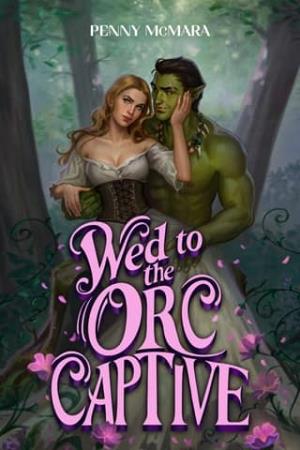
Wed to the Orc Captive (Orc Wed #2)
1. The Captive
THE CAPTIVE
They had captured two orcs, was the news that rolled in, not during the raid, but in the aftermath.
It was news that rolled over me like rain does when your clothes are already soaked, when as far as you’re concerned, there isn’t any more that the water can do.
My father was dead. Jack Cooper hadn't been a good father, but he had been mine. And his death was going to cause me as many problems as his life had.
I trudged through the town to the guardhouse where Tenithin had set up his tax collecting table.
People murmured as I passed. Someone— probably Winnifred— whispered that the overseer had demanded that they take the orcs alive.
It was a man’s voice that snorted back, that by the blood on the clothes of the men who’d brought them, those instructions were not warmly followed.
I’d always heard more than I was supposed to, and it didn’t help me. The basket on my arm was heavy, and I focused on that, on pulling against the weight that tried to drag me into the mud.
The guardhouse was open. Tenithin, our resident vulture, hunched at the wide table, leaning over a ledger, and one of the men, Jarreth, lay moaning on a cot shoved against the wall, bloodied rags around his knee.
The wooden lattice of bars locking off half this room usually held a few drunks or the occasional gossip, or once, John Creely’s son when he’d tried to steal a sow pig.
Now inside that cage a man-shaped creature lounged against the wall near the bars, eyes closed, head tilted back, the sharp, cragged features of the murdering horde.
A deep scar cut down his forehead, purple against the olive green of their kind’s skin.
“Ah, Annora!” Tenithin bleated. “I’d expected you.”
The orc’s eyes opened, and for a moment I forgot why I’d come. His yellow irises lit on me, and was this the last thing so many of the people I’d grown up next to saw, this burning color like molten iron?
“Ah, you noticed the orc,” Tenithin chuckled. “A nasty business, that. We’ll see what the overseer wants done with them, soon.”
The orc’s eyes slid over me. They had bloodied him up, clearly.
There was a cut on the bridge of his nose, and bruising on his jaw and his cheekbone, but he looked utterly unphased, and maybe that was because of the scars that traced his skin, the way his nose had clearly been broken before.
Maybe whatever human peasants could do was nothing to an orc.
His eyes came back to mine, that yellow like a snake’s, and his mouth twisted, contemptuous, a smirk.
“Foul-looking things, aren't they? You don’t often see them up so close.”
The orc glanced at the tax collector and spoke in a deep, cynical voice that rippled, his accent rolling foreign from the cell. “We can understand your language.”
Tenithin looked back, sharply. “Well, wasn't no one talking to you, was there?” He put his back to the bars. “Ugly as sin. But we two have better things to talk about, don’t we?” His rheumy eyes trailed to my basket.
“A…a piteous business, what happened to your father. I know his honor was sorry to hear it.”
False compassion was a performance I was familiar with. Even drowning, I knew the needed response. “He'll be missed.” The lie was a tang on my tongue.
“Of course, of course. Now the undertaker said there were…two brass candlesticks, a good blanket, and a stew pot, along with the deceased’s clothing?”
“Yes.”
“You’re sure?” His wet eyes stared. Oh. He thought I was lying. He thought I’d risk judgment to defraud the overseer.
But I wouldn’t be helped by hiding candlesticks. There was no salvation for me in blankets or a dead man’s boots.
“He was…not inclined towards earthly possessions.” Please look serene, please look serene.
Tenithin hummed suspicion, but didn’t argue, and none of this felt real. The tears from my father's burial had dried in my cheeks maybe an hour ago, or maybe that was rain.
“Well then, I assume you’ve brought…”
I drew out the two candlesticks. “Also…” I pulled out a couple jars of mixed greens in vinegar. “As a gift.”
“Ah.” He picked it up, in his broad hand.“The wife will be pleased. You learned this from Bogdanna, I assume, before…?”
I should lie. I should lie. I should— “It was my mother’s recipe,” I croaked out.
“Oh.” Disappointment tinged his tone. “Well. Still good for a bite, then.”
Jarreth groaned on the guards’ cot, twisting that leg.
Tenithin was noting things down in his ledger, that he’d received the most valuable leavings of the dead.
How much the candlesticks should be worth.
That I was unmarried and now, unparented.
I spoke, too quick, “Is someone coming to take care of him?”
“Hm? Who—"
I looked at Jarreth.
“Oh, him. Well, Bogdanna would come, but Magdala's having her baby…”
I fidgeted with the handle of my basket, the basket that was now so much lighter.
More than anything, more than food, or safety, or freedom from the image of my father’s eyes as they glazed over and his guts slid out, I needed people like Tenithin to see me as someone who did things they needed.
I needed to be needed more than I needed water and bread.
I could survive being hungry a few days or weeks, but if they decided I was a thing to be traded instead of a person to keep, I wouldn’t want to survive long.
“I could take a look at him, if you’d like. ”
Jarreth groaned again, and Tenithin looked up, and maybe there was something like interest in his eyes. “Go ahead then.”
Jarreth’s broad face was shiny with sweat. The bandages looked dry, but too tight, and stained with brown. “Hey there, Jarreth.” I eased my basket onto the floor, and crouched beside him. “It’s just me. Bogdanna will come see you when Magdala and her babe are safe.”
Jarreth didn’t respond. I knelt by his leg and started untangling the bandages.
This had been the trajectory of my life before, tying men’s bandages and waiting vigil with the women who brought life into the world.
When my mother passed and that purpose had been stripped from me, when my father’s demands kept me captive in her place, I’d thought maybe dying might be better. Maybe even marriage.
I’d been very naive.
Jarreth groaned again, and I pulled back the fabric to reveal a nasty gash over his knee.
Tenithin clucked. “I told him he ought to put spirits on it,” the old tax collector called from behind his table. “Spirits or salt or something, to keep the ill-humors at bay.”
“Did you wash this, Jarreth?”
He mumbled something. It did not look particularly washed.
Blood sickness was the greatest danger of wounds, festering and fever, rotting and death.
Once evil got into the blood, you could watch a strong man waste away.
I steeled myself. It had been sitting too many hours for stitching it up to be reasonable, now that the bleeding had already stopped.
I dug through my basket for a bottle of vinegar and poured a bit over the top to cure it, ignoring his hissing curse.
“You’ll want to take yarrow, to make a fever,” I said, “so you don’t let it turn.
Valerian will help you sleep. Bogdanna will have it for you when she gets here.
” I cast about for clean bandaging, but the guard house was more tax office than sick room, and I certainly couldn’t go tearing up my only clothing.
Looking more impoverished or needy would not work in my favor if the Overseer’s eyes fell on me.
A single young woman was already a problem to be solved, and I needed everyone to forget about solving me.
I sorted through the rags from before. Maybe I could turn them so the old blood was on the other side.
Jarreth— he was a large man— mumbled, sweat beading on his pale brow.
I leaned in. “What—"
“Sing,” he said. “I know…you took the power, from your mum n’em. Sing. For my leg.” He reached into his pocket, to hold out two coppers, in a shaking hand.
Bile rose in my throat.
I looked over at Tenithin, the closest thing here to a hand of the law. It wasn’t illegal. It wasn’t strictly illegal. But how many times had censor come down on something that wasn’t really within the law?
Tenithin continued scribbling in his ledger, waved a thick hand.
“You won’t trouble me. Folk customs are what they are.
The magisters will hardly fault you for giving a man a little comfort, hmm?
” he winked. He winked, like every moment now wasn’t taking my life in my hands.
I shook myself. I’d just given the man mustard greens. He had no reason to wish me ill.
“Alright, ” I said, hoarse, to the man on the dirty cot. And then, “Apologies. I’m rusty at this.” I held my hands over his knee, and I started a song.
It wasn’t the common tongue. What trembled out of me wasn’t a language I knew.
It came out of some place in me that my mind couldn’t reach.
The mages with their inspections usually left the singers alone, scoffing at it as a folk magic.
We were only safe from their prodding because we were weak. But even weak magic had a little value.
I held my hands over the injured knee, this wound that needed someone better than I was, a real healer, a real surgeon, and I willed that the heat flowing into my hands could help some way, pleading with whatever power gave me the voice to ease the swelling, to beat back the blood sickness, to spare him from the butcher’s saw.
And as my song trebled out, quiet and simple like a nursery rhyme, I wondered if it also sounded to everyone else in that room like I was wretched and begging.