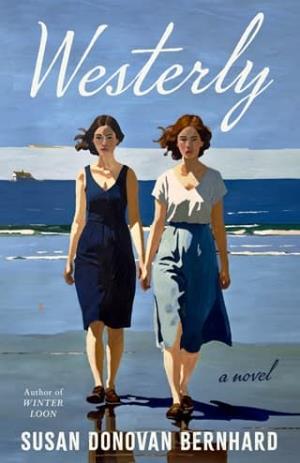
Westerly
Prologue
Faye puts the pies in the oven and turns on the timer, her hands quivering.
She hears William in the living room reading picture books to their granddaughter, Nola Wren, the murmur of his voice, the kerplink, kerplank, kerplunk of blueberries hitting Sal’s pail.
The child giggles, a joy-filled chirp, like birdsong from the yard.
The Irish Times sits heavy as an anvil on the table, though the photo there billows like ash above the newsprint, an apparition, the past come to life.
Faye wonders how she might lash herself to this kitchen, to William, to the life they’ve built—anything to keep from being swept away by what that newspaper could unleash.
This is her favorite time of year, the season turning from summer to fall, the way sunlight becomes shimmery and golden.
Already, squirrels bustle about with green nuts from the oak tree.
Already, robins congregate in friendly flocks.
Yet some storm gathers. She feels it in her bones.
It broods there on the table, black and white.
She remembers a line, something from a Millay sonnet.
My sky is black with small birds bearing south.
William gasps, and she knows he has moved on to the theatrics of Miss Spider’s Tea Party.
That damned newspaper.
“Take a look,” he’d said earlier when he came in from the barn.
“Are these your German girls? The ones from the boat?” When Nola Wren interrupted, tugged on his pant leg, William abandoned the paper as if it contained nothing but a human-interest story and not the story of lives tangled and lost and resurrected.
And on this, of all days. Molly’s homecoming.
Faye grips the kitchen shears like a weapon, gingerly steps toward the table as if she might slay, with quick stabs, this beast that stalks her. The headline is bold and dark as a crow.
Officials, Families to Celebrate
Operation Shamrock 50th Anniversary
Beneath the headline is a photograph, a group of children, thirty or more, alive with ribbing and pushing and horseplay.
She can almost recall the pop of flashbulbs.
The boys perch in back; some hold archer’s bows and single arrows.
The girls sit on a concrete barrier, arms draped around shoulders, scraped knees and slouched socks dangling lazily over the edge.
They are happy and fed. Oranges and chocolate, milk and butter and bread.
Faye’s stomach aches with memory. She is there, her younger self, peering past the camera and into the future.
Her accusing stare gives Faye the shivers.
Another girl, her face as familiar to Faye as her own, turned slightly, head tilted in laughter.
Like a herding dog keeping sheep in line, a nun in black, her white wimple flapped like donkey ears, has corralled the group along with yet another woman, younger, hair spun up like sugar on a paper cone.
Faye sets the shears down, holds the picture to her ear. She bows her head, hoping to hear their voices, if even for the briefest moment, before she must quiet them again.