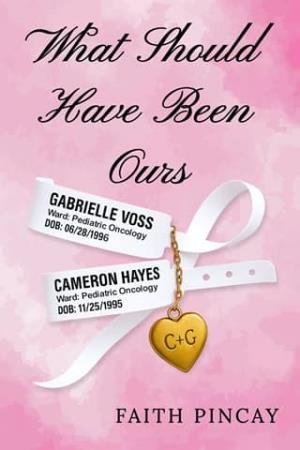
What Should Have Been Ours
Gabrielle
If I never had to step back into this hospital again, I would die a very happy woman. Good thing I’m not dying anytime soon. At least that’s what my doctors kept saying today at my annual check-up.
Growing up—and I mean practically my whole childhood—I lived in and out of this hospital, constantly fighting for my life.
I spent so much time confined here, I now hate every little thing that reminds me of it.
The smell of the antibacterial soap that clung to my skin, the sound of the machines you had to stick your arms elbow deep in to be properly disinfected, the relentless beeping of the monitors I was constantly hooked up to, reminding me that I was never truly free because my body hated me simply existing in this world.
Even a simple knock at the door could sometimes pull me back into a memory of being stuck in a hospital bed for weeks with the constant flow of doctors and nurses in and out of my room, always handing out bad news—the kind that always had my mom swallowing back tears and forcing a fake smile for my sake, trying to shelter me from the truth of how bad it was getting.
She would always attempt to wrap me up in this false reassurance like a safety net that we both knew couldn’t actually catch me.
I knew from a young age that my life would most likely be cut short. I had come to terms with that reality much earlier in life than most people would want to.
Once, when I was thirteen, I had been in the hospital for six weeks—six weeks straight, stuck in a room that reeked of hopelessness.
I was stuck there because the surgery I had just had left my immune system with crippling anxiety of all the evil germs the world was riddled with outside of these walls.
It felt like I was losing more and more of myself every time I got readmitted.
My body made sure I never got to live a normal life or have many normal childhood experiences. I was even pulled out of school at seven and homeschooled until my senior year of high school.
Growing up, life revolved so much around cancer.
That particular hospital stay was the first time I overheard my mom talking to the doctors about how bad things had gotten and how they were running out of treatment options for me.
The options they did have left were slowly being checked off the list as failures.
I saw how much it affected my mother. I could see her trying to accept the fact that her only child would be taken away from her too early in life.
I was all she had. My father left pretty early on in my diagnosis, like he had already decided how my story would end.
I was still pretty young, but I understood that he left because I was too much for him to handle—the sickness, the hospitals, the slow, unbearable waiting.
He couldn’t handle the idea of losing me, so he chose the easier path.
He erased me before death could. It was pathetic.
I think his absence fueled me, like an internal fire lit to keep me fighting and proving everyone wrong, just so that when he came crawling back after life was easy again, I could tell him I wanted nothing to do with him.
That if I wasn’t worth sticking around for when things were hard, he didn’t deserve me back when I could be the perfectly healthy, normal daughter he really wanted.
He never did, though. He moved on with his life. Got remarried and everything. Completely erased us.
I think I started to hate him even more as I watched my mom go through all of it alone. She couldn’t lean on me while trying to be the one to hold me up. She had no one else besides the support groups filled with false hope and fake smiles from others who were barely holding themselves together.
It all started to become such a blur. I constantly felt numb and exhausted as I watched everyone around me fighting for me to live, while I started to care less and less about the idea of continuing the endless battle of waking up every day just to have to fight again.
It started to feel more like a burden than a gift.
Thankfully, even in all the negativity that surrounded this place, I still had a few glimpses of happiness. I met some amazing people here who were going through what I was going through. Although our diagnoses were all different, our struggles were the same.
Sadly, most of the friendships I formed here were like a revolving door. They would either get better, have shorter treatment plans than me, or…not make it.
I tried not to think too much about the ones who didn’t make it. The ones that were in the treatment chair beside me one day, telling me about their lives, their dreams, all the little crushes they had, and then just gone like they never existed, like the world never knew their names.
Sometimes, it was easier for me to try to do the same, as cruel as that was for their memory.
I had to stop myself from spiraling into the dark thoughts about all the destruction this disease did.
How cruel it was for the ones they left behind, the ones who loved them, the ones who had to keep living their lives like their hearts hadn’t been ripped out of their chest and left them with a gaping hole as they went on, like things could ever be normal again.
Most people don’t like to say goodbye to the ones they love most. It was always “see you later”. But here, you learned that goodbyes were more important because the finality of it all was always at the forefront of our minds.
As much as I liked some of the kids I met here, I tried not to get too attached. I learned quickly how broken down you could become with the losses. Especially after the first real experience with a kid I got close to dying. I told myself new friends weren’t worth that pain.
Not getting attached applied to everyone except for one boy.
The only other kid I was close to growing up.
But let’s be honest, it wasn’t something I could have stopped if I tried.
Cameron was as genuine as they came. He didn’t sugarcoat everything we were going through like everyone else around here did, and I always admired him for that.
He was the biggest troublemaker in the pediatric ward, and every nurse was constantly looking out to make sure he wasn’t getting into something he shouldn’t be.
He had this pull to him.
He could convince me to do the craziest things with him, no matter how much trouble it came with.
Like pretending our rolling IV stands were makeshift race cars and we were in Mario Kart. We would race down the halls, running and jumping on the bases, trying desperately to steer ourselves and avoid hitting anything.
One time, Cam almost ran straight into a nurse who was coming out of one of the rooms, and we got a long lecture about the dangers of hallway racing.
Or, like when we would prank all the new nurses that came into our wing of the hospital by placing googly eyes everywhere—on the IV bags, monitors, white boards, oxygen tanks, and even our charts if they accidentally left them lying around.
My favorite was playing fake doctor with the other kids while sitting in the treatment chairs. We would go around making up fake diseases for hours.
“I’m suffering from chronic boredom syndrome. Treatment: Immediate release.”
“I’ve got Cafeteria food poisoning-
Symptoms: Taking one bite of the hospital’s meatloaf and immediately regretting every life decision you’ve ever made.
Treatment: Smuggling in outside food, preferably the greasiest pizza or the fattest burger you can find.”
“I have Advanced Poked-to-death-itis-
Symptoms: Full-body flinching anytime someone in scrubs came in the room— even if they only had a clipboard in their hands.
Treatment: Dramatically gasping anytime a nurse went to place an IV to scare the hell out of them for a laugh and to buy you extra time before being stuck.”
Cam’s personal favorite,
“The Incurable case of being a pain in the ass.
Symptoms: Being too charming, too sarcastic, and too much of a troublemaker for the nurses to handle.
Treatment: Absolutely nothing. This is a lifelong condition.”
Under all of the trouble, he was also the sweetest person I’ve ever met.
When we were little, he knew how much I hated the jello every nurse tried to give me for ‘hydration’ after treatments, so he would sneak me pudding cups and eat the jello for me, leaving the empty container so the nurses would think I finished them, and taking my empty containers of crime evidence back with him to his room so they would never suspect a thing.
Sometimes, when he saw how down I was starting to feel, he would sneak me out of my room, rolling me down the halls in a wheelchair when I was too weak to walk, just so we could go stargazing on the hospital’s rooftop.
The area was restricted to employees only, but somehow, he always found a way to sneak past anyone who could catch us.
Every good memory I have here was because of him.
I still remember the day we met. It’s my favorite memory to hold on to through all these years. Alongside every other memory with him. Even the bad ones.
The day we met, I decided that I was going to be a mute.
Seven-year-old Gabrielle was tired of talking to all the nurses and answering a million questions from every doctor who walked into the room.
I had been cooped up in my hospital room for six days, and I was desperate for any ounce of freedom outside that place.
But I wasn’t allowed to leave the hospital to do anything fun I wanted.
So…I revolted. Anytime a doctor or nurse would come in to ask me questions or talk to me, I would pretend I didn’t even see them. They would, in turn, look to my mom, who would just shrug like she was just as confused as they were.