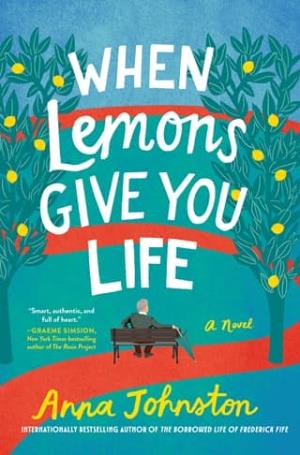
When Lemons Give You Life
1
Griff
I used to believe that food could fix anything.
Forgotten anniversary? Dark chocolate fondant cake with a molten center, cloaked in whipped orange blossom cream—rich enough
to distract from the missing bouquet of flowers and faint smell of panic. Accidentally backed into your neighbor’s garbage
bin? Lamingtons—featherlight sponge layered with raspberry reduction, dipped in glossy ganache and rolled in a coconut peace
offering. Dog ran away? Steak tartare—hand-chopped eye fillet topped with a quail egg yolk. Just enough umami to lure Fido
home. Even the neighbors’ pets will come for that one.
But some wounds don’t yield to heat, seasoning or time.
My eyes rest on the beige plastic breakfast tray that has even less self-respect than I do. They say that food is love. If
that’s true, then nobody loves me, not anymore.
I fling the bowl of lukewarm tinned spaghetti toward the bin. It misses, detonating on the wall in a splatter of tomato sauce.
Limp noodles cling for dear life then slide into the rubbish with a wet plop.
The toast follows. Satan’s butter (also known as margarine) makes it stick for a moment before it succumbs to the same fate.
“Not again, Greg, you old bugger!” Allison, the manager, still hasn’t learned my name.
She stands, hands on hips, green eyes locked on me in a death stare beneath cakey layers of makeup, her dark hair pulled into a tight ponytail.
“Today of all days, when the bloody cleaner has called in sick again!” She wipes the murdered pasta off the wall then heads to the ensuite mirror to wash her hands and reapply her lipstick, the smack of her chewing gum punctuating the silence.
Morning light seeps through the gap in the grimy curtains, cutting the dust into gold slants along the scuffed yellow walls.
Even the air feels tired in here, like it’s been recycled too many times.
Welcome to Sunny Glen Aged Care Facility: where people and their tastebuds go to die. It’s exactly nine months since I was
incarcerated, and like a fully done baby I’m ready to be delivered from this miserable place. Everyone here claims they are
not guilty of the crime of old age and were imprisoned by mistake. Even poor Gladys, who has one bad leg and two glass eyes,
insists she should be back in her Californian bungalow making her famous pumpkin scones.
But I’m the only one telling the truth. I have every single one of my marbles (I checked yesterday). Just because I’m a widower
doesn’t mean I can’t look after myself. I’m not one of those blokes whose domestic skills stop at burning snags on the grill.
My gaze drifts to the cheap pine bookcase opposite my bed, searching for a connection to the man I used to be—the one without
early-onset rigor mortis who still knew how to live. The viola, which Allison “accidentally” knocked off the shelf during
one of her surprise inspections, is broken now, like everything else that used to matter. Above it, the framed photos stare
back: a shrine to a past life when I was visible, when people looked at me like I was worth something.
Forty-year-old Griff, crisp in chef whites, grins in front of his newly awarded Michelin star plaque in Paris, blue eyes sparkling
with hunger for everything still to come. Forty-three-year-old Griff, on his wedding day, arms wrapped around the dark-haired,
honey-eyed love of his life, now frozen forever in 2D. Gray-haired, sixty-two-year-old Griff, mid-champagne pop, celebrating
the three-hatted Melbourne restaurant he built from the ground up.
Now, the closest I get to cooking is tuning in to the Food Network, watching Martin Yan cook hoisin duck while I’m trapped
here eating poison fu—
A knock sounds at the door. “Morning! Sorry I’m late.
They keep promising to hire more staff, but they never do.
Here’s your medication. Remember you take this every morning?
” Dayna is the youngest and least annoying of the nurses, though she could afford to dial down the chirpiness.
She smiles, revealing teeth that age or a lifetime of sweets have not yet had the chance to ruin.
“The sun’s out today, that’s nice, isn’t it, Griff?
” she says slowly, like she’s speaking to someone who’s just learned English.
I try to smile, but my lips are too sad. Nice would be sitting with my precious husband in our sun-drenched garden, surrounded
by wattle trees, freshly baked tarte Tatin and the comfort of the one person who knew me—all of me—and stayed anyway. Living
without Beau is a recipe I will never master. Each morning arrives heavier than the last, and the weight is now more than
I can bear.
Dayna hands me my cholesterol pills and a plastic cup of tepid water.
I toss them back like a shot of whisky.
“Careful, Griff. Wouldn’t want you to choke,” she says, brushing her auburn fringe from her face.
Speak for yourself, love.
“All done? Good man, see you later.”
Good man? Pfft. If only she knew how very bad I am. Or how hard I’ve tried not to be.
She’s barely left the room when I hear her voice float down the hall. “Griff’s getting worse. I’m not sure how much he understands
anymore. And he’s still so down; I hoped the new meds would’ve helped by now.”
It’s not just me who’s depressed here. My gaze drifts along the beige hall to the central courtyard, a square of patchy grass
and cracked paving. In the middle stands Sir Birdbrain, the scarecrow who looks like he could do with a Prozac or two, the
poor sod. A magpie pecks at his hat, adding insult to injury. They put him there to deter the swooping birds last spring,
but it didn’t work, and many a resident’s toupee is now lining the nest of the black-and-white brute.
“Is there anyone on the waiting list?” Dayna continues. “Maybe we could try to put someone in with him? It is a double room,
after all.”
I stare at the vacant bed opposite mine, identical to my own, with its wipe-clean headboard, plastic-covered mattress, and comforter in faded eucalyptus print. A heavy sorrow presses down, thick and airless. I can’t have any witness to what I’m about to do.
The one perk of being a resident in the most short-staffed, negligent nursing home in Australia is that I get loads of time
to myself. The only days things get done is when accreditation’s around the corner. Then fresh flowers appear, we’re properly
groomed and we even get a decent meal, which I highly suspect is from the Italian joint down the road—I saw the Uber Eats
delivery van. Heard on the grapevine that Allison even had the nerve to make extra on the side, invoicing residents’ families
for a “seasonal menu upgrade” at a shocking markup.
An ambulance siren screams in the distance. I knew the day I moved in that my parole would never come. There’s only one way
out.
I remove the A4 notebook from my underpants drawer, running a hand over the smooth red leather cover. The Death Menu. It’s my bucket list. For most people that’s a list of things you want to do before you die; for me, it’s a selection of
ways I could kick the bucket. Thinking about it would have sufficed, but years of culinary training mean I have to document
everything, preferably with bullet points and garnish. I may not be able to choose what I eat or wear, but I sure as hell
will be going out on my own terms. It’s the one thing I can still control.
As toxic as it is, “Allison’s Death Stare” still hasn’t killed me. I’ve already had a red-hot crack at “Bored to Death.” Turns
out, simply existing in this rot-hole isn’t lethal. I’d seen “Death by Chocolate” on enough dessert menus to wonder if it
was actually possible, but if last Easter taught me anything, it’s that eating an entire packet of chocolate eggs in one go
will end with me on the toilet rather than in the grave.
I skim further down to Number 13, the most likely contender. For some time, I’ve been fake-swallowing my sleeping tablets—a
trick perfected during my early childhood when I dreamed of becoming a magician, practicing the disappearing coin in the mirror,
slipping it down my sleeve at precisely the right moment. I can swig the pills down with some top-shelf whisky, and it will
be lights out for good.
I’ve given myself till the end of the day to decide. Tonight, the year 2024 and I will go out together with a bang . . . or a cacao overdose . . . or with no noise at all.
I flip to the last page and pull out a Polaroid photo, the edges curled from years of handling. My throat tightens as she
beams up at me from the faded square, with her missing teeth, dark pigtail braids, and face full of blind trust. A reminder
of a memory I don’t want to have, of a person I have no right to miss.
I often wish I had one of those AA handbooks that tells you exactly how to make amends with everyone you’d ever wronged. But
I’m not sure there’s a step that could traverse a lie so vast, so irreversible, it would be pointless to even try.
So, now that I’ve finally caught up on the latest season of MasterChef, I have nothing left to live for, and I’ll be damned if I can stomach another of these godawful meals. Honestly, I’d rather
eat the gingerbread latte–scented candle Gladys’s niece made for all the residents at Christmas, now stinking up my closet.
At least it would have some flavor. I grab a pen and scrawl Number 35: “Eat Scented Candle.” It must be toxic, right?
A soft flutter from the hall breaks the silence.
I glance toward my open bedroom door as a scruffy sparrow lands on the threshold. Its tiny chest puffs in and out, breathless
but defiant. It looks around, then hops a cautious step inside, eyeing the abandoned toast in the bin.
“You’re brave to come into this place, little mate,” I venture. “Hang on a tick. I can do you one better than that.” The words
feel strange in my mouth—it’s the first I’ve spoken out loud in two weeks. I remove a packet of gourmet crackers I’d been
saving from my wardrobe and crumble one onto the floor. “Come on then. It’s not much, but it beats that slop.”
The sparrow hops forward, head jerking side to side, then pecks at its meal.
“Gosh, you’re a beauty, aren’t you?” I say gently, sitting back down. “If I had it my way, I’d serve you slow-roasted millet
on a bed of freshly diced Fuji apple.”
The bird pauses, crumbs clinging to its beak. Then, without fanfare, it flits onto the toe of my slipper and settles.
I stare at this grubby, battered creature choosing to rest here, of all places. A lump rises in my throat, the kind that comes
when someone trusts you without asking for anything in return. “I don’t think birds are allowed in here,” I whisper. “But
I won’t tell if you won’t.”
And for a few moments, I’m not alone.
Loud yelling travels down the hall. My feathered friend startles, vanishing into the corridor. The sound is coming from one
of the dementia residents, poor thing. I wonder, for the millionth time, what it feels like to live inside a mind that is
slowly misplacing itself. Are they better off than me? I’m surrounded by people losing their memories, while mine won’t leave
me alone.
Most of those residents don’t have visitors anymore. Dementia is like the finest of cheesecloths, sieving out the true friends
and family from the fake. My stomach twists—a reminder of the loyalty I no longer deserve.
Two residents shuffle past, frames rattling—poor Rob, his back curved like a boomerang, and Silvia, who constantly pleads
for a ride home to Rome, unaware she’s lived in Australia for the past fifty years.
Guilt flushes through me, sudden and hot. They need to be here. My gaze snags on the mirror. The man staring back does not.
This Griff is sixty-four.
This Griff has all his faculties.
This Griff is faking dementia.