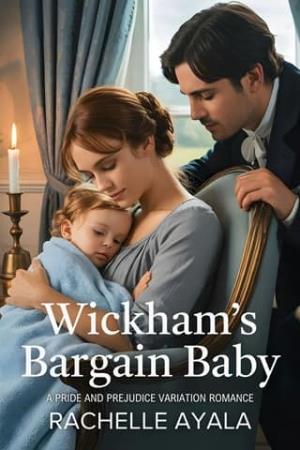
Wickham’s Bargain Babt (Darcy and Elizabeth Forever: Pride and Prejudice Variations)
1. The Marriage Bargain
CHAPTER ONE
THE MARRIAGE BARGAIN
Fitzwilliam Darcy was the last man Elizabeth expected to appear in her drawing room. He arrived early on a rainy spring morning and requested an audience with her father.
Her mother bustled up the stairs and squeezed into the chamber Elizabeth shared with Jane. “Lizzy, dear, you must freshen your face and arrange your hair properly. The green gown will do nicely; it complements your eyes. And for heaven’s sake, stand up straight, and pray, do not slouch.”
Jane exchanged a worried glance with Elizabeth.
It was rather too inconvenient, and Elizabeth wished she had not confessed her secret fears to her sister, whose face hid nothing.
Placing a hand upon her belly, she steadied her fluttering nerves and allowed her mother to begin coaxing her rebellious curls into submission.
“What could Mr. Darcy possibly want with me?” she asked her mother, who was uncharacteristically subdued. With ten thousand a year sitting under their sagging roof, Mamma ought to have been in transports of delight. Instead, she carried herself as if preparing for a rather unpleasant funeral.
“Mamma, do we owe him money?” Jane’s brow creased to impossible depths, her hands twisting around each other.
The winter had been cruel indeed. Elizabeth and Jane had spent two months in London with the Gardiners, and during their absence, the house had surrendered to its age and neglect.
The roof had given way under the weight of the snow, and their father’s cough had taken a permanent hold upon his lungs.
“Mamma?” Elizabeth prodded when her mother’s face in the mirror approached the consistency of granite. “What is the matter?”
“Mr. Darcy wishes to propose.”
“To whom? Jane, or me?”
Jane’s face blanched in the mirror. “But we hardly know him, and he despised us when he left Netherfield. Miss Bingley made it quite clear that he found our family deficient.”
“Yes, but…” Mamma looked nervously at the door, as if expecting the arrival of bailiffs. “Papa will explain. Come. He is waiting.”
Elizabeth exchanged a look with Jane as a foreboding dread settled in her chest. This was not the mother she knew. Even with Mr. Collins, Mamma had been loud, pushy, and hopeful. Her unnerving silence was far more terrifying.
Naturally, the fear of her father’s death cast a pall over everyone, worsened by his cough that had grown harsher with the rainy weather and by water seeping even into his study, now converted into a sickroom.
Elizabeth swallowed the bitter taste of uncertainty. Mr. Darcy, for reasons known only to himself, had come to Longbourn to purchase a bride, and she appeared to be his intended choice.
“Girls, girls,” Mamma commanded her other daughters.
“Do be certain to appear at your best, should you be summoned. You too, Jane. Greet Mr. Darcy with your most pleasant smile. And Mary, do not present such a dour countenance. Lydia and Kitty, remain near the banisters, where you will be seen but not heard. Now, Lizzy, chin up.”
Elizabeth followed her mother down the stairs, feeling like a prisoner led to the scaffold, though in her situation, this might be the very escape she needed.
The study was still, save for the wet, rattling sound of Papa’s cough. Mamma knocked before pushing open the door. Her touch against Elizabeth’s back was almost comforting.
“Mr. Darcy, may I present my daughter, Elizabeth?” was all she said before she tried to retreat.
“Dear Mrs. Bennet,” Papa wheezed. “Please, sit.”
Mamma looked flustered, unaccustomed to being included in a matter of such gravity, but she clutched her handkerchief, cleared a stack of moldering volumes from a chair, and obeyed.
“Now, Mr. Darcy, you may address my daughter,” Papa said.
Mr. Darcy’s presence seemed to shrink the cramped room.
He clasped his hands behind his back in that familiar, aloof stance she had witnessed at a dozen assemblies, as if he longed to be anywhere else.
Why did he bother to occupy space he clearly despised?
What did he think, surveying the water-stained ceiling and the damp encroaching in every corner?
“Miss Elizabeth Bennet,” he enunciated her name as if making plain that she was the Bennet girl he was addressing.
“Mr. Darcy.” Elizabeth forced a curtsy of the precise depth required by propriety. “What unexpected pleasure.”
His gaze fixed upon her for a measured moment, plainly finding no pleasure whatsoever in their encounter.
“Miss Elizabeth, I will not insult your understanding by pretending this is a morning call. I would rather set the matter before you plainly and trust you to receive it in the same spirit.”
“By all means, sir. I have always found plain speaking a great virtue.”
“Lizzy, darling, do be seated. Mr. Darcy, if you please. I shall call for tea.” Mamma rose and fluttered to the door. “Hill! The good tea, if you please. Mr. Darcy has a matter of the highest importance to lay before our Lizzy.”
Elizabeth’s heart was like a trapped thing in her chest. She took a seat, though Darcy remained standing.
“I have lately taken charge of a child,” he began.
“A boy, not yet two years of age. His mother is passed, and his father is my half-brother, who is not to be trusted with a kitten, let alone a son. In any case, he has no wish to make the attempt, and the boy is now my ward. He has a devoted nurse, a warm nursery, and every comfort that money may provide. What he does not have is a mother. That, I find, is not among the articles a man may buy.”
“Indeed, I don’t expect we will find many mothers for sale at Tattersalls, unless you favor the snorting kind. May I ask why you speak to me?”
Mr. Darcy tugged at his cravat as if uncertain how to respond to such directness. Elizabeth glanced toward her father, who offered a weak, encouraging nod. Beside her, Mamma signaled with frantic, fluttering gestures to curb her tongue.
“Lizzy, your mother and I will not compel you… to accept a proposal,” her father said between gasps and coughs. “However, you should hear Mr. Darcy out. He comes from… a position of honor… and addresses a necessity we cannot ignore.”
“Yes, Papa.” Elizabeth braced herself, recognizing this as a proposal she would ordinarily reject outright. “Mr. Darcy, I am rather astonished you have chosen me.”
“I would, Miss Elizabeth, because you are the only woman of my acquaintance I could not manage to forget over a winter of trying.”
He seemed to hear the sentence only after it had left him, and looked as though he would have called it back if he could, his jaw set against any further such lapses.
“Naturally, you could not forget me, Mr. Darcy. You heartily disliked me, found offense in everything I said and did, and looked at me across every room in Hertfordshire with the most particular disapproval. And you found my family beneath you. It hardly bodes well for a mere winter of failed forgetfulness.”
His jaw clenched, signaling that she had landed a blow, though she was not entirely proud of how satisfying she found it. Mamma made a sound like a kettle undecided whether to boil, while her father produced a noise that began as a cough and ended, unmistakably, as a laugh.
Hill entered with the tea service, allowing a pause in the conversation. Darcy did not touch his tea, though he at last took a seat, his presence no longer looming, but heavy.
He cleared his throat to continue, “Miss Elizabeth, I will not quarrel with your sentiments, since I mean to be honest. I require a wife who is a gentlewoman of sense and character, fit to govern a household and to love a child who has recently lost his mother. In return, I will discharge your family’s debts, set Longbourn to rights, and provide for your mother and your sisters against whatever may come.
I will also engage a London physician to treat your father’s illness.
Should we marry, I shall consider your family my own, and I hope you might extend the same consideration to mine. ”
He avoided the matter of affection entirely, which was perhaps for the best. Elizabeth had always sworn to marry only for love.
But this was before her impetuous behavior in London.
She had wandered near the Cheapside coffee houses and found herself drawn into that circle of radical thinkers and poets, amongst whom was a man—no, better not to think of him, she reminded herself as color filled her cheeks.
“Perhaps you wonder why you are so suited to this role,” Darcy added, misinterpreting her silence.
“I have watched you sit in a crowded room while your relations did their utmost to mortify you, and not one of them contrived to do it. A child not quite two will try a great deal harder, and at far less convenient hours. I require a woman who cannot be routed.”
It was the most backhanded compliment ever laid at her feet, and the most observant. She had assembled a serviceable opinion of him not five minutes since—a cold man pricing a governess he need not pay, whereas a wife was a permanent, captive acquisition.
Now, he had complicated matters by actually seeing her.
“Papa,” she said, and discovered she could not meet his eyes. “What would you have me do?”
The cough that answered her dragged on until it seemed it would never cease, and when he spoke, his voice was a mere rasp.
“I had rather hoped to be carried off before I should be put to any use. You observe how my arrangements are forever overturned.” The jest cost him a fit of coughing.
“The choice is yours, Lizzy, and I’ll not insult you by calling it a free one.
Mr. Darcy has been honest. He claims no sentiment he hasn’t got, which is more than most men manage.
Decide as you please. I shall approve of whatever spares me the exertion of an opinion. ”
In other words, the welfare of her entire family rested on her shoulders.
She reflected, with a wry, bitter humor, that Mamma was too shocked to remind her that had she accepted Mr. Collins, she might have held the keys to Longbourn herself.
That had been November, when she was still a lady with prospects.
Now, the memory of her London escapade felt like a stone sewn into the hem of her gown, dragging her down.
She thought she had no more dread left to feel, only to realize she was mistaken.
She had been offered a respectable marriage, a house in the north, far enough from anyone who had ever seen her walk where she ought not to.
Then, her thoughts drifted to the boy—a baby really—who cried for his mother.
Having comforted many stray creatures in her time, she knew that peculiar, hollow loneliness.
“Mr. Darcy,” she found her voice. “You have not asked me a proper question for which I must answer. You spoke to my parents and laid out your terms. I am still a maiden who would prefer to be asked. I find I am quite sentimental about the matter, as it may well be the only sentiment I have left by Thursday.”
“You require the proposal on my knees?” He raised a skeptical eyebrow as if unable to believe a woman he viewed as a practicality should be so touched. “Very well.”
Before he could move, Mamma’s restraint finally shattered. She threw open the study door. “Girls! Girls! Mr. Darcy is about to propose to Lizzy! Come, come, we are to be saved!”
Her mother still had some of her old spirit left, even as the plink plunk of the leaks into the washtub kept its steady rhythm.
A flurry of skirts and gasps crowded into the study.
Elizabeth caught Jane’s eye and gave a singular, decisive nod, a silent sisterly language sealing their pact: Elizabeth would marry Darcy, and Jane would keep her lips sealed, staying to comfort Mamma when the end came.
Beyond that, she refused to look or think about.
Mr. Darcy rose, then lowered himself to one knee and took her hand, looking across at her rather than up, for Lizzy had always been the smallest of the family, her father’s “Little Lizzy.”
“Miss Elizabeth,” he said, his gaze intent. “Will you do me the honor of becoming my wife, and a mother to a child who has none?”
The phrase “a child who has none” pierced her heart in a way the financial settlements and the leaking roof never could. She would have to revise her opinion of him, which was vexing, as she had only just settled into it.
“Yes,” she said. “I will.”
And then, they looked at each other, while Mamma finally burst into tears and chortled at the top of her voice, and Lydia was already complaining that she was surely tall enough to manage a two-year-old, and Mary offered the dry, unbidden observation that it was better to marry than to burn.
Elizabeth could only give Darcy a wet smile, blinking back tears she had no right to shed, born of reasons she could never explain, not even to Charlotte Lucas.
Darcy did not smile in return, and she found, upon reflection, that she preferred it—for a man who could offer a pleasantry at such a moment would have been entirely absurd.
Rising to his feet, he released her hand, bowed, and turned to her father. “Mr. Bennet, my solicitor shall attend you. I have come prepared with a special license, and we shall be wed on Thursday. Mrs. Darcy will want for nothing. My carriages shall be arranged to ensure her every comfort.”
“Thank you, Mr. Darcy,” her father wheezed from the pillows. He coughed, then turned his fever-bright eyes toward Elizabeth. “Godspeed, child. Godspeed.”
“Miss Elizabeth?” Darcy queried as he stood with his hand upon the door. “Will you require additional arrangements?”
“No, Mr. Darcy, I shall be prepared.”
If he found her eagerness strange, he gave no sign, bowing stiffly to her weeping mother and her stunned sisters before stepping out into the rain.
The study, once filled with his formidable presence, now felt overwhelmingly small, as if the walls had closed in upon those who remained behind, their future now significantly altered.