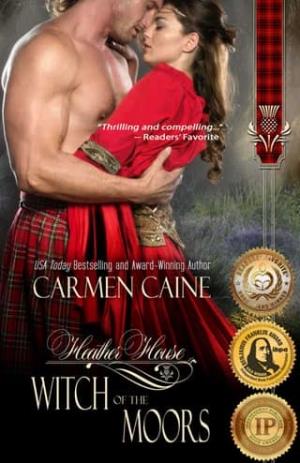
Witch of the Moors (Heather House)
A Parting
The dream returned that night.
Flames. The acrid stench of burning flesh. Profound silence shrouded the scene as a black column of smoke billowed up into the gray winter sky to greet the newly falling snow.
Sorcha knew what came next. The dream appeared with each full moon in an agonizingly painful cadence.
Screams split the air, the ear-piercing shrieks of a woman meeting death.
From a bird’s-eye view, Sorcha saw herself stumbling after a black warhorse, her red hair plastered with mud, her face white, and her hands tied securely with a length of coarse rope.
The priest astride the horse held the other end.
He yanked it. Hard. She fell to her knees, scraping her palms on the rough cobblestones as a mob armed with torches and sticks descended upon her.
Manure and rotten vegetables rained down from above.
She lay where she fell, too exhausted, too numb to feel as a flurry of snowflakes swirled before her eyes.
The priest pulled the rope again, intoning a prayer, his words whipping the crowd into a frenzy.
Sorcha awoke with a gasp. Sitting bolt upright, she stared blankly at her surroundings. A simple croft, sparsely furnished.
“’Tis the dream, lass?” a woman’s soothing voice queried.
Memory returned in a rush. Heather House. She was safe, hidden deep in the forest bordering the windswept moors.
Sorcha drew a long, steadying breath. “Aye, ‘twas the dream,” she admitted, scrambling to her knees. There would be no more sleep this night. Twisting her long, auburn locks into a loose braid, she began rolling her straw pallet and added briskly, “I’ll see to the goats, Christine. Dawn is not far off.”
“Leave the goats be, Sorcha,” Christine ordered softly. “We must speak.”
The curiously sad undertone threading her words made Sorcha pause.
Christine stood by her bed, a gentle middle-aged woman with shoulders bowed as if sagging under a weight too heavy to bear.
Her silver-blue eyes brimmed with sorrow and her smile, though warm, held more than a full measure of pain.
“My heart is heavy, child,” she murmured, moving forward. “The day has come.”
Slowly, Sorcha rose to her feet.
“You’re such a wee, slight creature, with more fairy blood than aught else,” the woman whispered, tears escaping from her eyes. “But ye’ve strength enough. Aye, ye must leave Heather House. At once.”
“Leave?” Sorcha repeated, her voice catching in surprise.
Heather House was her home, a sanctuary from the chaos of the outside world.
Years ago, she’d fled the Montgomery raids with her mother, the same raids that had killed her father, Brogan Cunningham—a man she only vaguely remembered.
Heartbroken, they’d stumbled across the moors and into the woodlands, discovering the glen with its ancient stones circling an even older willow and, following a small burn, they crossed the stone bridge that led to Heather House.
The wise-woman, Christine, had welcomed them with a ready smile and kind words that soothed their pain.
They’d never left.
“Leave?” Sorcha said again, willing the frantic beating of her heart to slow. “The stones called me here, ye said it yourself and many a time.”
“Indeed,” Christine granted, pausing before the table laden with bundled herbs ready for market. “The moment I saw ye, ‘twas clear ye possessed the second sight, lass. ‘Tis in the eyes.”
She fluttered her fingers at her own unusual ringed eyes, eyes identical to Sorcha’s own: a silver ring circling the pupil, followed with a band of deep sea-blue and ending with an outer edge of violet. Uncommon eyes. The mark of the Second Sight.
As Sorcha joined her at the table, the wise-woman reached out to cup her cheek with a steady hand. “My dreams tell me that ye have to go, lass. ‘Tis time to see the curse hanging over your head undone, lest it spell ye for eternity.”
Sorcha tensed. “The dreams,” she said, fighting a lump in her throat.
Of what use were the accursed things? She’d dreamt of her mother’s death three months before it came to pass.
She’d foreseen the fever but had been powerless to stop it from carrying her away.
And her recurring dream … well, ‘twas clear, the ending. She shuddered. “’Tis foolish to leave. Only disaster awaits me in lands beyond.”
“The dreams canna be changed,” Christine said, holding up a cautionary finger. “‘Tis written in the stars that ye’ll be on that cobblestone road tied to that priest’s horse. But how it ends hinges upon if ye leave this fair morn and … this.”
She pointed to a small rosewood chest on the table, nearly buried by herbs, and opening the lid, withdrew a tattered scrap of plaid, too faded and worn to reveal the clan from which it came.
“’Tis been here nigh on a hundred years, left by a lass sharing your name,” she said, pressing the thing into Sorcha’s outstretched palm. “’Tis yours now. Aye, ‘twill change your destiny, if ye let it.”
Something small and heavy slipped through Sorcha’s trembling fingers, falling to the table.
It was a kilt pin, old and made of silver.
Too distraught to take further notice, she clutched it tightly in her hand and said, “But how will ye get on without me, Christine? Who will take the herbs to market, haggle with the—”
“I’ll miss ye sorely, sweet lass, but dinna fret for me,” the woman interrupted her with a soft smile.
Picking up a small leather satchel, she thrust it into Sorcha’s hands and began rattling off a list of instructions.
“I’ve packed ye things for the journey, and some barley bread and a bit of cheese.
Now, remember, be wary of healing others on the road, as they say some call it witchery now.
And never reveal the Sight, lass. Dinna ever tell others of your dreams. Ye must find someplace to earn your keep, but that shouldn’t be difficult for ye.
I’ve seen ye grow into a strong woman now, a proud Cunningham.
Your father was a respected man of his clan, and the laird is duty-bound to help ye find a place among your own kin, lass.
Surely, ye have family left that still walks this green earth. ”
Kin? Sorcha faltered. Her mother had once mentioned an older sister in the Isles, but who knew if or whom she’d married, or even if she still lived? And her father’s brothers had died before him.
Christine read her hesitation. “There might still be some in your clan who remember,” she encouraged softly. “Your father’s brothers may have children still living.”
“Aye,” Sorcha whispered hoarsely.
“Go to the monks, they’ll see ye on your way,” Christine said, but then her voice altered, sounding soft and harsh at the same time. “But above all, remember this: ye must never come back to Heather House on your own. If ye do, ye willna last the day.”
Sorcha stared at her numbly.
The sky outside lit with the promise of a magnificent sunrise, tinting the scattered clouds a lovely shade of pink, but she scarcely noticed.
She saw only the tears coursing down Christine’s cheeks.
Christine, a woman of ageless, timeless beauty, and the kindest spirit she’d ever known.
Desperately, she studied every detail of the woman’s face, committing it to memory.
Enfolding her in a last embrace, Christine whispered into her hair, “Go with my blessings, my sweet lass, and God give ye speed.” With one last kiss on the forehead, she gently pushed her towards the door.
Sorcha stumbled forward, but paused on the threshold to steal one last look.
Heather House. She would never forget it, the bunches of lavender and yarrow intertwined with ropes of garlic hanging from the rafters, the black iron cauldron hanging over the fireplace, and the leather-bound ‘Bald’s Leechbook’ on the small wooden cupboard with Christine’s white cat curled up on top of it.
The animal stared at her with knowing, amber eyes as it wove the tip of its tail in a slow, hypnotic dance.
Home.
With tears blurring her vision and feeling more than a little stunned, Sorcha stepped outside.
She hardly saw the path before her feet as she strode away, past an ancient, stately oak and the goat shed behind it.
She didn’t stop. She kept walking as the first rays of the sun kissed her tear-stained cheeks.
In her mind’s eye, she saw the cottage, the sun gilding the thatched roof with a golden glow.
On any other day, she would have enjoyed the sweet autumn morning and the crisp crackle of the fallen leaves swirling in patterns around her feet. She would have journeyed to the markets and spent the day good-naturedly haggling with customers over a fair price. But not this day.
With a heavy heart, she crossed the stone bridge spanning the burn and, wiping her tears away with the back of her hand, took the dark, narrow woodland path leading to the monastery, valleys, and glens of the lowlands beyond.