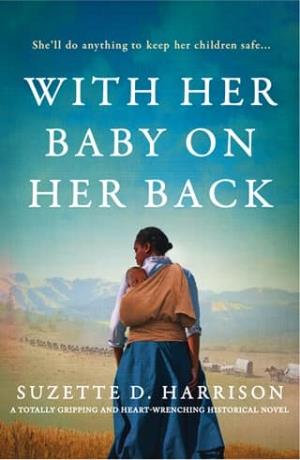
With Her Baby on Her Back
Chapter 1
ONE
ZANITHA KNOWN AS ZINNIE
Fulton, Mississippi
Life moved me through four states in three decades.
Georgia. Mississippi. South Carolina. And Mississippi again.
This move here wasn’t anything I’d experienced.
It was everyone. Everything. From butter churns to bed linens.
Lanterns. Cast-iron skillets. More importantly, black bodies being forced from one coast to the next in perpetual bondage.
God called us to Salt Lake Valley to build His Mormon community.
So claimed Master Ryland when catching a spirit four years ago. Now, he and his religion were upturning the household. Had us packing everything in God’s name. For their religious freedom, to escape persecution. Our wishes weren’t considered.
Wish I could escape plantation people!
My newborn swaddled against my chest, I descended rickety kitchen steps. Somewhere along the journey she’d be big enough to carry on my back, but for now Hattie was far too small despite her baby fat. Up front, I could treat my eyes to her sweet brown skin. And her innocence.
The harshness of slavery waited like a dog in the wings, but right now she was cocooned, safely harnessed against me. One day I would be helpless to prevent slavery’s sting. Just like I couldn’t prevent this migratory journey. I was anxious for my daughters. All three of them.
How would I keep my girls safe across the miles and distance required for this religious pilgrimage?
“The farthest they’ve ever gone is market square in the center of town.”
This moving was just one more thing I was commanded to do without my consent.
Careful of Hattie, I heaved a box onto the wagon thinking, other than this drastic overhaul, religion hadn’t changed Ryland Marion Tolliver.
Took him from surly and sour, to surly and saved.
Left him conversing with other converts these past four years until landing on this godforsaken uprooting—this cramming our lives onto conveyances like vagabonds or gypsies.
Sanctification ain’t kept him from coming for me or my sister, Lovie.
My half-sister’s waist was widening with child number five; while my newborn, Hattie, lay in her cloth harness against my breasts. His violations made it difficult to decide if our children were cousins or siblings.
I heaved another box and abandoned useless ruminations.
Slavery was too vicious for choices. Too many of us had been ripped from arms and sold away.
Didn’t matter whether once or many times as with me.
We’d lost precious family links. Ragged holes in our souls taught us to recreate kinship and community.
Lovie and I were told we were half-siblings, products of an enslaved man from the Carters’ plantation.
Lovie had known her mother. I never knew mine; she was sold within my first year of life.
I’d been passed around, handed down from plantation to plantation, left to the mothering of Mama Ruth and the stand-in women.
Wasn’t until Ryland and Norene Tolliver’s nuptials twelve years back that Lovie and I were reunited and told of our kinship.
Life taught me not to trust half of what plantation people said and none of what they promised.
Unless involving punishment. They withheld knowledge as if keeping power—even when it pertained to something as intimate as our lineage.
Still, my soul—and the shared shape of our eyes and nose—confirmed Lovie was mine and I was hers.
Whatever our blood ties, no matter how convoluted, having family was a balm for the wounds living enslaved created.
Unlike Lovie, I wasn’t pretty. I was neither tall nor stout.
Skin brown like Mississippi dirt in spring, with thick plaits hidden by scrap fabric manipulated into a kerchief.
To hear Ryland Tolliver tell it, I was uninteresting.
Too stern-eyed and serious about the mouth to be comely.
With arms and legs muscled by slavery. Seemed like every muscle had been put to use in preparing for this journey. And not just mine, my children’s.
I shielded my eyes with a hand and gazed down the lane.
My Annabelle and Abigail were with the other children sweeping the road beyond the driveway.
Ages ten and four, my girls knew to tote water buckets, wash dishes, gather eggs from the coop, help with meals, sweep, or find kindling.
Slavery was an age-defying institution. Everyone contributed.
“God, one day…” Heaven knew my thirst for freedom.
I stretched an ache away as best I could with my newborn in her harness.
She’d been with me, heavy in my belly, through all this readying.
Now, we were two nights from leaving Mississippi—with its weeping willows, lush bluebonnets, katydid choirs, and hateful miseries.
“Little girl, I know nothing about Salt Lake or out west. Can’t say if anything good’s waiting on us.
” I smoothed Hattie’s slick hair, recalling meetings where plantation men discussed the journey as I attended their womenfolk whose take on the matter was limited to reluctantly leaving their homes before segueing into gossip.
“Don’t matter where we exist.” In a country where slavery reigned, I had no voice. No choice. The Tollivers accepting Mormonism required our migration. Come snow, tornado, or hurricane, in two days we were riding west to build the Mormon kingdom.
Angrily, I rubbed stiffness from my arm, too tired to bend and massage my aching feet pressing painfully against the poorly constructed confines of ill-fitting brogans that—same as our clothing—were issued annually.
Get you some rosemary and white willow bark. Make a poultice or tea.
Mama Ruth’s voice floated on the cool spring breeze, brushing my face as if her fingertips as I mounted the back porch for another crate. A pang stole across my heart.
I missed Mama Ruth and the women who stood proxy for the mother I never knew, mothering and teaching me priceless skills needed for midwifery and catching babies.
They raised me, taught me. Shared sacred secrets of healing roots and herbal medicines brought across the waters from Africa’s continent or learned from Native women.
My mother-women were out there somewhere.
On other plantations or homesteads. If they—like Mama Ruth—hadn’t already entered heaven.
Their wisdom was tucked deep inside me. I refused to lose it for anybody.
Zinnie, don’t leave nary one of those water sacs in Mississippi!
Mama Ruth’s haunting voice was insistent despite her worldly absence. Its ethereal resonance snatched my thoughts, creating a temporary paralysis.
My body froze but my heart pounded like a drum clandestinely played in hush arbors where we secretly assembled and danced in fits of Spirit come Sunday. The notion of leaving any part of my children in Mississippi was soul-splitting.
“Where in heaven is that darn Zinnie?” Miss Norene’s voice floating through the kitchen window had me running before she could send for me. Being defiant came with horrifying consequences, but I needed those water sacs. I feared their loss more than the wrath of a plantation woman.
“Lord, I cannot leave them!” Those sacs cushioned my daughters in my womb once-upon-a-when, offering sweet waters for divine creation. Burying those precious cocoons after birth was my plea to the universe to guard their spirits. I needed all three and refused to leave them anywhere I wasn’t.
Anchoring Hattie, I ran with Mama Ruth’s insistent breath on my neck. Felt like my stand-in mother might materialize despite our painful parting decades ago when I was transacted from the Carter plantation only to wind up on this tenant-farmer-poor-man’s imitation.
You wasn’t transacted. You was gifted!
There’d been no monetary exchange between John Carter and Ryland Tolliver. I’d been given to Master Ryland and Miss Norene, Mister Carter’s cousin, on their wedding day. Same as tea towels, patterned plates, or any other doodad in a dowry chest.
I rushed towards the garden. Toiling from deep dark before dawn to too long after sunset didn’t excuse not retrieving my children’s birthing sacs.
Long as I have those sacs my girls’re with me!
No matter how they came to be, my children were pure.
Precious. I never chose their conception and was weary of, yet subject to, Ryland Tolliver’s wicked attention.
When root tea failed with these three, allowing my daughters to sprout within me, I accepted them as heaven’s kiss in a system of wickedness.
I cherished my girls with every part of my being despite their violating origins.
I was determined to collect their birthing bags, needing them to be more than memory keepers and refusing to leave them as food for Mississippi’s foliage.
May they keep my girls from being sold, like I was from my mother when I was an infant.
That incantation against separation hid behind my lips. If such devastation ever came between me and my three, I’d have proof of their existence. Not merely in my shattered spirit, but through birthing sacs as tangible evidence.
Zinnie, don’t you tear nothing!
I’d benefited from my own root medicine taught by Mama Ruth’s hand. That didn’t mean I was fully healed weeks after birthing Hattie. Pain couldn’t prevent me from rushing into the field until stumbling onto a patch bordered by the small stick fence my girls and I erected.
Memories of their earnestness as we constructed that fence fueled me toward our little plot now nearly barren.
The Tollivers granted their enslaved small squares of Mississippi for gardening.
The fruits of the earth supplemented our weekly, paltry food allowance.
Cabbage. Snap beans. Okra. Peas. Melons.
We grew whatever we could, often swapping and sharing.
Nearly every ripe thing had been harvested for this westward Salt Lake journey. Without the colorful produce, our naked patch of land seemed lonely.