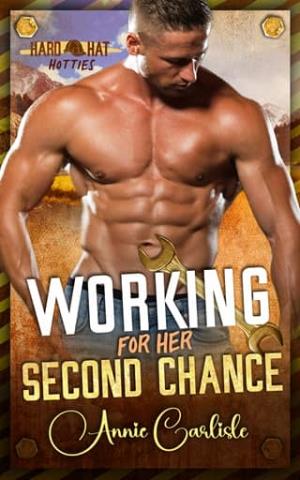
Working For Her Second Chance (Hard Hat Hotties #4)
Chapter 1
Macy
My rental SUV kicks up gravel as the highway narrows into the county road that becomes Main Street, and the mountains do what they always did here—rise up on both sides like walls, trapping the sky into a narrow strip of blue that makes everything below feel closer.
Tighter. More personal than a town this size has any right to be.
The old mill is gone—razed, from the look of the empty lot, though someone's laid fresh gravel and staked orange construction flags in a grid pattern that suggests plans.
The storefronts on the south side of Main have scaffolding up, raw lumber and Tyvek wrap over what used to be a laundromat and a video rental place that was already dying when I left.
New buildings going up beside the bones of old ones.
The whole town has that half-finished look of something caught between what it was and what it's trying to become.
A feeling I know by floor plan.
The clock on the dash reads seven forty-two. My kickoff meeting at the construction staging area is at nine, which gives me exactly enough time to do the one thing I swore I wouldn't do: walk into Kincaid's Early Bird like I'm a teenager again looking for a booth by the window.
The spreadsheet on my laptop—"Forge Creek Revitalization: Master Timeline v.
7"—has no line item for emotional detours.
There's a contingency tab for weather delays, supplier issues, and permit complications.
There is not a contingency tab for "returning to your hometown and having feelings about it.
" An oversight I'll be addressing in version eight.
The diner looks the same. Long and low, brick front, foggy windows bleeding condensation from the kitchen.
The smell hits before the door swings shut behind me—bacon grease, coffee that's been on the burner since five, and something sweet underneath.
Cinnamon rolls. The kind Marlene makes from a recipe she says is her grandmother's but adjusts every year because, as she once told my mother, "Grandma didn't know about butter. "
The counter is the same worn Formica. The stools are the same cracked vinyl.
And the spot at the end—the spot where I used to set up napkins and sugar caddies at five-thirty in the morning while a boy with a hard hat and a scar on his left palm drank black coffee and asked me quiet questions about load-bearing walls—that spot is empty.
Of course it's empty. It's been empty for twelve years. Things don't wait for you just because you remember them.
"Well, I'll be damned."
Marlene Kincaid stands behind the counter with a coffee pot in each hand, one regular and one decaf. She's grayer than I remember. Smaller, maybe. Her apron is the same faded green, and the silver streaks in her hair catch the fluorescent light like wire.
"Macy Sinclair." She sets both pots down and puts her hands on her hips. "As I live and breathe."
"Hey, Marlene."
She comes around the counter and hugs me before I can decide whether I'm ready for it. She smells like coffee grounds and dish soap, and her arms are stronger than they look. My throat tightens. I press my lips together and count to four, the way you count before you touch a wire you’re not certain is dead.
"Sit." She points to a booth by the window—my old booth. "Coffee's on the house. Are you eating?"
"Just coffee. I've got a meeting at nine."
"The revitalization thing." She pours without asking how I take it, and gets it right—black, no sugar.
All this time and she remembers. "Whole town's buzzing about it.
About time, if you ask me." She pauses, rag in hand, and gives me a look that could strip paint.
"Your mama would've loved seeing this place get a face-lift. "
The mention lands in the soft spot between my ribs. "She would have."
"Mm-hmm." The rag moves across a counter that doesn't need cleaning. "You doing all right up there in Denver?"
"I'm doing great."
"Mm-hmm," she says again, which is Marlene for I have elected not to believe you but I'm going to let you sit with your own nonsense for a minute.
The coffee is perfect—hot and slightly burnt, the way only a diner can make it. Outside, Main Street is waking up. A truck idles at the stoplight. A woman in a Carhartt jacket carries a box into the hardware store. The mountains do their steady, immovable thing above it all.
Six months. That's the job. Oversee the architectural plans for the downtown revitalization, coordinate with contractors and utility crews, get the project through to the handoff phase, and go back to Denver with a portfolio piece that'll make every firm in the state pay attention.
Clean. Professional. A career move, not a homecoming.
"You've got that look," Marlene says, refilling my mug even though I've barely touched it. Preemptive pouring. A power move.
"What look?"
"The one you had when you left. Like you're already planning your exit from the entrance." She tucks the pot back into its warmer. "There's nothing wrong with ambition, sweetheart. But I've seen your type. You plan so hard you forget to show up for the thing you're planning."
The thing about Marlene is that she means well and she's annoying about it.
My mother loved her—they worked shifts together for a while, back when Mom was still doing the overtime that slowly hollowed her out.
I have this image of my mother that won't leave.
Tuesday nights, coming through the door at eleven with the plant still on her—the chemical tang of the processing line caught in her hair, her jacket, the creases of her hands.
She'd eat standing at the kitchen counter because sitting down meant admitting how tired she was, and admitting it meant she might not get back up.
Saltines and peanut butter, standing in her socks on the linoleum, chewing with her eyes half-closed.
And on the counter beside her elbow, always, the manila folder with my scholarship applications.
The plan. Her plan for me, written in the hours she didn't sleep so I could have the life she didn't get.
When Mom got sick, Marlene was there. Brought casseroles that nobody ate. Sat in the hospital chair during the night shifts. And then after, when grief was this thing I couldn't fit into a timeline, Marlene never asked me to pretend I was fine.
She just poured coffee and wiped the counter and let me be a mess in her booth until I wasn't.
I finish my mug. Leave a ten on the table because Marlene will refuse payment, and the ten is the compromise we've been negotiating since I was sixteen. On my way out, she calls after me: "Your apartment's ready. Doris left the key under the mat."
"Thanks, Marlene."
"And Macy?" She waits until I turn. "Whatever that spreadsheet says about this town, give us a chance to surprise you."
The drive to The Yard at Forge Creek takes four minutes, because everything in this town takes four minutes.
The staging area is a sprawling gravel lot on the edge of town, lined with stacked lumber, concrete pallets, and equipment bays.
A small office trailer sits near the gate, its windows plastered with safety notices and shift schedules.
Lila Moreno from City Hall is already inside, organizing permit folders with the focused intensity of someone who has strong opinions about filing systems. Mid-thirties, dark hair in a practical bob. She sticks out her hand when I walk in.
"Macy Sinclair? Lila Moreno, permits and planning. Welcome to the circus."
"Thanks. How organized is this circus?"
"We've got permits, timelines, and a budget that council approved after only three rounds of revisions, which is practically a miracle." She drops her voice. "What we don't have is cooperation from every contractor on sequencing."
"The local guys think they know better than the plans?"
"In their defense, they probably know the terrain better. But terrain doesn't change the engineering."
"Oh, I like you already," Lila says.
The trailer fills over the next twenty minutes.
Hank Mullins, the public works foreman—early fifties, broad shoulders, flannel hat pushed back—claims a folding chair like it owes him rent.
Two guys from the grading crew hover near the door.
A woman from the county inspector's office flips through her clipboard.
And then the door opens one more time.
The sound my body makes is not a sound. It's a voltage spike—a full-system jolt that starts in my chest and radiates outward, hitting my hands, my throat, the backs of my knees.
My brain hasn't caught up yet. My brain is still reading the safety notice on the wall.
But my body knows who just walked in the way you know a live wire by the hum before you see the warning tag.
River Dawson steps inside, and twelve years collapse into nothing.
He's bigger than I remember. Broader through the shoulders, thicker through the arms, built the way men get when their bodies are tools they use hard every day. Dark hair cut short under a ball cap. Blue-gray eyes that sweep the room once, land on me, and hold.
One and a half seconds. That's how long he looks at me.
Long enough for every circuit in my nervous system to fire simultaneously.
Long enough for my body to remember—his hands, his left palm against mine across a diner counter and then again across a pillow, the sound of his voice in the dark saying my name like it was something he wanted to keep.
Then he looks away. Deliberately. Like I'm a line he's testing for voltage and has decided not to touch without gloves.
He's wearing FR-rated jeans and a work shirt cuffed to the elbows. His hands are rough—calluses visible from here, small white scars across his knuckles. A tool belt hangs from one hand. He sets it down by the door with the careful precision of a man who respects his equipment.
"River." Lila nods at him. "Glad you could make it. Macy, this is River Dawson, lead journeyman lineman for the regional co-op. He's heading up the grid relocation. River, this is Macy Sinclair, project architect from—"
"Denver." His voice is lower than it used to be. Quieter. A voice that doesn't need volume because the weight carries. "Yeah. We've met."
Two words that contain an entire summer and the lie I told at the end of it. We've met. Like "met" is a word big enough to hold what happened between us. Like the English language has a casual verb for "I was your first and you were mine and I said I'd come back and I didn't."
The room doesn't react, because the room doesn't know. Lila glances between us and moves on.
Right. Professional. I set up my laptop and pull my presentation onto the projector. My hands are steady. My voice is steady. Everything about me is steady, because I've spent a decade building a version of myself that doesn't shake when the ground moves.
"The downtown revitalization is a three-phase project," I begin. "Phase one is infrastructure—grid relocation, underground conduit installation, transformer upgrades. Nothing else moves forward until the power is rerouted."
River leans against the wall near the door, arms crossed. When I get to the grid relocation schematic, he straightens.
"Eight weeks." He says it flat. Not a question.
"That's the target."
"For a full underground reroute of six blocks, including three transformer replacements and a main feed relocation."
"Correct."
"In a town where half the poles are original install from the eighties and the soil is forty percent shale."
My jaw tightens. "The engineering firm accounted for soil composition in the conduit specs."
"Did they account for the fact that the main feed on Elm crosses under the old mill foundation? Because if they're planning to trench through that, they're going to hit rebar and concrete for thirty yards, and your eight-week timeline becomes twelve."
The trailer goes quiet. Hank Mullins takes a slow sip of coffee like he's watching a tennis match from comfortable seats.
He's not wrong. That's the worst part. He's not wrong, and he knows it, and the way he holds my gaze while he says it—steady, certain, not backing down—is exactly the way he looked at me across that bonfire when he laid his whole heart on the ground and I stepped over it.
"If there are subsurface obstructions the survey missed, we'll adapt the routing," I say, keeping my voice level.
"Might want to adapt the timeline while you're at it."
"The timeline is what the client approved."
"The ground doesn't care what the client approved."
Somewhere in the back, Hank murmurs, "That's going on a bumper sticker."
Lila clears her throat. "Maybe we can set up a separate meeting to walk the specific routing concerns? River, you've got the institutional knowledge. Macy, you've got the engineering."
River nods. One dip of his chin. He picks up his tool belt and pushes through the trailer door without looking back.
The meeting continues. I walk through the rest of the presentation with a smile that's all professional and zero percent real. When it's over, I sit behind the wheel in the gravel lot with the engine off and my hands on my thighs.
They're shaking.
I open the master spreadsheet. Scroll to the contingency tab. Add a new row at the bottom.
Row 47: Unexpected variable. River Dawson. Mitigation strategy: TBD.
TBD. The professional abbreviation for I'm in trouble and I don't have a plan for it yet.
The power lines stretch along the road toward the ridge. On the far side of the staging area, a white co-op truck is parked and a figure stands below one of the poles—too far to see clearly, but I know who it is the way you know which wire is live without testing it.
He doesn't wave. Just lifts two fingers off his belt—the Forge Creek salute, I see you, I know you—and turns back to his work.
The rearview mirror holds the image longer than it should. The mountains. The power lines. The man who stayed.
Six months. That's the plan. Clean, professional, in and out.
The plan does not account for the fact that my hands are still shaking, or that I can still feel the ghost of a scar under my fingertip from a morning at Kincaid's when I touched a boy's hand across a counter and the world shifted on its axis and I pretended it didn't.
Version eight is going to need a whole new section.