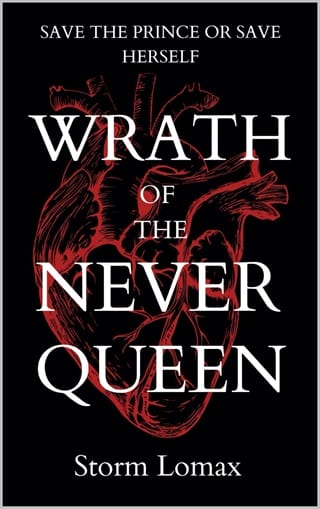
Wrath of the Never Queen
Prologue
T he quiet, polite town of Mossgarde holds its first execution in 150 years.
Mossgarde sits several hundred leagues south of werewolf territory and even further east of dragon country in the depths of a treacherous swamp. It is a series of connected platforms raised above the stagnant water, with homes built against the sides of the large trees. Very little sunlight penetrates the thick canopy, and so lanterns are strung between buildings, glowing purple with witch magic. There is a stillness in the air, deceptively so, as Mossgardians know. Underneath the soupy water and amongst the giant trees, there is a constant hum of life. Those who live here thrive. The First Home of Dragons turned the New Home of Witches.
Until today.
The spectacle of an execution has drawn a large crowd, not only of Mossgarde residents but of people from across the realm. Werewolves from Swordstead arrive clad in fur-lined cloaks, more suited to their own icy climate than the humidity of the swamp. An emissary sent from Coalsburgh stands with the werewolves. She is used to the dry heat of dragon country but her palms are clammy, nonetheless. She eyes the executioner's block with a furrowed brow.
The werewolves and the dragon stand amongst the citizens of Mossgarde, taut as a bow string. Because this is not a simple execution—it is a demonstration. A message. The people who crowd into the town square, barely large enough to hold them all, do not come for morbid entertainment. They have come to mourn.
Garbed in black, the people of Mossgarde gather to watch their queen as she is brought to the executioner’s block with a cloth bag over her head.
She stumbles on the bridge connecting the town square to its neighbouring platform, but she is held steady by the towering guard behind her. His hands grip her wrists, bound behind her, as he steers her forward. Instead of her signature crimson gown, studded with jewels and draped with rich velvets, she wears a simple white dress. A dress for commoners. The crowd murmurs, a grim set to their faces.
The king arrives behind her, a garrison around him. He sits atop a croca—a lizard-like creature large enough for an adult to ride, able to traverse through the swamp water. The king remains several feet away from the chopping block, choosing instead to rest his croca on an elevated platform above his citizens.
“Good people!” His voice rings out across the throng of people, clear and firm. “You have gathered here on this historic day to—”
“What have you done with our queen?” someone calls from the crowd, sharp with accusation. A grumble of agreement ripples through the rest of the citizens.
The king clenches his teeth but is careful not to let his irritation show. It is a vital time, he knows, and he must play his cards carefully. His eyes flicker to the queen, his wife, as she wavers on the spot. Running his tongue along his lower lip, he calculates how long the drugs in her blood will last. How much time he has to sway the crowd to his favour. He makes his play.
“I understand it is difficult to see her like this,” he says, not able to bring himself to say her name or title. “For me, it is even more difficult. To see the one I loved and trusted reduced to this. But she has committed the most heinous of crimes.”
The king watches as mouths frown and foreheads wrinkle. He waits a few more moments, allowing tensions to rise, before he speaks.
“She has cursed our child.”
A sharp gasp runs through the folk of Mossgarde. Appalled whispers and shaking heads are exchanged. The werewolves and the dragon glance at each other and shift uncomfortably—the queen had arranged almost all their trade relations. The swamp may be humid and difficult to traverse, but it produced food year-round, unlike their own climates.
The king carefully arranges his face to match his peoples', casting his eyes down in sadness.
“Liar!”
The king’s head snaps up. His lips curl slightly, but he catches it in time, smoothing his features out into something like offence. The Mossgardian who called out pushes her way through the crowd, pointing an accusatory finger.
“There is no curse! The queen is not capable of such an act of evil.” She turns to the rest of the people. “We know her. She is one of us. She would not curse her own child!”
The king lets her speak, waiting patiently for her to finish. When a sea of angry and disbelieving faces look at him, he makes his next play. He raises his fingers and snaps. On cue, his guards pick up a cage and carry it through the crowd. Almost at once, the discontent falls away as the people stare, open-mouthed.
A monster sits in the cage. It presses its long, twisted snout against the metal bars, snarling and screaming in a high-pitched yowl. Bulbous growths run along its scaly skin, and its limbs are bent awkwardly as though they have been broken and healed wrong. The monster throws its head back and screams.
The people nearest to it slap their hands over their ears, wincing at the blood-curdling noise. The woman who had called out before is now silent, horror etched across her face.
“Disgusting!” someone shouts. The rest of the crowd follows, jeering at the monster. The king watches, letting them work themselves into a frenzy before playing his final card.
“It is my son!” he bellows. A hush falls over the town square, punctuated by the wails of the monster. “This is what she has done to him. Instead of a newborn baby boy, she has given me this…this beast .”
Horrified, the people of Mossgarde look at their prince with wide eyes. The king points to his wife.
“What mother curses their own child like this?” he asks, allowing just the right amount of sorrow to enter his voice.
The atmosphere turns. Where there had been mourning and confusion is now outrage. Angry cries to remove the queen’s head echo through the swamp, spreading like fire. A few remain silent. The king notes their faces for later but otherwise enjoys his victory. The people of Mossgarde are on his side. He has done it.
And then something catches his eye .
The queen straightens, pulling her shoulders back into something resembling her usual posture. Even with her hands bound behind her, he sees her fingers flex as the strength returns to them. He is out of time.
“You heard the good people of Mossgarde,” the king calls to the executioner. He ignores the screams of his son.
The executioner nods, shoving the queen roughly to her knees and positioning her covered head over the block. The taunts of the crowd reach new heights, laden with vitriol. The prince matches them, screaming and battering his deformed claws against the bars of his cage. The queen raises her head slightly, hearing him, and balls her hands into fists. The smell of blood is in the air.
The king raises his hand as the executioner raises his axe.
When the head of the queen rolls, Mossgarde cheers.
The werewolves and the dragon, unsettled, leave quickly. The king allows them, for now. He will not soon forget their silence. Turning away from the body of his wife, limp and bloody and empty of life, he raises his hand for quiet.
“There is still the matter of my son,” he says. The prince, almost in response, lets out a piercing shriek, causing the people nearby to wince. “She has cursed him most cruelly but I believe there to be a cure. The late queen confessed to me—perhaps due to a fleeting sense of guilt—the curse she inflicted can indeed be broken.”
Optimistic murmurs ripple through the crowd, even as they grimace at the sight of the prince. The king presses his fingertips together, letting this information settle before continuing.
“True love,” he says, smiling and spreading his hands in front of him. “True love can break the curse. And so, we must band together in this most trying time to free my son from his affliction.”
At his words, the citizens throw curious glances at one another.
“I hereby announce a royal law,” the king continues. “Once my son comes of age, each year thereafter, one young woman must volunteer to break the curse. This brave young woman will be fed and housed in my castle, and if she gifts true love to my son, she will even be named Queen.” He pauses, sweeping his hands out in an open gesture he believes signifies his generosity. “For the very act of volunteering, her family will be paid most handsomely.”
Parents hold their daughters close, even as the temptation of payment and the allure of royal status looms.
“Let us show we cannot be divided by the actions of one vindictive woman. Begin preparing your daughters now—in eighteen years’ time, they will all be heroes.”
The king gives a cheery wave before turning his croca away, his guards following closely behind. Even as he leaves, it is not unnoticed that the chopping block remains.