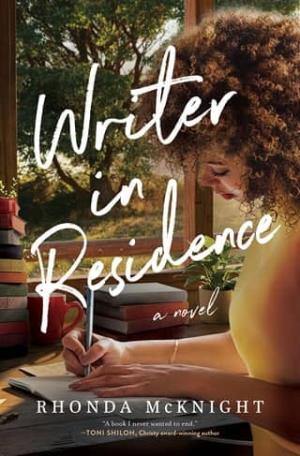
Writer in Residence
Chapter 1
Nothing could have prepared me for what I was experiencing, because failing as a writer didn’t happen all at once.
It came in quiet steps—a missed deadline here, a half-written paragraph there, bad story ideas everywhere—until the silence
between words was permanent.
One morning I woke up and realized I’d stopped trusting my own voice. And I wasn’t the only one who didn’t believe in me.
I stared at the subject line of an email that had turned my life upside down.
Re: Your Option Book
I clicked Open for what had to be the twentieth time and reread it—again—though I could probably quote every single word.
Hi Alexandra,
I’m so sorry, but the team has decided to pass on your proposed ideas.
Though interesting, they’re not consistent with the direction the line is moving in.
We’d love to see something fresher, more relevant for today’s market.
Please submit a detailed outline and the first hundred pages for consideration.
Warmly,
Sally Grant
Senior Editor
Detailed outline!
First hundred pages!
If I hadn’t already crashed out about this yesterday, I’d be losing it right now.
I hadn’t been asked for sample chapters since I was a new author. Since before the accolades and bestseller lists. Before
Sally. The one who was taking the line in a different direction.
I wanted to blame her. After all, she was my spokesperson on the team. If she didn’t fight for my stories, there was no one
to do it. But I couldn’t realistically put this on Sally. Publishing was a business. Sally had bosses too.
The first published novelist I ever met told me not to throw my life away writing. I’d attended his book signing with hopes
of being inspired. I was a freshman in college. Discovering that an author was speaking at the local bookstore seemed like
a gift. I had questions. When I asked what I should do to have a writing career like his, he’d replied, “You’re a sweet kid.
Find something else to do.”
He didn’t stop there. He proceeded to say other uninspiring things like:
“This is a tough row to hoe.”
“It’s not all it’s cracked up to be.”
“It’s feast or famine. More famine than feast, darling.”
His cagey, bitter smoker’s voice put his message to music.
Any writer talking in that many clichés was not to be taken seriously, and I hated his book, but my eighteen-year-old self listened.
I changed my major from creative writing to education and taught for eight soul-sucking yet rewarding years.
If those things could coexist. I wondered if I’d have to go back to it.
Back to a life without characters and stories.
Sure, I could do both. Most writers worked a full-time job, but I hadn’t had to.
I sold enough books to pay my bills. But now, as I sat in front of my laptop staring at a blank document, the author’s warning picked at the edges of my brain, bringing startling clarity and humbling remorse.
Like his words, my career had become a cliché.
I couldn’t make my muse work. I was out of words.
No words. No story. No story. No contract. No contract. No publisher. No publisher. No career. Failure was in my present.
Famine was in my future.
My phone pinged with a text from my mother, Beck. Why she texted me when she was in the next room, who knew? I guess it was
her way of respecting the writing time I so righteously protected.
We are leaving in five minutes.
I sighed. The last thing I wanted to do was go out tonight. But Beck threatened to turn off the internet. We lived together,
or rather she lived with me, since the house was legally in my name. However, Beck used my heavy dependence on technology
to get me to obey. Obey, because at thirty-eight years old, I was still doing most of what she told me.
I protested, though. I grumbled as I changed out of my sweatpants and then whined and moaned the entire ride, which was forty
minutes, ending in the partially full parking lot of the Lowcountry Literacy Center in Ravenel. I’d heard about this place.
My memory went back to a social media announcement about the ribbon cutting . . . a few years ago? I wasn’t sure. I couldn’t
imagine what this outing was about.
Please tell me she hasn’t signed me up for some speaking thing.
I didn’t have the capacity to inspire anyone. Not today.
A myriad of thoughts skittered through my mind with all the possibilities of what could be going on inside, especially on
a Wednesday evening. “Why are we here?”
“Because something cool is happening!” Beck shrieked, turning off the engine. She reached into her bag and removed two red-and-white
church mints, handing one to me before putting the other in her mouth.
Beck cocked her head in my direction. “You’ll wish you had fresh breath if you meet someone.”
I stuck the mint in my pocket. “I’m not going to meet someone. I’m not even interested in meeting anyone.”
“Yeah, yeah, yeah.” Beck waved me off. She pulled the sun visor down and frowned in the mirror. I know what she saw, because
she ticked off the list all the time—hooded eyelids, laugh lines, and a crepey neck. None of which were pronounced nor made
her any less beautiful. At fifty-four, my mother was aging backward. Pretty soon she was going to look younger than me.
More cars filled the parking lot, which made me more curious. “Would you please tell me what’s happening here?”
“I told you it’s a surprise.”
“Whatever it is, it’s a horrible one.”
“A-le-xan-dra,” Beck replied, stretching the syllables of my name like she always did when she was frustrated with or placating
me, “fix your attitude.” She powdered her nose and dropped the compact back into her bag. “Come on.” And with that she was
out of the car, slamming the door behind her.
I sighed, which didn’t fix my attitude, reached for my bag, and followed her.
By the time I finished the little spin through the revolving door, my aggravation had become anxiety.
I should have been the last person to be uncomfortable in a literacy center.
After all, I wrote books for a living. And not just that—during my teaching years, I was a middle grades reading specialist. I loved that job.
Until I didn’t anymore, until the lure of writing full-time collided with the exhaustion from teaching and trying to meet state testing expectations.
I needed a break from education; I took one and never went back.
As I stood in this place, a little guilt circled my heart.
I had completely walked away from that aspect of my life. I didn’t even teach Sunday school.
I walked into the main room where everything was happening. It was full of books and pictures of students, and one wall was
decorated with trophies and framed certificates. Although only seconds ahead of me, Beck was already chatting with someone.
I busied myself reading the history of the center under a series of pictures on the wall, which included the groundbreaking
for construction and the ribbon cutting, as well as framed newspaper articles—the first being the center’s receipt of a $500,000
grant and the second, congratulations for the center’s instrumental role in improving high school writing test scores.
Next, I moved on to the trophies, which were for the Reading Bowl—the county, state, and regional contests. The center had
accomplished quite a bit in three years.
I scanned the rest of the large conference room, spotting a stack of handsome-looking hardcover books on a table at the far
end. I only wore glasses when driving or going to the theater, but my nearsightedness had gotten progressively worse since
my last eye exam. I could not make out the title or author’s name.
Is this an author book discussion?
I groaned. This was the last thing I wanted to do. There were Hallmark movies to watch and ice cream to be eaten. Besides,
these days author talks only added to my feelings of failure, especially authors in hardcover.
Not too far from the book table, a man sat on a stool.
Head down, he was tapping on his phone. Something about his mess of glossy black curls and the shape of his head looked familiar, I thought, or maybe it was his wide shoulders.
Were shoulders that distinct? I didn’t know, but my eyes were locked on him, waiting until he raised his head.
It wasn’t seconds before he did, and then I discovered why he looked familiar.
I knew him.
Kind of.
His name was Gabe, and he’d been the manager of a bookstore in Beaufort. Back when I traveled for tour events, I’d had book
signings at his store. He’d been passionate about books. It was cool that he was still around them. He stretched, and his
silky knit sweater resettled itself nicely around his chest. He did have distinct shoulders—memorably broad and square where
they attached to his biceps. We’d chat about working out. He was apparently still in the gym. I was not. Now I really didn’t
want to be here. I’d gotten as fluffy as my novels.
Like always, Beck found the food. She walked toward me carrying a dessert-sized plate stacked high with little snacks. “You
have got to try some of this stuff.”
I shook my head. “I’m not hungry.”
“Oh, please. It’s free,” she said, removing a toothpick and pushing it into my face. “This is some kind of grilled meat with
artichokes. The garlic sauce on this is to die for.”
Garlic? Absolutely not. If I couldn’t get out of here, I’d have to talk to Gabe. I reached into my pocket for the peppermint,
opened it, and popped it into my mouth. “I said no.”
“You’re being a poop head, Alex.”
“I told you this was a bad idea. I don’t want to be here for some random author’s thing.”
“You used to love book talks.”
There was no point arguing with Beck. We were already here, and she was right. I loved listening to authors share the inspiration
for their stories, or at least I did love it, before I entered this losing season.
A projector screen came down behind Gabe. He hopped off the stool and moved it to a corner of the room as a graphic appeared