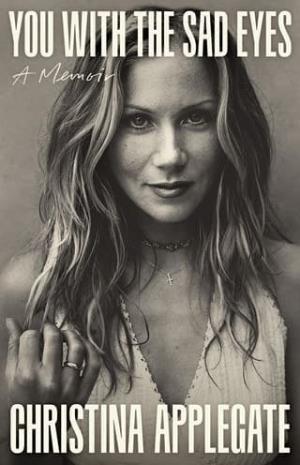
You with the Sad Eyes
Prologue
MY MOM ALWAYS TOLD me that I was a sad little girl.
“You were just born that way,” she’d say.
But I actually don’t believe that’s true.
I was introduced to the weight of the world much too early on in life.
I think being left by my father and growing up in a household that was abusive and scary and awful may have loaned me those sad eyes.
Even if I hadn’t admitted it to myself, my sad eyes had been revealing the true me all along.
Looking back, I guess I’ve faked it until I made it my whole life. When you’ve been through the kinds of things I’ve been through, you have to get good at hiding behind a persona, and my Christina Applegate persona was successful, especially in shielding me from having to face the past.
That was then. But now? I embrace my sad eyes—I’ve earned them.
In my public life, I’ve played the character “Christina Applegate” for so long, since I was a very young child.
The comic actor, the serious actor, the all-singing, all-dancing, ultimate performer, the good talk show interview—I was all those things.
I even wrote a paper in school professing myself a “triple threat” and saying I wanted to be Meryl Streep.
That person is unrecognizable to me now.
I am not Christina Applegate.
Recently, I noticed that a dear friend of mine had me listed as “Christina Applegate” in her phone.
“Take that out,” I said. “And don’t you ever call me by those two names together.” It took her a moment, but she understood.
Anyone who truly knows me knows I am not Christina Applegate.
I was never, ever that person. Whenever I hear “Christina Applegate” I get spine tingles, and not in a good way. Those two words together do not denote the secret place, the center of my soul, the real me.
Instead, there’s one nickname I save for my true essence. Usually, I don’t want the world to see who I really am, so I have kept it secret. But when those closest to me use my nickname, just two short syllables, I feel they know me in the deepest and most beautiful way.
I promise by the end of this book you’ll know those two syllables, too, and not just in name. I’ll finally reveal every reason for those sad eyes, will describe the full spectrum of a life seen through them—the good, the bad, the ups, the downs, the everything.
It’s not a process I’m looking forward to, being that vulnerable. But I want to reveal who I am, fully, for the first time. Maybe I don’t even know who that is, but hey, I have nothing left to lose.
In 2021, I was diagnosed with multiple sclerosis.
MS attacks your nervous system and slows down your functions—your respiratory system, your organs, everything.
The disease eats away at all the things we take for granted.
Some of us with MS have a raft of pain; some don’t.
I have a lot of it. When I wake up, I often can’t get my arm to move far enough to grab the cup of water by my bed or my phone from its charger.
I have infusions every six months to slow the disease’s progress, but those infusions kill all the B cells in my body, making me prone to infection.
My stomach frequently slows to a halt, leaving me to regularly rush to the emergency room in agony.
Most days, simply walking across the room feels like scaling a mountain.
One of the worst side effects of the illness is the exhaustion.
It feels as though I’ve been on a three-day-long sleepless bender, but no bender for me—that’s how I feel after a good night’s sleep.
Hence all the time I spend on and in bed, snuggled up against Jake Ryan, which is what I call my heating pad.
A sidenote that if you were born in the seventies, as I was, Sixteen Candles was the shit.
In the last moment of the movie, Jake Ryan, wearing bad jeans in front of a red Porsche, looks at Sam Baker (played by Molly Ringwald) and says, “Yeah, you.” If you don’t know what that means, put this book down right now and go watch the movie. It’s much more uplifting.
As you may be catching on, on the back of that diagnosis and the symptoms I face, I no longer care what I say or how I come across or how it makes anyone feel.
I don’t have patience for bullshit anymore, no patience for things that are meaningless or merely “extra.” Add to that, I don’t have room for inauthenticity or hidden meanings.
There’s no longer subtext when I speak. Everything I say is true, and unadorned, and real.
This is new for me, as I’ve always been a private person.
When I was growing up, we didn’t have trolls, cellphones, social media.
Instead, we just had the Z Channel, which was famous for airing the seminal music video, “Brass in Pocket” by the Pretenders.
There was no MTV, no Bravo, no Real Housewives—just that video airing once in a while in between televised movies.
I didn’t live a public life the way celebrities have to now.
At the time, everything was more private.
In many ways, I know I seem to have lived a perfect life, and I’ve been told that this has inspired some people to look up to me.
The truth is, I never felt seen. Just as I know that so many people who have suffered in different ways haven’t felt seen either.
I succeeded in life despite what I went through, but it’s time to tell the truth, even if while writing this I feel like I’m giving a TED talk. I promise, I’m not!
And it’s not just because I’m no longer working.
Sure, there’s no one breathing down my neck to represent their business or their movie or their TV show, things I’ve had to represent, usually willingly and passionately, for almost fifty years.
It goes deeper. I’ve become an honesty missile.
When your physical situation deteriorates, and your life shrinks to the size of a California king, suddenly all the things you thought were important shift, too.
The truth clarifies, like a camera lens slowly focusing.
I know it’s a cliché that clowns are sad, but my outward success and humor masked a tough life, and an abiding sense that I wasn’t good enough.
I hid all that for the good of whatever movie or TV show or play I was representing.
Now, those days are gone. I have one friend who insists I’ll work again, but he doesn’t see the full extent of my pain.
In fact, my body has let me down so much that I’ve taken to naming the various parts so I can yell at them. My entire body is Sylvia, so if I have weird things going on, my friends will yell, “Stop, Sylvia, stop it!”
Sometimes I get weird shakes in Barbara (my right arm), and once in a while Stanley (left arm) joins in.
My right leg is Meghan Markle.
Don’t ask.
My left leg is Tootie, from The Facts of Life.
My gallbladder is named Gail, my liver Olivia. My kidneys are Calliope. I haven’t named my intestines yet, and I probably should because I’m mad at them all the time.
Stacey’s a bitch, but Staceys are always bitches, aren’t they? Stacey is my stomach.
When Barbara and Stanley and Meghan and Tootie and Gail and Olivia and Calliope and Stacey are doing weird things, I try to talk to them, and because I have a disease of the nervous system, it’s almost like they listen.
When I was first diagnosed, Barbara would shake constantly, and one of my friends, Carolyn, would yell, “Barbara! Be quiet!” Sometimes it would help.
My brain has a name, too: Stuart, aka Fucking Asshole.
This disease has robbed me of who I am, has robbed me of my life, of the things I loved. I was invincible. I loved running. I loved Peloton, I played tennis, and I loved—I mean really loved—to dance.
I want to pick up the guitar over there by the wall, but my hands cramp. I used to love saying to Sadie, my amazing daughter, “Yes, of course I’ll take you wherever you want to go in the car.” Now, I often can’t drive her anywhere.
But I like to watch TV—the worse the better, usually reality shows like Real Housewives—because with TV I get to escape. I don’t have to think. I don’t want narratives, art, series in which you invest in some antihero across seven brilliant seasons. I want rich women screaming at each other.
I keep the TV on twenty-four hours a day because without it the quiet is so loud in my head I can’t bear it.
Would I have wanted it this way, to have everything stripped away?
Did I envision finally arriving at a place of raw honesty about my life, and that would be a good thing?
Fuck no. I want to work and dance and take Sadie everywhere, but being forced into this home-based life has stripped away my last vestiges of reserve.
It has afforded me time and space to look back on my life and take stock of it for the first time.
Alongside the need to confront the truth and enormity of all that I have lived through, a beautiful thing emerged: I have started to make a little sense of it, to understand what happened, see patterns, discover meaning, find the love and acceptance and healing in it, and start to forgive myself, to give my young self, especially, some slack for all the bad decisions and self-destructive behaviors.
In my closet there is a locked box of all my journals from the age of thirteen to the time I stopped wanting to write. I had told my best friend and godmother of my child, Rachel, that when I die, she may open the box. I never thought it would be opened before I was gone.
Lucky you—the box is open. I’m going to extensively quote from those journals. I’ve kept meticulous records, all too aware that those pages were the only place I could share the unfiltered truth.