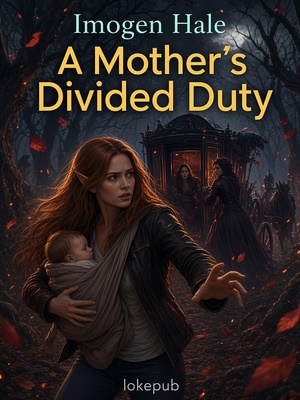
A Mother's Divided Duty
One
My noble father,
I do perceive here a divided duty:
To you I am bound for life and education;
My life and education both do learn me
How to respect you …
—William Shakespeare, Othello
ACCORDING TO THE CLOCK on the bedside table, it was almost noon, the solid middle of the day, when all good fae should be asleep and dreaming of better worlds.
According to the high, undulating wail coming from the corner of the room, it was time for everyone in earshot to be awake.
Especially me. I sat up, not bothering to push back the covers, and felt half the bedding come with me, the blanket tangled solidly around my torso like I was a badly wrapped present.
My husband, Tybalt, sat up at the same time, blinking in the dim light trickling in around the edges of the blackout curtains.
Fae are naturally nocturnal. Despite this, I’ve never been very good at sleeping, and I wake up fast whether it’s night or day, since my body is primed to be disturbed at all times.
Tybalt wakes up fast because he’s Cait Sidhe, a shapeshifter who spends half his time as a literal cat.
We are not the same. But I love him anyway, and it was easy enough to remember that, even as I slid out of the bed and staggered across our bedroom toward the sound of the screaming.
For most of my adult life, I’ve done my best to run away from anything that screamed that loudly or with that much purpose.
Moving toward it felt like I was doing something wrong, but ignoring it would have been even worse.
No matter how much I may sometimes want to, leaving my baby to wail herself to sleep is not allowed.
“I’ve got her this time,” I said, waving a hand vaguely in Tybalt’s direction. “You got the last one. Sleep.”
He made an incoherent grumbling sound and fell face-first back into the bed, while I continued across the room to the cradle we had pushed up against the wall.
It was antique, almost archaic, entirely out of place among the cheaper modern furniture filling most of the space around it, but when the sea witch gives you a cradle for her goddaughter to use, it’s a little impossible to refuse.
And it was a beautiful piece of furniture, carved from a single piece of Sitka spruce and covered in a carved bas-relief of tangled briars.
The graven flowers they put forth were wild roses, a strain more associated with Maeve than with Titania, and cats crouched in the space beneath the briars, watchful and wary.
Modern childcare standards told me it wasn’t safe to let my baby sleep in an antique, but again, sea witch.
Anything she gave us was going to have been enchanted to prevent any possible harm from coming to its occupant.
Our child was probably safer in that cradle than she would have been anywhere else.
Which was honestly a good thing, since both Tybalt and I were pretty far behind when it came to what the humans currently considered safe.
There was a brief pause in the screaming as Miranda stopped to inhale, and then it resumed, rapidly climbing to a furious pitch.
If it hadn’t been for the adjustments I’d made to our bedroom wards—adjustments I was sure I would never, ever have cause to regret, because it wasn’t like putting sound-dampening wards on the place where I slept could lead to bad results—the rest of the house would have been awake and banging on the door by now, demanding to know if everything was okay.
The amended wards were for their comfort, not for ours.
Both Tybalt and I knew it was our job to be available when our girl needed us.
I leaned over the cradle, looking down at the scrunched-up, furious face of my daughter. She was waving her chubby fists in the air, fingers balled tight, and her eyes were screwed shut, while her mouth seemed to have consumed the entire bottom half of her face.
“Hey, hey, kitten, it’s okay,” I said, bending and scooping her into my arms. Her wailing stopped for a moment as she adjusted to her changed position, then resumed, if anything louder than before.
She had a set of lungs on her; I absolutely had to give her that. If there were some sort of shrieking Olympics, she could … well, she could lose horribly, because we exist in a world with Sirens and Baobhan Sith, but she’d still wow the judges with her sheer determination to be heard.
“Let’s get you comfy,” I said, slipping a finger under the edge of her diaper to test for wetness.
There wasn’t any. As I had expected, she was dry as a bone—this was her “Where the hell is my waiter?” wail, generally reserved for any time she felt like her table service wasn’t arriving fast enough.
Learning to differentiate the many ways she cried was a fascinating process, like learning a secret language that would only ever be spoken by a handful of people, before it was forgotten forever.
I’d gone through the same process with Gillian, my older daughter, and by the time she’d been two, our hidden language had been gone.
Now there was Miranda, and she didn’t have the same cries.
Every baby is different, just like every pregnancy—and every mother.
I wasn’t the person I’d been when I was falling all over myself trying to keep Gillian alive, that was for sure.
Shifting my hold on Miranda to better brace her against my chest, I sank into the chair we’d positioned next to the cradle, letting myself relax into its over-padded embrace.
Miranda stopped wailing long enough to hiccup and push her head insistently against my breast, making it even more obvious what she wanted.
“I’m getting there,” I said, and hiked up my shirt while she rooted around. I didn’t have to do much from there. Even at four months, her skill at finding a nipple was unparalleled, and she latched on, beginning to suck. I leaned farther back into the chair, closing my eyes.
“Our daughter is a genius,” said Tybalt, voice closer than it should have been.
I opened one eye. He had rolled around in the bed, positioning himself so that his head was at the foot, chin propped on his knuckles and weight resting on his elbows.
He still looked sleepy, hair disarrayed from the rest we’d managed to get so far.
“Most babies figure out how to nurse,” I countered.
“I am permitted to be biased,” he said primly.
I laughed.
So this was the future I’d never been entirely willing to let myself imagine, even when I’d been on the verge of death and coming up with pretty fantasies to convince my body not to give up fighting: even in my wildest dreams, the idea of a world where I’d be sitting in a warm, comfortable, secure bedroom with a baby at my breast and a man who loved me looking on, fully aware of what I was and not rejecting it for any reason, had been too impossible to believe.
I’d tried to believe it once before, but my first real lover had been human, and he had never been in a position to understand or even know me for what I really was. I hadn’t even been allowed to tell him.
My name is October Daye, and I’m not human.
Neither is my husband, and neither is our daughter.
I’m a changeling, the result of a marriage between a fae woman and a human man, making me a part of both worlds while rooting me firmly in neither.
I’m less human than I used to be: the balance of my blood has shifted over the years, sometimes at my own hand, sometimes at the hand of another.
But I’m still human enough to be mortal, and to be weaker than the pureblooded fae around me in some small but essential ways.
I don’t see as well in the dark, and I don’t have their preternatural sense of balanced grace.
Which is, quite honestly, fine by me. I do well enough with what I’ve got.
They call my particular type of fae the Dóchas Sidhe.
We’re pretty new: so far as I’m aware, there are only three of us in the world.
Myself, my older sister August, and now Miranda.
My older daughter was born part Dóchas Sidhe, but there were some complications, and well.
She was entirely human for a while, before she became a Selkie to save her life, and now she’s one of the Roane, permanently bound to the skin of the sea witch’s youngest child.
Faerie makes families weird in new, special ways, is all I’m saying.
As a Dóchas Sidhe, my magic lies primarily in blood.
I can smell it well enough to track someone who’s bleeding, and if the blood belongs to someone fae, I can isolate the scent of their magic from just a few drops; I can smell magic even without blood, using the traces it leaves behind to isolate workings and standing spells that should be imperceptible, and if I can find it, I can tear it down.
I heal like I’m getting paid for it, and can recover from even near-mortal injuries in seconds.
And I can change the balance of someone else’s blood, if there’s anything there to change.
It’s like there’s a slider bar inside me, one that I can use to move myself between fae and human as necessary.
I try not to. It hurts, and it always upsets me when I don’t recognize the woman in my mirror.
The more human I am, the darker my hair and eyes get, turning muddy brown and a sort of grayish-blue.
The more fae, the paler, until I end up—so far—ash blonde with fog-gray eyes. Very little pigment for me.