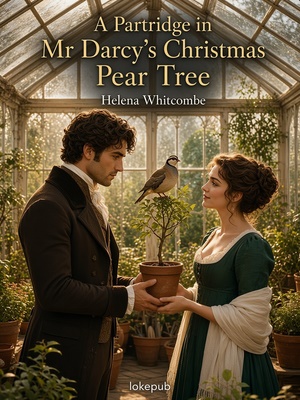
A Partridge in Mr Darcy's Christmas Pear Tree
Prologue
Elizabeth Bennet needed information.
She ruminated that it might not be all that difficult to obtain information if one was a wealthy man, but it was exceedingly difficult to do so if one was the daughter of a country squire of no repute and modest fortune.
Actually, the Bennet matriarch overspent on new gowns for her daughters; on ribbons, lace, and furbelows to over-trim said gowns; and on needlessly lavish feasts whenever guests could be enticed to come to dinner—and the Bennet patriarch overspent on more and more books, even when there was no space for the books he already owned—and so, as far as Elizabeth Bennet’s attempts to obtain information went, their family had no fortune.
The Bennet estate, Longbourn, had a lean-to greenhouse where produce could be grown out of season and where exotics could survive English winters.
Located in southern England, just north of London, Longbourn did not suffer extremely harsh winters, but there were many days and nights each winter with freezing temperatures.
Elizabeth was the only one in the family who visited the greenhouse. She used it each winter as a place to read, to escape the noise of her four sisters—well, really, only three of her four sisters were noisy—and especially to enjoy nature without having to brave bitter temperatures.
Naturally, given her usage of the little glasshouse, Elizabeth could not help but notice how little effort was expended there.
By the time she was ten years old, Elizabeth was working in the greenhouse, although she carefully avoided the word work; her mother would throw a tantrum worthy of Juno in The Aeneid if she thought Elizabeth was doing any sort of work other than needlework.
No, when Elizabeth could not stay silent on the matter, she said that she was attending to her plants, making it seem as if she barely lifted a finger on behalf of exotic blossoms in a pleasure garden.
The truth was, however, that Elizabeth quite liked mucking about with soil and water, and she was pleased that her efforts resulted in something useful—in delicious fruits and vegetables.
Most of all, Elizabeth loved to learn about grafting and pruning, ringing and pinching out—techniques with which gardeners forced fruiting out of season or miniaturised food-bearing trees and shrubs.
But that was the rub: Elizabeth did not gain much cooperation from Mr Smith, the only one of Longbourn’s team of three gardeners who did any work in the greenhouse.
She surreptitiously watched him as he worked, and learnt much from observation, but he answered her questions with gentle laughter and protests that she was a little girl…
later, that she was a young lady…that she was the daughter of a gentleman and therefore had no need for such information.
Given the fact that she already knew her age and sex, and that he shared not a syllable of actual horticultural knowledge with her, Elizabeth was frustrated by the ostensibly kindly Mr Smith.
Once, she asked the only neighbour who had a conservatory if she could speak with his gardeners, but he muttered so negatively about improper interests and distractions to decent, hardworking men, she retracted her question immediately, wishing to maintain the neighbour’s good opinion.
She decided that she had to rely on her father’s library.
Unfortunately, her father’s hundreds and hundreds of books leant more towards The Aeneid and the Bard than to helpful tomes on gardening.
And her father, like Mr Smith, brushed away her questions and requests for information as if she was a garden pest.
Elizabeth’s beloved Uncle Edward was more sympathetic.
By the time Elizabeth was sixteen, she regularly visited her Uncle and Aunt Gardiner, who lived in London, and Uncle Edward discovered that an organisation called the Horticultural Society of London had been founded several years earlier; members were sent illustrated volumes of Transactions of the Horticultural Society of London.
However, her uncle had a growing family of his own, and though he was a successful merchant, he could not justify spending the money to become a member of the society.
Instead, he bought Elizabeth an issue of Curtis’s Botanical Magazine, because there was an article written for the general public about gentlemen who had experimented with and published about new techniques for glasshouse horticulture.
These gentlemen-farmers were lauded as amateur scientists whose quests for knowledge benefitted all mankind.
Four gentlemen-farmers were named in the article, along with the names of their estates.
Uncle Edward lent Elizabeth a topographical dictionary so she could learn each man’s county.
He even advised her as to how to approach these gentlemen by letter.
“Sign with just your initials,” he advised.
“They are less likely to respond if they know you are a lady.”
“Oh! Propriety!” Elizabeth exclaimed. “Would I be ruined if it was discovered that I wrote letters to gentlemen?”
Uncle Edward scoffed. “The nature of your correspondence will be far from the sort of letters that could cause ruination. Still, you should not refer to yourself as a lady, or a daughter, or anything that might identify you as a maiden.”
With that warning, Elizabeth got down to the business of writing introductory letters to the four gentlemen named in the article, explaining that Longbourn had a lean-to greenhouse, mentioning the county and its weather patterns, briefly listing the produce grown, and asking if the proficient would agree to answer questions by correspondence.
A delicately worded allusion to the cost of membership in the society attempted to hint that such a membership was beyond the means of “E. R. Bennet.”
Only one of the gentlemen responded. But that response was very prompt, very polite, and very legible—actually, the script was quite beautiful, with such an even slant and such straight lines, it was as if it were a handwriting exercise.
The signature, like her own, used only an initial for the given name.
She briefly delighted in the notion that the “amateur scientist” F.
Darcy was, in fact, a Fanny or Faith (or something like) rather than a Frederick or Francis (or another male name).
But the particulars of the article made it clear that the author had visited the gentleman’s hothouse in person.
As a matter of fact, F. Darcy’s estate, called Pemberley, and his greenhouse, which sounded to be twenty times the size of Longbourn’s, were described in loving detail.
The author of the article clearly envied the owner of the beautiful estate and enormous greenhouse, and he wrote as if his goal was to ensure that all who read his fulsome praise would share his envy.
For two years Elizabeth wrote monthly letters to F.
Darcy. She described the difficulty she had hand-pollinating the strawberry plants.
She mentioned that the leaves of her cucumber plants were turning yellow.
She wondered why her pear tree had lush, glossy leaves but no fruit.
Every letter reported on successes, which often resulted from measures F.
Darcy had suggested, but every one also mentioned a problem.
F. Darcy wrote back promptly with congratulations for the former and detailed solutions for the latter.
She never mentioned anything about her life outside of Longbourn’s hothouse.
Of course she did not; such descriptions and anecdotes would reveal her age and sex.
In his turn, F. Darcy never talked about himself or his life.
Still, there was something about his letters that spoke of kindness.
A man who had such a grand estate as was described in the Curtis’s article certainly must have many responsibilities, many important things to do, many tenants and servants who depended on him.
He must be very kind to take the time to write to her each and every month.
She could not help but think of him as an affable person, a sort of friend, really.
And she always looked forward to hearing from her gentleman-farmer friend.
Then, one day in early December, in 1809, Elizabeth received a thoroughly bedraggled letter.
The sender’s direction had been so badly sullied, it was unreadable, but she recognised the handwriting: the letter was from Mr Darcy.
Longbourn’s direction was not as thoroughly soiled, but the county name had been spattered so that it was anyone’s guess if it read Hertfordshire or Herefordshire.
Since she had been waiting days now for a response to her last letter, wondering if F.
Darcy was ill or too busy to respond, she had a hunch that the letter had been mistakenly sent to Herefordshire first.
Elizabeth hurried out to the greenhouse to open the mussed letter in privacy.
The mud and water that had stained the outer side had partially obscured the inside, as well, so it took her a few minutes to read even the parts of the letter that remained visible.
It took time to puzzle out that Mr Darcy was planning on coming to Longbourn!
She held the letter up to the glass and was finally able to read that he was planning his visit for the fourth of December.
Which was that very day!
Elizabeth Bennet exited the glasshouse in a daze.
She knew she should tell her father for the first time about her correspondence with a strange man—a monthly correspondence, for two years!
But when she stepped into the hallway near her papa’s study, Mrs Hill hissed at her.
“Miss Elizabeth,” she whispered, “your father has a visitor!”
Oh, dear.