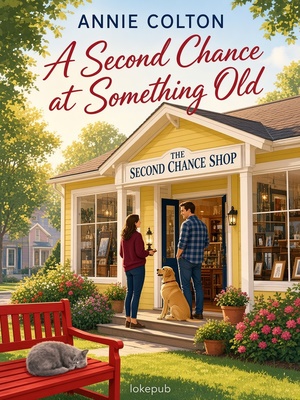
A Second Chance at Something Old
Chapter 1
It was bizarrely chilly for early June, and Madeline pulled her jacket tighter, then zipped it up against the breeze—a rare thing for her always-running-hot perimenopausal self.
She paused on the sidewalk in front of the new, not-yet-open shop.
Her shop. She tried to see the place through the eyes of potential customers.
If there’d be any. Please let there be some!
First, she studied the sign hanging from a wrought iron post near the stone walkway that led to the old-fashioned wraparound verandah and entranceway.
The Second Chance Shop, it announced. A line below read, Whimsical gifts for the practical heart.
Beneath that, a vertical row of creamy placards linked by delicate chains formed the following list: New ~ Used ~ Antique ~ Vintage ~ Upcycled ~ Recycled ~ Consignment.
Madeline smiled. She adored the name and concept.
At that thought, the pain she carried everywhere now, as much a part of her as her lungs, heart, or liver—pain that dozed occasionally but never slept too deeply—stirred and raised its fanged head.
Then bit, hard. It wasn’t supposed to be just her store, though.
It was supposed to be hers and Lauren’s.
Feeling the strike as if it were a physical blow, Madeline inhaled sharply and pressed her hand to her sternum, where all her stress and sorrow formed a hard knot, like a rock that might eventually crush her once and for all.
She forced herself to breathe. It was a ragged, panting attempt at first, but at least it was something.
You’re getting stronger with the load, she encouraged herself. It will never disappear, but you’re getting better at carrying it. You are.
When she could inhale like a normal person again, not a suffocating animal, she forced her attention back to the sign.
It was pretty and piqued curiosity—or it would hers, anyway, if she came across a similar one somewhere.
That was good. And the rundown heritage house, in danger of being bulldozed when she’d scooped it up, had surprised her and the contractor who did the renovations by being remarkably solid.
The necessary work had mostly been cosmetic.
Well, except for the bathroom, which had ugly water damage, including a soft spot by the toilet that suggested the subfloor and maybe even a supporting beam might need replacing.
She’d tackle that pricey job in a year or so, though, when business took off.
Postponing it meant she wasn’t completely broke . . . yet.
The little place was as charming and picturesque as she’d imagined it could be with its butter-yellow siding, cream trim, big porch, and cherry red benches placed here and there.
The big lilac bushes edging the property were finished blooming now, as were the bright scattering of tulips and daffodils.
In a few weeks, however, the flowerbeds would be full of new summer color, or so the realtor had told her, and the antique half barrels would be bursting with nasturtiums—which Madeline had planted herself, about the limit of her gardening ability and know-how.
Even on this gray, borderline stormy day, the effect of the whole was .
. . lovely. She still couldn’t quite believe it.
And yes, people would come, she was sure of it. But was that a good thing?
Madeline shook her head with frustration at herself.
Only seconds since she’d made the fervent inner wish for customers, and here she was already waffling.
But seriously, who up and quits their life, flees to a small town they’ve never even visited before, and decides to call it home and start a business out of nothing there? A complete lunatic, that’s who.
Or perhaps, a softer, kinder voice whispered, someone deeply mourning and trapped in a limbo of depression for three years. Someone who no longer had a life to quit and who needed to do something radical to keep going on at all.
“Yeah, yeah,” Madeline muttered out loud, but a familiar sense of disbelief trembled through her.
Three years. Had it really been that long since the car accident that stole her husband, daughter, and sister, who was also her best friend?
It seemed impossible that Lyle, Lauren, and Ronny had been gone so long—and that she’d endured this long without them.
As this latest assault of grief mercifully ebbed away, Madeline pulled a ring of antique keys from her pocket.
They were mostly for fun, collected through the years, and unlocked who-knew-what—or nothing—anymore.
Yet two of the old keys did actually open something at The Second Chance Shop.
One was a large, decrepit two-bay shed in the back corner of the lot that she would’ve had knocked down and taken away, except her money was better spent elsewhere at the moment.
Plus, it acted as a trellis for an equally ancient, massive rose bush covered in big fuchsia blooms.
The second lock that took an old key was a door inside that led to the basement, which was really more of a crawl space that provided access to the hot water tank, plumbing, and electrical.
It had five-foot ceilings—and ducting for natural gas heat installed many years after the house’s original construction made that “height” even lower in places.
Still, it was dry, at least, and she could see herself using it for overflow storage in the future.
In the meantime, she’d keep its antique door with its cut crystal knob locked at all times.
She didn’t want curious treasure hunters to be tempted by the cobwebby staircase.
She held the heavy ring up near the front door.
It had been retrofitted to meet current security needs but not replaced because she wanted to maintain as many of the house’s original features as possible.
The smart fob hanging beside the skeleton keys worked its magic.
There was a quiet click and a metallic whirr as the lock released the deadbolt.
Then, with the bells that hung above the door jingling merrily, Madeline was inside.
Pausing a moment, she inhaled deeply, reveling in the shop’s scent, a soft mixture of all-natural, non-perfumed organic soaps, traces of citrus that reminded her of Lauren, but were due to the environmentally friendly lemon cleaner she used, and peppermint from the glass jar of scotch mints she kept on the counter.
At least those were the hints Madeline picked up today.
Sometimes the air carried notes she didn’t quite understand, though it always smelled good and never failed to make her feel . . . lighter.
As she neared the front counter and set her purse down, something brushed against her leg.
She looked around and saw—nothing. And nothing moved nearby or seemed out of the ordinary.
Great. In addition to mental ghosts, now she was going to start thinking there were literal ones.
Good times! It wasn’t all bad, however. If it led to gossip, it would be one more thing to bring people around the place.
A quick press on the fob and the door relocked behind her.
Madeline left the lights off. She knew the shop’s layout like the back of her hand.
Plus, she didn’t want any of the lookie-loos who drove past frequently to stop, thinking the store was finally open—because that would be a terrible thing, right?
Having people show up, interested. She shook her head at herself and continued her critique in the dim natural light that reached through the windows and touched what it could.
It was a gray day—fitting, she thought—and the light was the same.
There was a ton of merchandise out on the floor already, including a whole wall of all-natural bath and beauty products and shelves of intriguing doodads and artfully arranged knickknacks and home décor items. Adding to this eye-catching welcome was an antique general store counter, purchased because it was gorgeous—and practical.
She wanted the till across from the door, so it was easy to watch who entered and departed from the shop.
She walked deeper into the house, silently applauding her decision to keep the original layout—kitchen, dining room, bathroom, bedrooms, etc.
—as themes for organizing and displaying stock.
It worked very well, creating a natural flow and desire to move room to room, but would also be handy for customers in a hurry, seeking a specific type of gift or household item.
They could head to the kitchen directly if they wanted cooking or food-related goods, for example, or to the dining room for dishes and flatware, tables or chairs.
One bedroom held romantic gifts, another was office-themed.
Madeline stopped her internal inventorying there, though she continued to caress the odd object or stroke this piece of fabric or that as she walked past them.
She knew what each room held, after all, and had gone over them again and again.
Her stock was more than satisfactory; it was beautiful—and varied and eclectic—so what was the holdup?
Why hadn’t she flipped the closed sign to open?
Why did her website and social media pages still exclaim “Coming Soon” instead of “Visit Us Today”?
She stopped when she reached an arched doorway that opened into a large, empty whitewashed room with old-fashioned, multi-paned windows showcasing the rose bush by the shed.
She wished she believed her own line: that this was her reason for stalling.
That she needed this space to be full before she could open for business, but she knew better.
It was a shame that it wasn’t properly utilized, but she had more than enough treasures for people to paw through.
Besides, if she’d really wanted to, she could’ve stocked this room already, no problem.
No, the issue was that she wanted this room—and had from the moment she’d first seen it—to carry Lauren’s creations.
And it never, ever would. She pressed a clenched fist to her mouth, so hard her teeth hurt.
And the damned space didn’t even have a door she could shut against it.
She should’ve walled it off—or painted it bubblegum-pink or some other shade her daughter would’ve loathed and put lawn furniture in it or something.
What was the point of a new start in a “memory-free” place if you created an empty shrine to one of the shining hearts at the center of your mourning?
And yet . . . it still felt right to be holding it for something. Or someone.
“And that’s why you haven’t opened yet,” she whispered with a half-laugh that was dangerously close to a sob. “Because you’ve officially lost it.”
She felt her family’s absence so keenly just then it was as if they were a physical presence.
They would want her to have a life again, to find a way to be happy—or, at least, a way to survive—the same as she would’ve wanted for them if she’d been the one to die.
And it was past time to start working toward that on their behalf.
But Lord, it was hard. Maybe not even possible—and perhaps it didn’t matter what they would have wanted for her.
Maybe even thinking she could go on to find new meaning for her days, a reason to look forward to waking up each morning was .
. . wrong. A betrayal. A step toward forgetting them.
Somewhere behind her in the empty shop, something scuffled. Startled from her thoughts, Madeline whirled around. It sounded for all the world like the footstep of someone trying to be quiet.