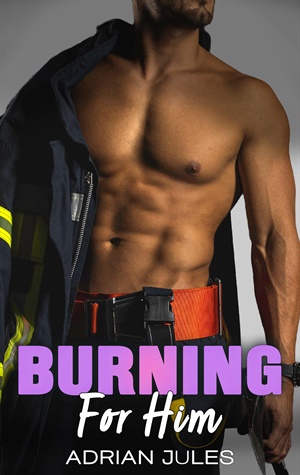
Burning For Him (Best friends to lovers MM FIRST TIME #11)
Chapter 1
The trail up to the fire camp is longer than I remembered.
Or maybe I’m just out of shape. Two years behind a desk, well, behind a camera, which is the same thing when you’re not the one carrying the gear, and my lungs are already burning by the time I reach the last switchback.
The dry August air tastes like dust and pine sap, and my cameras bounce against my hips with every step, the straps digging into my shoulder.
I haven’t seen Felix in two years.
Not since the engagement ring came off my finger.
Not since I buried myself in assignments that took me farther and farther from home, Syria, then Ukraine, then a string of wildfire seasons across the American West. Anywhere there was danger and a story and a reason not to sit still long enough to think about what I’d lost.
The camp comes into view through the trees.
A cluster of tents, a command trailer, the low hum of generators.
And smoke. The smoke is everywhere, a haze that clings to the back of my throat and stings my eyes.
The fire is still miles away—I saw it from the helicopter, a red wound on the horizon—but the air here already knows what’s coming.
Crew bosses shout over the clatter of gear. Someone’s radio crackles. I adjust my cameras and walk into the chaos.
And then I see him.
Felix is standing near the command tent, arms crossed over his chest, his back to me.
He’s wearing the same yellow Nomex shirt as everyone else, but there’s no mistaking him.
The way he holds himself. The set of his shoulders.
The way his head tilts slightly when he’s listening to the radio, like he’s hearing something no one else can.
His voice carries across the camp as he barks orders into the handset. “Copy that, Air Attack. We’ve got a spot fire on the eastern flank. Divert the tanker.”
Same as always. Collected in the chaos. Eyes that miss nothing.
I met Felix in college. He was an environmental science major who spent more time in the woods than in class, and I was a photography student who thought I’d be shooting weddings and senior portraits for the rest of my life.
He dragged me on a backpacking trip our junior year, and somewhere between the blisters and the dehydrated dinners, we became the kind of friends who don’t need to talk to understand each other.
He came out to me on that trip. Sat me down on a log overlooking a valley and told me he was gay, his voice steady but his hands shaking.
I told him I didn’t care. I told him nothing had changed.
And nothing did, except that I started noticing the way he looked at me when he thought I wasn’t paying attention.
But I was engaged to Jenna by then. Had been since sophomore year. And Felix never said a word, never crossed a line, never did anything except be the best friend I didn’t deserve.
Two years is a long time.
He turns. Sees me. His expression flickers… surprise, then something else, something I don’t have time to name before a grin cracks his face.
“Graham.” He crosses the distance between us and claps me on the shoulder. His grip is solid, warm through my shirt. “Didn’t expect to see you here.”
“They didn’t tell you?”
“Must’ve missed the memo.” He steps back, eyes sweeping over me like he’s cataloguing the changes. “You look good. Tired, but good.”
“So do you.” He does. The years have carved lines around his eyes, but they’ve filled out his shoulders too. He looks like someone who’s spent two seasons fighting fires, capable, grounded, completely in his element.
“How’s Jenna?”
The question slams me like a rock. Of course he doesn’t know. Why would he? I didn’t call. I didn’t write. I just disappeared into the next assignment and the next and the next.
“We, uh. We didn’t make it.” I adjust the camera strap on my shoulder. “Engagement’s off. Has been for about some months.”
Felix’s face goes still. “Shit. I’m sorry.”
“It’s fine. It was the right call.”
He holds my gaze for a moment longer, and I can see him deciding whether to push. He doesn’t. He just nods, once, and gestures toward the command tent. “I’ve got a briefing in five. Stick around, we’ll catch up after.”
“Sure.”
He starts to turn. And then the wind shifts.
It’s not a gradual change. It’s a wall of hot air that slams through the camp, rattling the tents and sending embers spiraling into the sky.
The radio in Felix’s hand erupts with static, a voice shouting something about a blowup on the western flank, and his expression changes in an instant.
The easy grin is gone. His body coils like a spring.
“Tower.” His voice is different now, sharp, commanding. “There’s a lookout tower half a mile up the ridge. We need to move.”
“What about the camp?”
“They’ve got their orders. We don’t have time.”
His grip on my arm is iron, urgent. I don’t argue. I don’t even think. I just follow him, my cameras banging against my hips, as he sprints for the treeline.
The trail to the tower is narrow and steep, switchbacking through pines that are already starting to smoke.
The heat presses against my face, my arms, the back of my neck.
I can hear the fire behind us, a low roar that’s getting louder, closer, angrier.
Felix doesn’t look back. He just runs, his boots pounding the dirt, his hand still locked around my wrist like he’s afraid I’ll fall behind.
The tower appears through the trees. A wooden structure on stilts, maybe forty feet tall, with a glass-walled cabin at the top. Felix hits the stairs first, and I follow, my lungs screaming, my legs burning, the sound of the fire swallowing everything else.
We reach the top. Felix slams the door behind us and leans against it, chest heaving. I double over, hands on my knees, gasping for air that tastes like ash and fear.
Then I look out the window.
The fire is a wall of orange and red, advancing through the trees like a living thing. It moves faster than anything I’ve ever seen—faster than it should be able to move—and the sound of it is deafening. Not a crackle. Not a roar. A howl, like something hungry.
I’ve spent my career capturing danger from a safe distance.
A lens between me and the subject. A viewfinder to frame the chaos.
I’ve photographed wildfires from helicopters, war zones from behind blast walls, riots from the other side of police lines.
I’ve always been the observer. The documentarian.
The guy who shows up after the worst is over and takes pictures of the aftermath.
I’ve never been this close to the edge.
“Graham.”
Felix’s voice cuts through the noise. I turn. He’s standing at the center of the cabin, his radio in his hand, his eyes on me instead of the fire.
“We’re going to be okay,” he says. “But I need you to stay back from the windows. Can you do that?”
I nod. My throat is too dry for words.
He watches me for another second, his gaze searching, and then he turns back to the radio. His voice fills the small space as he calls in our position and waits for a response that might not come.
I press my back against the wall and slide down until I’m sitting on the floor. My cameras are still around my neck. I don’t remember them being there. I don’t remember anything except the heat and the noise and the way Felix’s hand felt on my wrist, pulling me up the stairs.
The fire howls outside. The tower shakes. And I sit there, useless, watching the man I haven’t seen in two years talk into a radio like he’s done this a hundred times before.
He probably has.
I close my eyes and try to remember how to breathe.